White House shooting at checkpoint — third incident in a month: 21-year-old suspect, Secret Service response, Korea takeaways
Trending · May 24, 2026 · DIR
A White House shooting near a security checkpoint in Washington marks the third such incident in a month. We lay out what happened on May 23, what is known about the 21-year-old suspect, how Secret Service’s layered defense worked, the social questions the case raises, and Korea-relevant takeaways — based on AP, CNN, and CBS reporting.
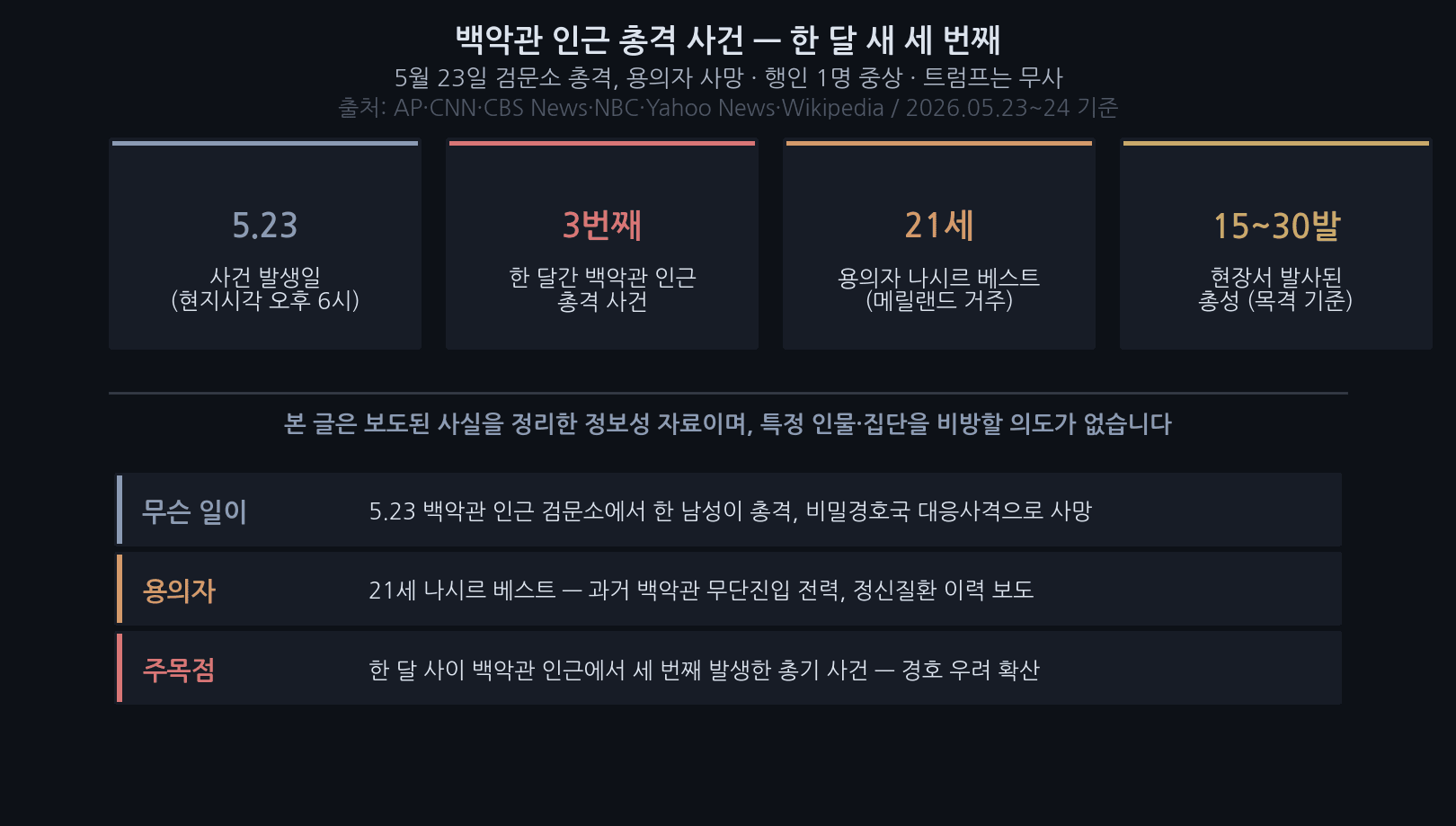
On May 23, 2026, a White House shooting took place near a Secret Service checkpoint in Washington D.C. A man opened fire on officers and was killed by return fire. One bystander was critically wounded. President Trump was inside the White House at the time, with no impact on his safety.
This article does not target any individual or group, nor advocate any political position. Its purpose is to calmly summarize what AP, CNN, and CBS have reported, surface the social questions the case raises, and note what it might mean for readers in Korea. For original reporting, see AP News and CNN.
White House shooting timeline — what happened on May 23
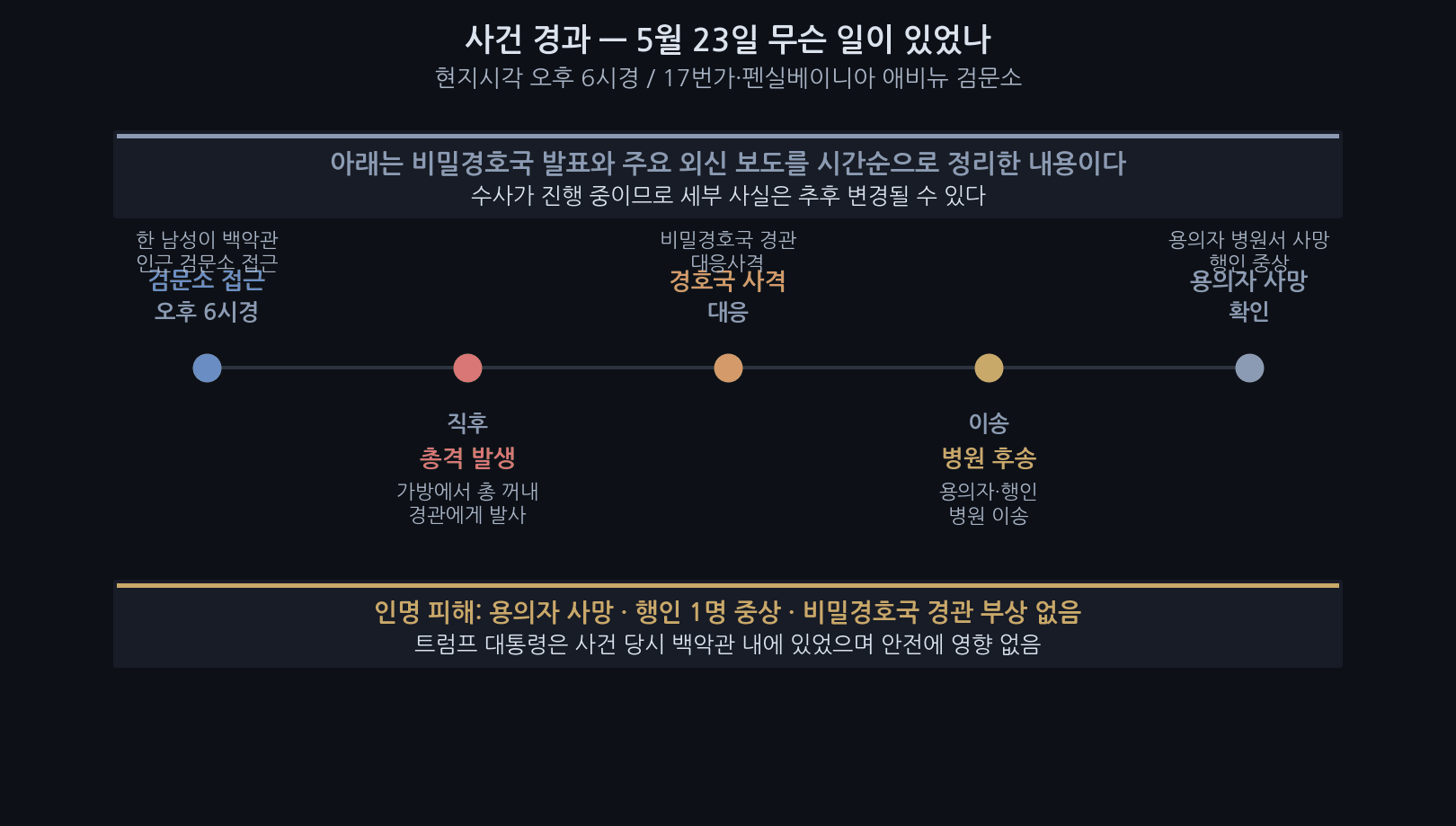
Per US Secret Service statements and major-outlet reporting, the incident occurred around 6 p.m. local time on May 23, 2026, near the checkpoint at 17th Street and Pennsylvania Avenue, a few hundred feet from the White House.
The Secret Service said a man approached the checkpoint, drew a weapon from a bag, and fired at officers. Officers returned fire; the suspect was wounded, transported to a hospital, and died. Witnesses reported between 15 and 30 shots. One bystander was struck and critically wounded.
| Item | Detail |
|---|---|
| Time | May 23, ~6 p.m. local |
| Location | 17th & Pennsylvania Ave checkpoint |
| Course | Suspect drew weapon from bag, fired |
| Response | Secret Service officers returned fire |
| Casualties | Suspect killed · one bystander critical |
Preliminary investigation suggests the individual approached, drew a weapon from a bag, and fired at officers.
— US Secret Service official statement · May 23, 2026
What is known about the suspect
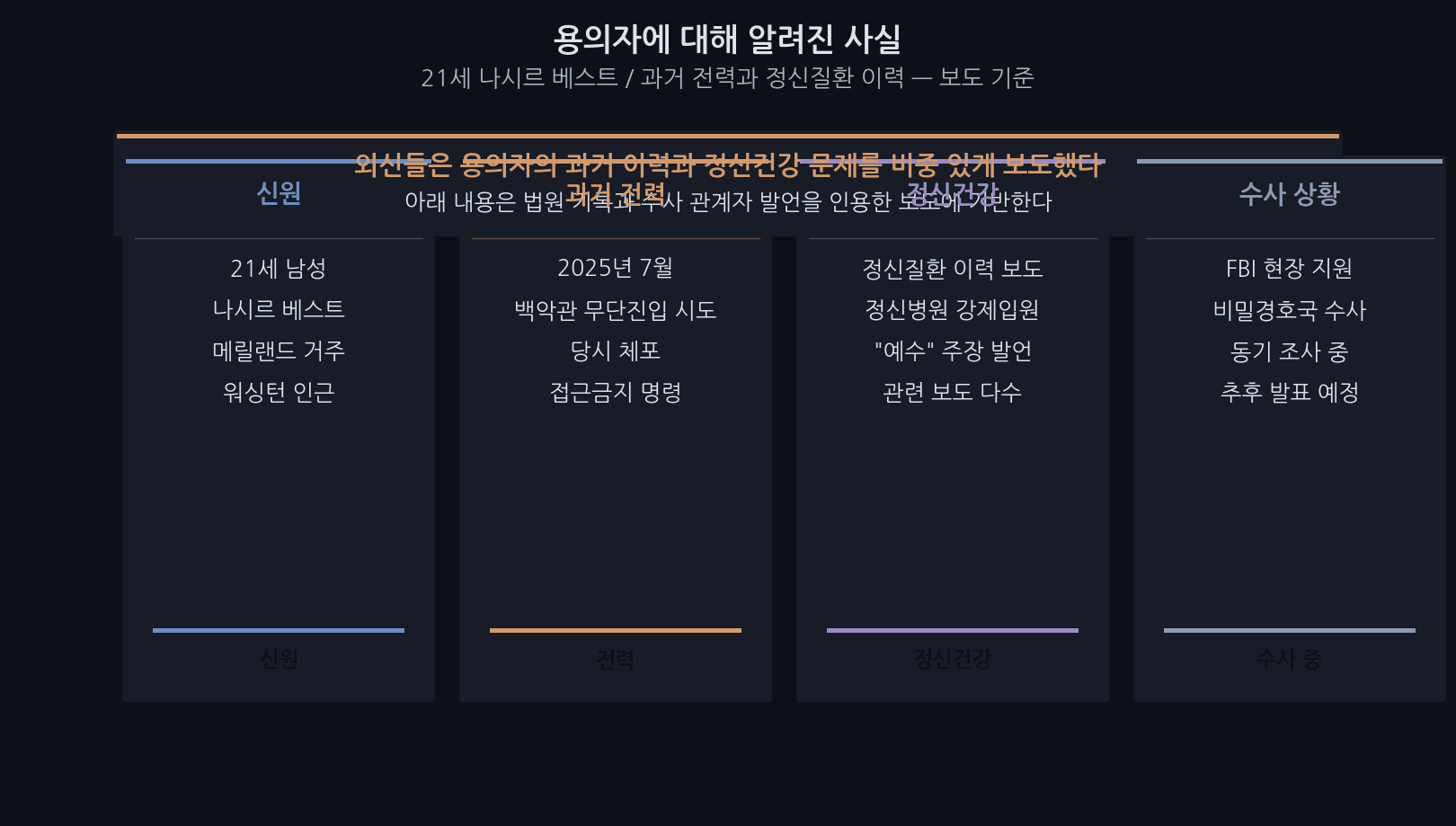
Reports citing investigators identify the suspect as 21-year-old Nasire Best, said to reside in Maryland. Multiple outlets have given prominent coverage to his prior record and mental-health history.
According to court records, Best was arrested in July 2025 after trying to enter another White House checkpoint without authorization, reportedly disobeying officer commands. CNN and others reported a history of involuntary psychiatric hospitalization and statements claiming to be a religious figure. The precise motive remains under investigation.
| Item | Reported detail |
|---|---|
| Identity | 21-year-old male, Maryland |
| Prior incident | July 2025 White House attempt |
| Legal | Stay-away order on record |
| Mental health | Reported psychiatric history |
| Motive | Under investigation — unconfirmed |
Three in a month — recurring White House shooting incidents
What makes this incident especially notable is that it is the third firearms incident in roughly a month near the White House or the president.
The first was an April 25 shooting attempt at a Washington hotel hosting the White House press corps dinner. The second was a May 4 shooting near the Washington Monument, in which an officer was targeted and a teen bystander was injured. The third is the May 23 checkpoint incident. The compressed timeline has amplified concerns about protective posture and public safety.
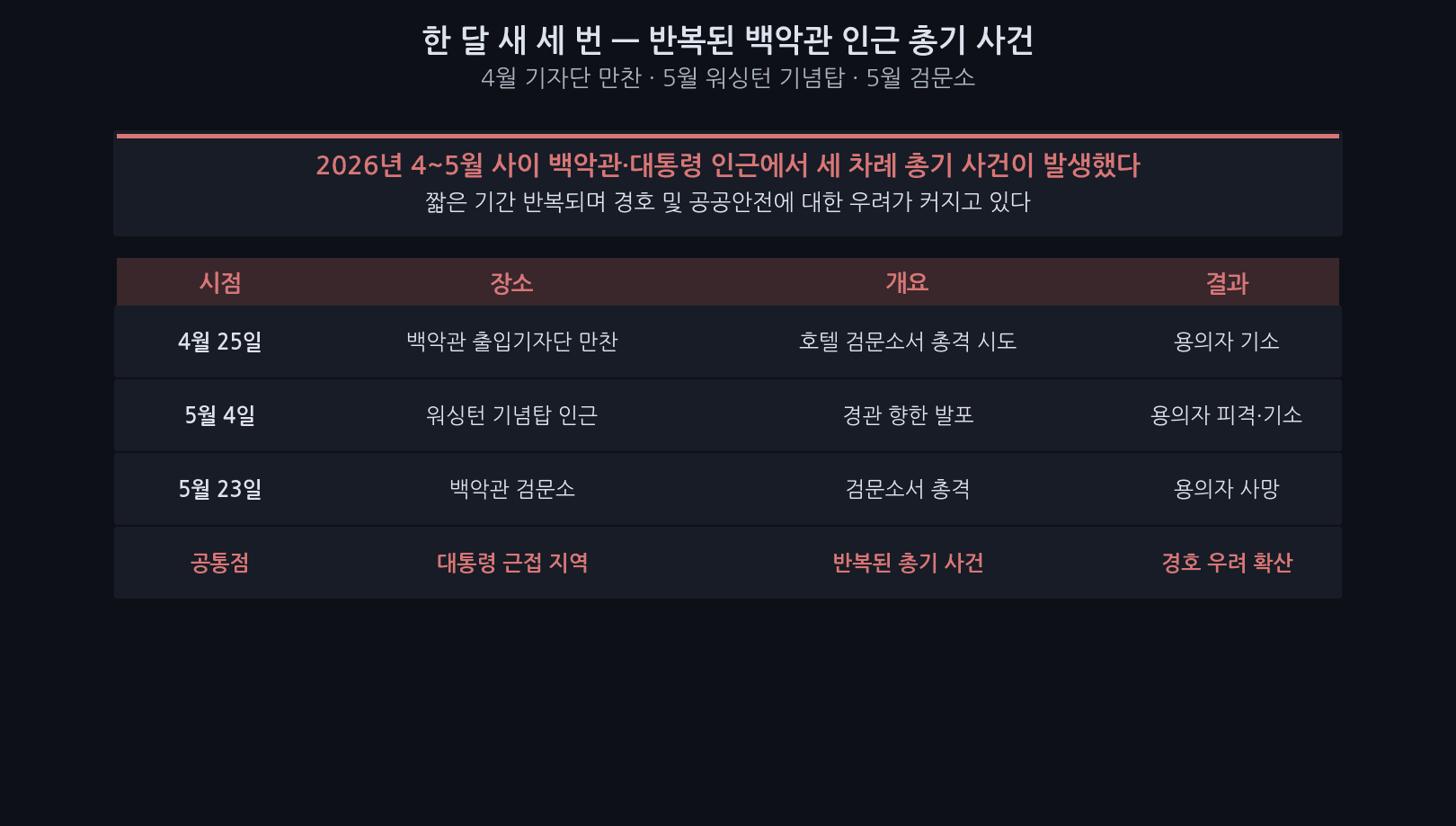
| Date | Location | Outcome |
|---|---|---|
| Apr 25 | Press-corps dinner hotel | Suspect charged |
| May 4 | Near Washington Monument | Suspect shot, charged |
| May 23 | White House checkpoint | Suspect killed |
| Pattern | Near the president | Repeated incidents |
US Secret Service — quick primer
The agency at the center of this incident is the US Secret Service, founded in 1865 and now part of the Department of Homeland Security.
Its best-known mission is protecting the president, vice president, their families, and other principals. Beyond protection, it secures the White House, investigates counterfeiting and financial crime. In this case, checkpoint officers returned fire and neutralized the threat without any officer injuries, according to the agency. The FBI joined to support the investigation.
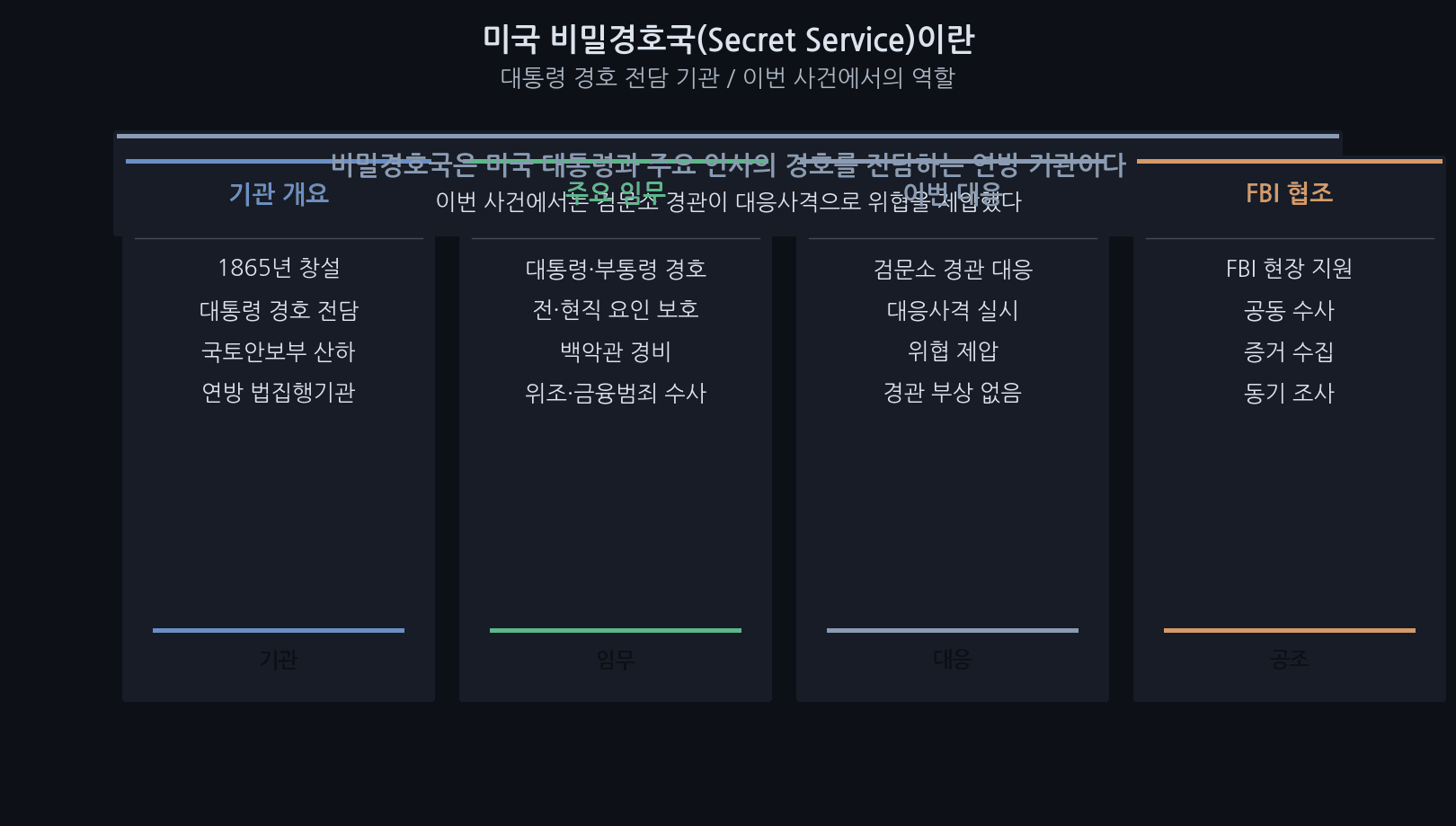
| Item | Detail |
|---|---|
| Founded | 1865 |
| Department | Under DHS |
| Core mission | Protection of president and principals; White House security |
| Additional | Counterfeiting and financial crime |
| This incident | Return fire by checkpoint officers; no officer injuries |
The FBI is on the scene supporting the Secret Service’s response to the shooting near the White House.
— FBI Director Kash Patel · social media · May 23, 2026
White House security architecture — how it works
White House protection is built as multiple layered rings of defense. The outermost layer is the surrounding streets and checkpoints, which screen vehicles and pedestrians. This incident occurred at that outer perimeter.
Inside that comes the fence line and sensors as the second ring. Inside the grounds, armed officers patrol with rooftop overwatch — the third ring. Finally, the president has a close-protection detail. In this case, President Trump was inside the White House, and protective authorities said his safety was unaffected.
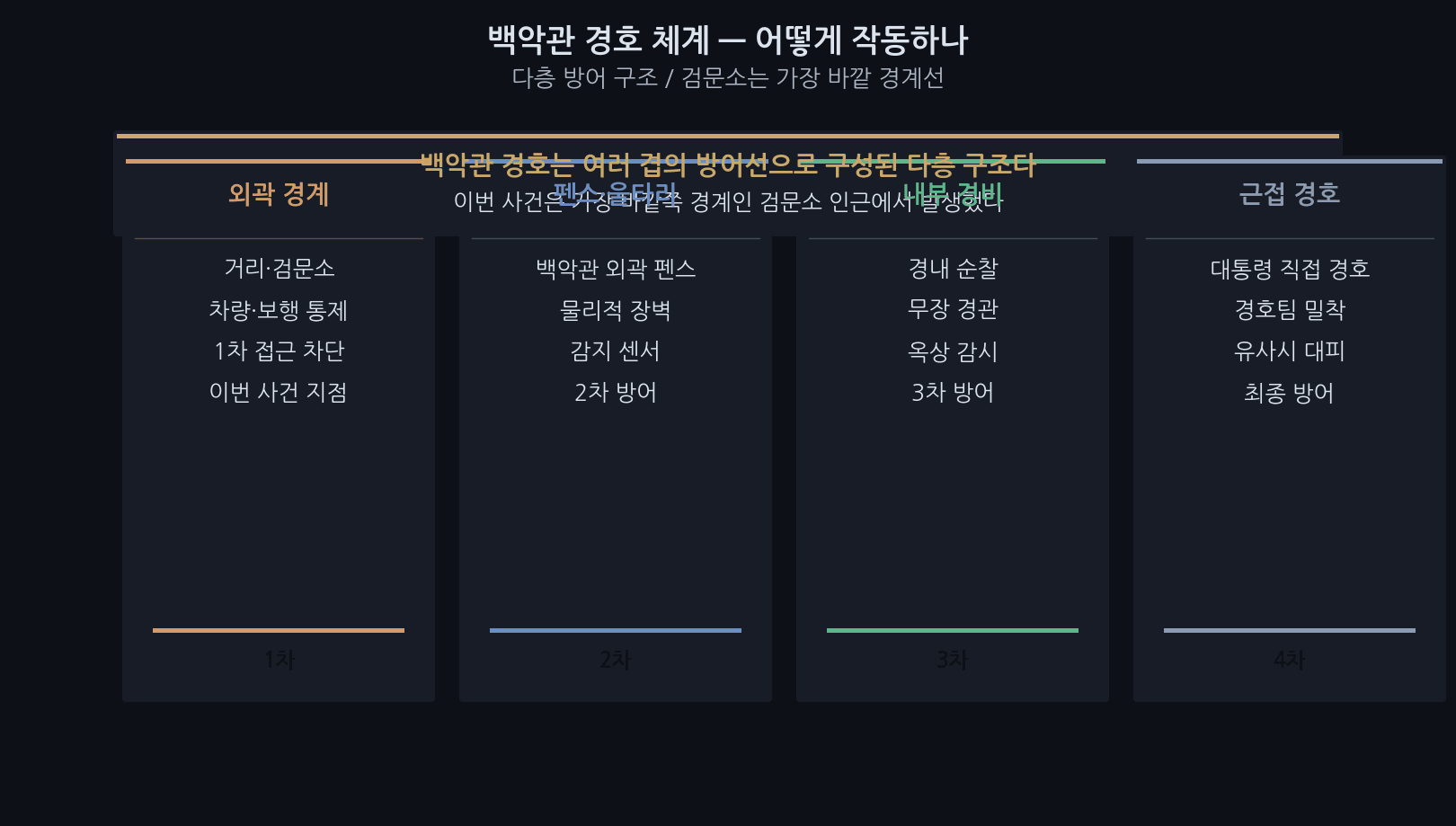
| Ring | Components | Role |
|---|---|---|
| 1 — Outer | Streets, checkpoints | Access control (this incident) |
| 2 — Fence | Perimeter fence, sensors | Physical barrier |
| 3 — Interior | Patrols, rooftop overwatch | Grounds security |
| 4 — Close | Presidential detail | Close protection |
Social questions the case raises
This incident goes beyond a crime story. International coverage has surfaced several recurring questions.
First, mental-health support systems. The suspect’s reported history brings into focus early intervention and safety nets for people in crisis. Second, access to firearms — a long-running US debate. Third, the balance between principal protection and ordinary public safety. Fourth, the social tension that repetition can generate.
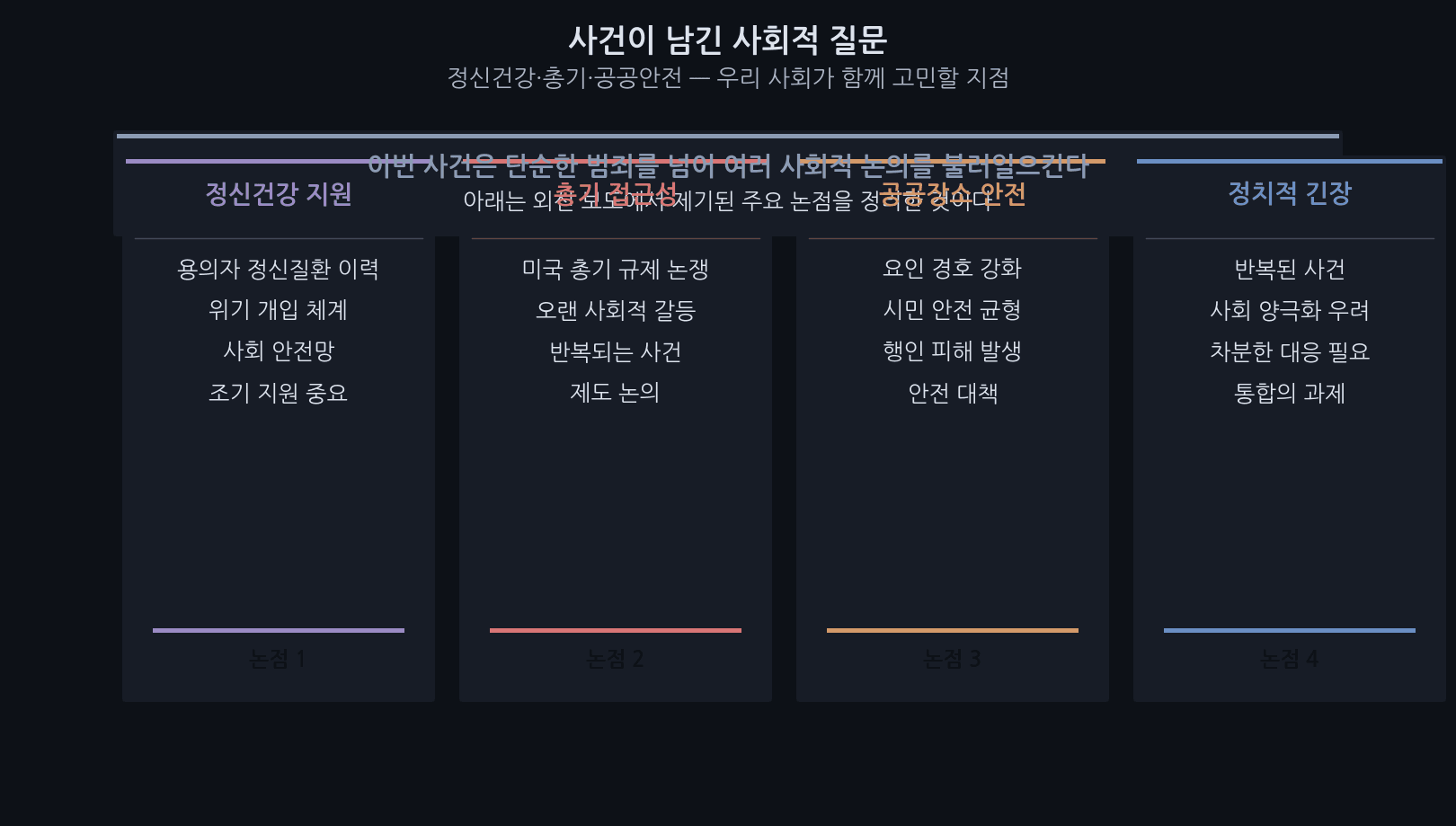
| Topic | Detail |
|---|---|
| Mental-health support | Crisis intervention and safety nets |
| Firearms access | Long-standing US gun-policy debate |
| Public-place safety | Balancing principal protection and civic safety |
| Social tension | Repeated incidents and polarization |
Korea-relevant takeaways
Although the incident is American, it offers food for thought for Korea too. Principal protection, mental-health support, and public safety are universal challenges.
Korea also runs a principal-protection system, with similarly layered defense principles. On mental health, expanding crisis intervention and welfare is a shared agenda. There is also the question of responsible reporting that considers contagion risk, and the reader’s posture of understanding facts calmly without being swept by alarm or stigma — equally relevant in Korea.
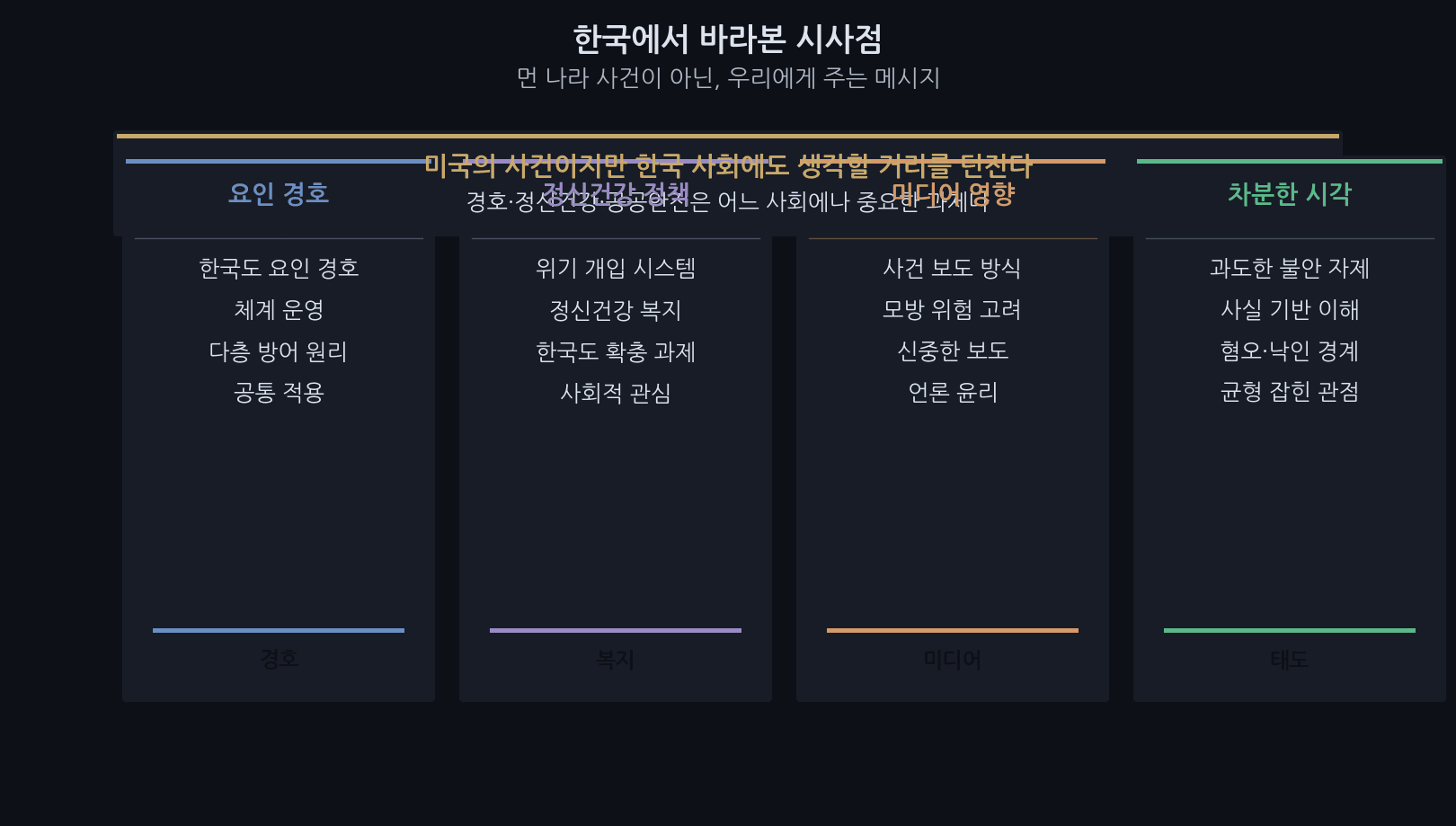
| Area | Takeaway |
|---|---|
| Principal protection | Layered-defense principle — applies in Korea |
| Mental-health policy | Need to expand crisis intervention and welfare |
| Media reporting | Responsible coverage that considers contagion |
| Reader posture | Avoid stigma; calm fact-based understanding |
White House shooting — five key points
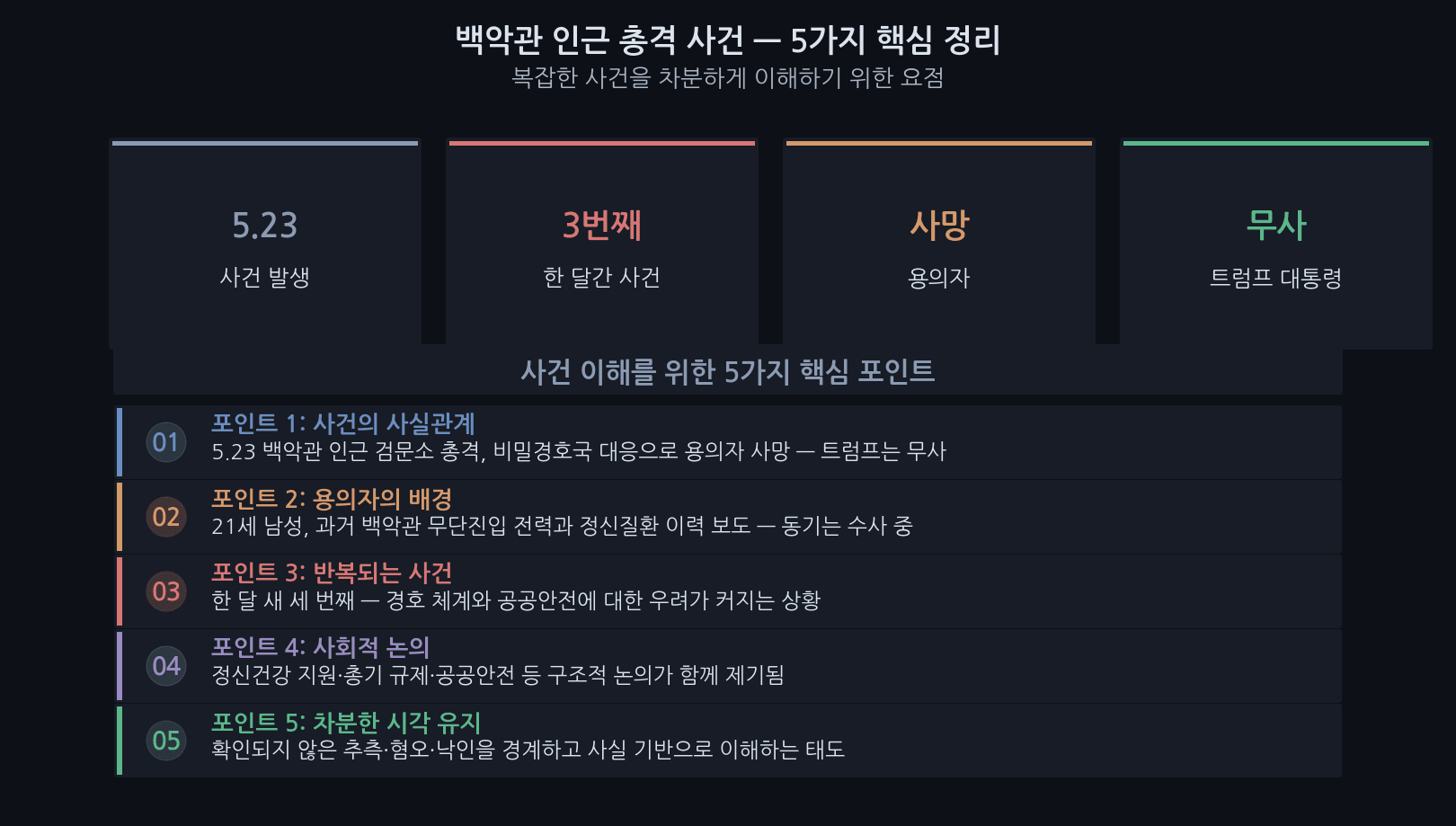
| Key point | Detail |
|---|---|
| 1. Facts | May 23 checkpoint shooting; suspect killed; Trump safe |
| 2. Suspect background | 21-year-old; prior attempt, reported psychiatric history |
| 3. Recurrence | Third incident in a month |
| 4. Social discussion | Mental health, firearms, public safety |
| 5. Posture | Avoid speculation and stigma; fact-based calm |
□ Suspect — 21-year-old male, prior attempt and reported psychiatric history (motive under investigation)
□ Recurrence — third firearms incident in a month, protective concerns rising
□ Social discussion — mental-health support, gun regulation, public safety
□ Posture — guard against unverified speculation and stigma; understand the facts
□ For the latest, keep following reputable reporting
Sources
- AP (Yahoo News) — Suspect dead after opening fire near White House security checkpoint (May 23, 2026)
- CNN — Man killed in shooting outside White House had previous Secret Service arrest (May 23, 2026)
- CBS News — Gunman killed after opening fire on Secret Service checkpoint (May 23, 2026)
- NBC (MS NOW) — Man dead after opening fire at security checkpoint near White House (May 23, 2026)
- FOX 5 DC — What we know about the White House shooting suspect (May 24, 2026)
- Wikipedia — May 2026 White House shooting (background)
This article is for informational purposes based on facts reported by major outlets. It does not target any individual or group and takes no political position. The investigation is ongoing and details such as motive may change; check reputable reporting for the latest. Descriptions of mental health are not intended to promote stigma toward any specific condition.