Trump Beijing visit — first in 9 years: US-China summit agenda and Korea market impact
Trending · May 14, 2026 · US-China summit
Trump Beijing visit marks the first US presidential trip to China in 9 years. 14 CEOs in tow. Iran, semiconductors, Taiwan, and Boeing deals all on the table — plus a full read on Korea market impact.
The Trump Beijing visit is underway. On May 13 at 7:50 pm local time, Air Force One landed at Beijing Capital International Airport, making this the first US presidential visit to China in nine years — the first since Trump’s own November 2017 trip.
This summit is no diplomatic formality. Iran war + tariff ceasefire + midterms + rare earths and semiconductors — four overlapping crises converge at exactly this moment. Korean investors face simultaneous short-term volatility and longer-run structural shifts.
From trade war to “managed competition” — the real purpose of this visit is not to end the competition but to find a way to keep competing without collision.
— Steve Tsang, SOAS China Institute

1. Why now — four crises converge on the Trump Beijing visit

| Date | Event | Meaning |
|---|---|---|
| 2025 | US-China tariff war | US 145% ↔ China 125% retaliatory tariffs |
| Oct 30, 2025 | Busan summit | Tariff ceasefire agreed — 7 months ago |
| Feb 2026 | US federal court | Reciprocal tariffs ruled unconstitutional |
| Feb 28, 2026 | Iran war begins | US-Israel strikes → Hormuz blockade |
| May 13, 2026 | Beijing arrival | First US presidential visit to China in 9 years |
Trump’s prolonged Iran war has pushed his approval to historic lows — he needs a diplomatic win. Xi holds rare earths and Iranian oil access as leverage, and wants China recognized as America’s equal great power. Both sides need a “winning summit,” creating a paradoxical incentive to cooperate.
Core context
2. Schedule — three days, under 48 hours

| Day | Key events | Significance |
|---|---|---|
| May 13 (Wed) | Beijing arrival, reception by Han Zheng, 300-child welcome | Protocol / diplomatic gesture |
| May 14 (Thu) | Bilateral summit ①, Temple of Heaven visit, state banquet | Core negotiating day |
| May 15 (Fri) | Summit ② (tea meeting), working lunch, communiqué, departure | Conclusion / joint statement |
★ Temple of Heaven signal — 2017’s Forbidden City imperial ceremony → 2026’s commoners’ park signals a diplomatic step-down in protocol. Markets care far less about the venue than about the joint-statement content.
3. Fourteen CEOs — Big Tech and finance all in
The strongest signal of the Trump Beijing visit is the 14-CEO delegation. The largest business envoy in US diplomatic history frames this summit as a business deal negotiation, not a security summit.

| CEO | Company | Watch |
|---|---|---|
| Elon Musk | Tesla / SpaceX | China EV market stakes |
| Tim Cook | Apple | Final diplomacy before stepping down |
| Jensen Huang ⭐ | Nvidia | Alaska last-minute boarding |
| Kelly Ortberg | Boeing | Aircraft purchase talks |
| Larry Fink | BlackRock | Financial investment cooperation |
| David Solomon | Goldman Sachs | Wall Street representative |
| Jane Fraser | Citigroup | Global finance |
| Brian Sikes | Cargill | Agricultural deal lead |
Jensen Huang’s last-minute boarding is the biggest signal. He wasn’t on the original invite list; he joined on Air Force One during the Alaska refueling stop. This strongly implies the US is considering easing chip-export controls to China.
4. Agenda — six US demands vs six Chinese demands

| 🇺🇸 What the US wants | 🇨🇳 What China wants |
|---|---|
| ① Convince Iran → reopen Hormuz | ① Taiwan wording: “non-support” → “oppose” |
| ② Boeing aircraft bulk purchase | ② Ease advanced-tech export controls (chips) |
| ③ More soy, beef, ag purchases | ③ Remove sanctioned Chinese companies |
| ④ Formalize Busan ceasefire (trade body) | ④ Rare-earth card for trade balance |
| ⑤ Build AI cooperation channel | ⑤ Recognition as US equal |
| ⑥ Raise nuclear arms reduction (likely rejected) | ⑥ Use Iran mediation for concessions |
Likely outcomes — “Boeing, beans, and beef”
| Item | Expected | Probability |
|---|---|---|
| Boeing planes | Tens to hundreds of aircraft for Chinese airlines | High ⭐ |
| Agricultural goods | More soy, beef, corn purchases | High ⭐ |
| Trade commission | Joint US-China trade & investment body launched | Very high ⭐⭐ |
| Nvidia chips | Partial easing of export controls | Medium |
| Taiwan wording | “oppose” vs “non-support” | Unknown ⚠ |
| Rare earths | Export-restriction moratorium extended | High |
5. The Iran variable — the hidden core of the summit
On the surface this is a trade summit. In practice, Iran dominates the whole negotiation. About 50% of China’s crude oil comes from the Middle East. China is Iran’s largest trade partner and crude buyer — holding the only key to convincing Tehran.

- China’s Iran dependency — ~50% of crude from the Middle East; Hormuz blockade is a mounting economic hit on China
- Trump’s ask — expected to request Xi pressure Iran to reopen Hormuz. Iran’s FM visited Beijing one week before Trump’s arrival
- Kyle Chan (Brookings) — “We now know Trump doesn’t hold all the cards. Rare earths are China’s Strait of Hormuz.”
- Putin shadow — Putin arrives Beijing right after Trump leaves. Iran FM → Trump → Putin = three consecutive summits on the same stage
6. Protocol shift — 2017 Forbidden City vs 2026 Temple of Heaven

| Item | 2017 (first visit) | 2026 (this visit) |
|---|---|---|
| Welcome venue | Forbidden City, private opening | Temple of Heaven (public park) |
| Tone | “State visit plus” honeymoon | Pragmatic managed diplomacy |
| CEO count | 30+ | 14 (roughly half) |
| Taiwan language | “Respects one-China policy” | Wording under negotiation |
| Deal announced | $250B in business | Real transaction-focused |
| Relationship label | “Very special person” | Managed competition |
7. Market read — 2017 data applied to 2026
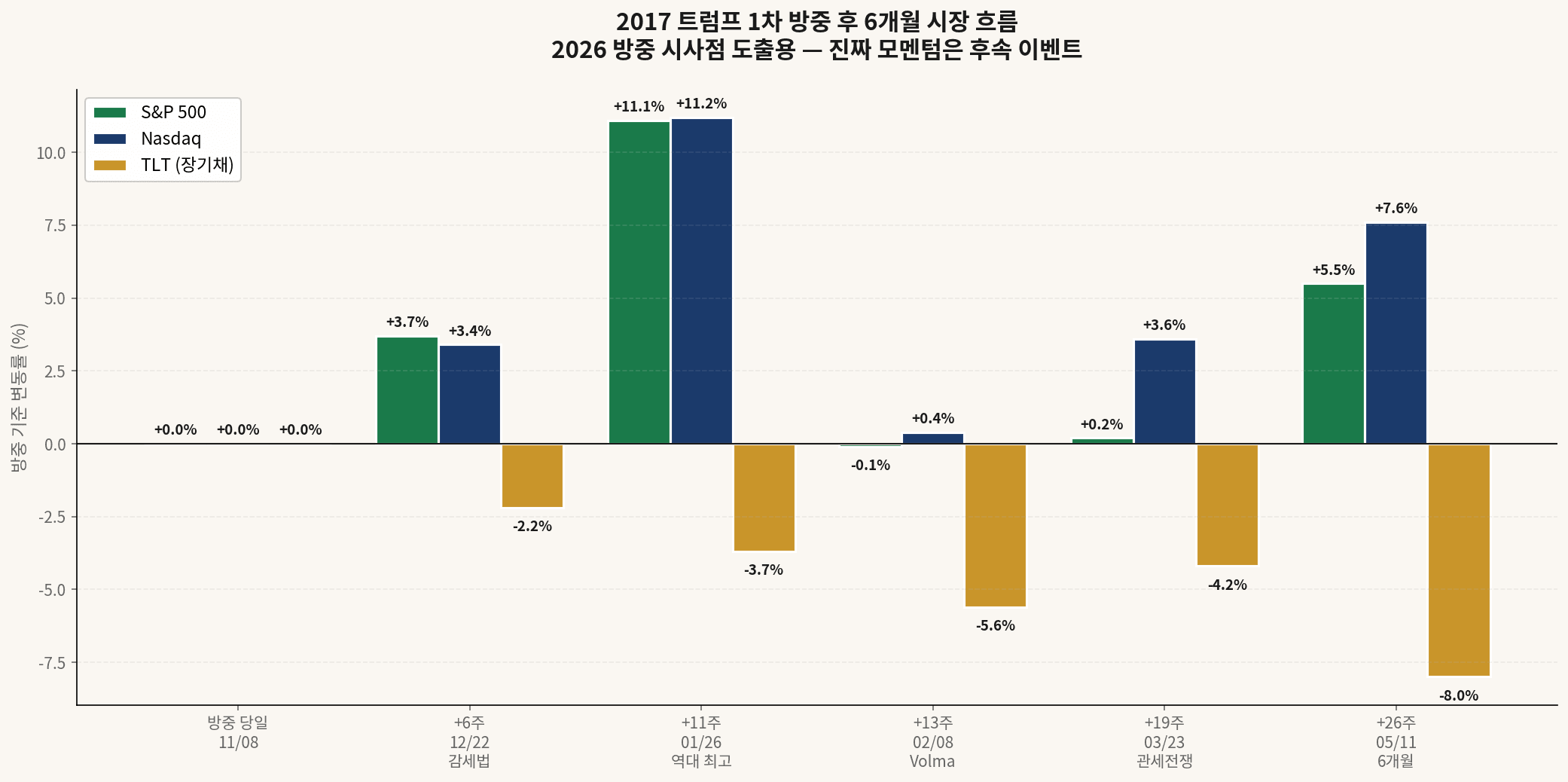
| Date | S&P 500 | Nasdaq | TLT (long bond) |
|---|---|---|---|
| Nov 8, 2017 — visit day | 2,584 (base) | 6,752 (base) | $126.5 |
| +6 wks (Dec 22 tax cuts) | +3.7% | +3.4% | -2.2% |
| +11 wks (Jan 26 peak) | +11.1% | +11.2% | -3.7% |
| +13 wks (Feb 8 Volmageddon) | -0.1% | +0.4% | -5.6% |
| +26 wks (May 11 six-month mark) | +5.5% | +7.6% | -8.0% |
- Visit-day market impact is muted — S&P was -0.1% on Nov 8, 2017. Already priced.
- Real momentum comes from follow-on events — 2017’s was the Tax Cuts and Jobs Act. 2026’s triggers are Boeing deal confirmation, Nvidia export-control easing, rare-earth agreement.
- TLT depends on the rate path — If Iran ends → oil drops → disinflation → Fed cuts, TLT can rally.
- Biggest risk lands ~4 months later — In 2017 the tariff war broke out four months post-visit. In 2026, watch Iran re-escalation, Taiwan tensions, and November midterms.
- Nasdaq outperforms S&P — 2017: Nasdaq (+7.6%) vs S&P (+5.5%) over six months. 2026: Apple, Tesla, Nvidia, Boeing are direct beneficiaries of this summit.
⚠ Key warning — ride the short-term rally, but hedge the mid-term risks (Iran re-escalation, Taiwan friction, midterms). 2017 shows the real pain comes 4–5 months later.
8. Korea investor impact — four channels

① KOSPI — US-China thaw = all-time-high momentum
KOSPI has been printing records through the pre-summit week, closing near 7,500. A US-China deal lifts Korean exporters (semis, autos) through indirect demand effects.
② Semis — Nvidia export easing cuts both ways
Export control easing → China AI-memory demand recovery → Samsung Electronics and SK hynix short-term boost. Long-term competitive dynamics could shift if Nvidia chips flow more freely.
③ Taiwan variable — alliance security implications
If China wins a Taiwan wording change, the security architecture underpinning the US-Korea alliance warrants monitoring. The risk of US “strategic ambiguity” pulling back is the structural variable to watch.
④ Autos and batteries — EV cooperation talks
US-China EV cooperation (Chinese manufacturing + US brands) is on the table. Korean battery makers face potential Chinese-battery resurgence risk. Hyundai, Kia, LG Energy Solution, Samsung SDI are all in the impact zone.
Seoul as pre-summit venue — Scott Bessent visited Seoul immediately before the trip to finalize the agenda with Chinese trade counterparts. Korea is serving as a diplomatic midpoint — highlighting its continued role balancing US and China ties.
9. Column view — how to read this summit
“What we have learned is that Trump doesn’t hold all the cards.”
— Kyle Chan, Brookings Institution
The Trump Beijing visit in one line: “the start of managed competition.” Not the 2017 honeymoon, not the 2025 tariff war. Neither side is going for a decisive win. Both are trying to avoid a decisive loss.
For Korean investors the playbook is short-term rally + mid-term risk hedge. Visit day itself won’t be the shock — the 2017 data makes that clear. Real volatility is set by follow-on events. Boeing deal confirmed → airlines and defense move. Nvidia controls eased → semis move. Taiwan wording retreats → defense names take pressure.
① May 15 communiqué — size of real trade deals (Boeing, ag)
Korea investor signals to watch: May–June
② May 15–16 market reaction — Boeing, NVDA, Tesla share prices
③ Putin Beijing visit (after May 20) — Russia-China-North Korea axis
④ Early June Nvidia export license — announced or not
⑤ June FOMC — inflation and rate direction signal
Nine years to Beijing.
— Trump Beijing visit in one line
The starting point of managed competition.