
Congo Ebola outbreak — WHO declares PHEIC: Bundibugyo strain, regional spread, and a calm look from Korea
Trending · May 24, 2026 · DIR
The Congo Ebola outbreak has triggered a WHO Public Health Emergency of International Concern (PHEIC). We unpack the May 2026 timeline, the Bundibugyo strain’s no-vaccine challenge, regional spread into Uganda, the international response, and how to think calmly about risk from Korea.
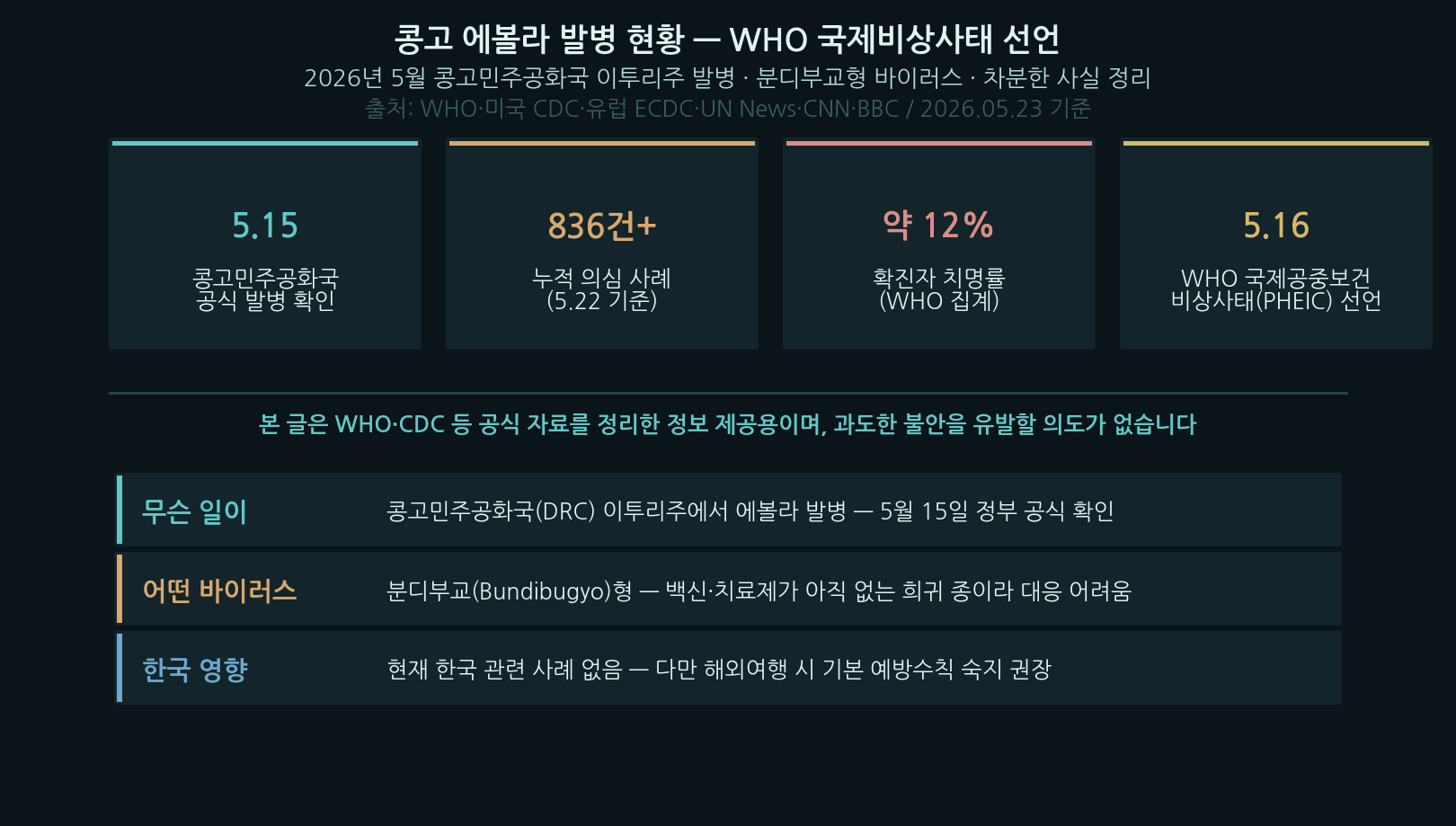
In May 2026, the Congo Ebola outbreak resurfaced in Africa. The World Health Organization (WHO) declared a Public Health Emergency of International Concern (PHEIC) and called for international coordination. The outbreak’s epicenter is Ituri Province in the northeast of the Democratic Republic of the Congo (DRC), with spread reported to neighboring provinces and Uganda.
“Ebola” alone is a word that triggers fear — but vague fear obscures judgment. This article aims to calmly summarize what official health authorities — WHO, US CDC, Europe’s ECDC — have reported. Primary sources: the WHO Disease Outbreak News and the US CDC Ebola hub.
Congo Ebola outbreak — May 2026 timeline
Here is the rough chronology of the Congo Ebola outbreak. In early May, a cluster among healthcare workers was detected at a hospital in Bunia, Ituri Province. Some initial samples tested negative but follow-up testing confirmed positives.
On May 15, the DRC and Ugandan governments officially confirmed Ebola. The next day, WHO declared the Public Health Emergency of International Concern (PHEIC). On May 18, the Africa CDC declared a continent-wide public-health emergency. Specialists noted that hundreds of suspected cases were already on record at the time of first reporting.
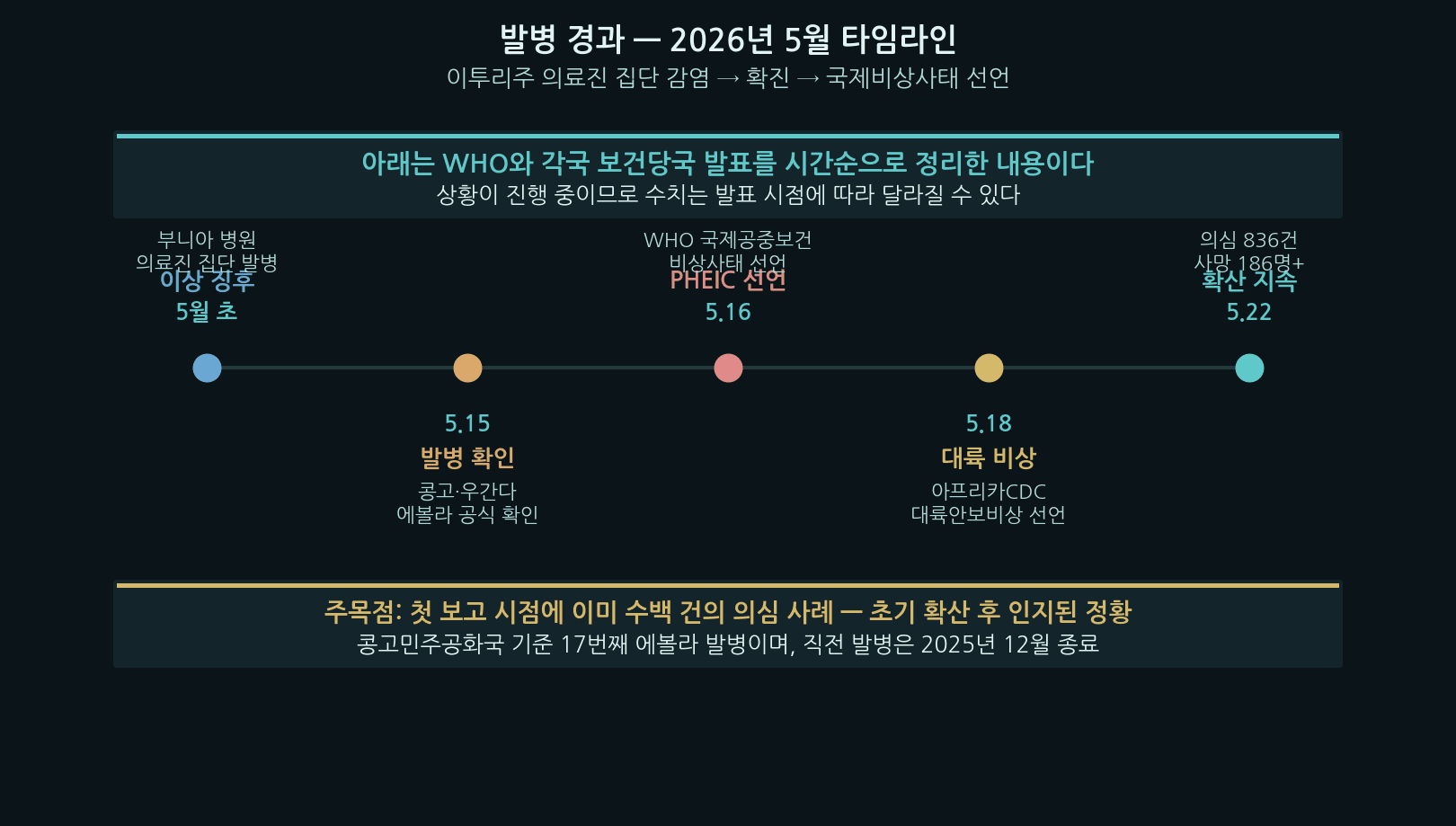
| Date | Event |
|---|---|
| Early May | Cluster among healthcare workers in Bunia, Ituri |
| May 15 | DRC and Uganda officially confirm Ebola |
| May 16 | WHO declares PHEIC |
| May 18 | Africa CDC declares continent-wide emergency |
| May 22 | 836 suspected cases, 186+ deaths reported |
Hundreds of suspected cases were already on record by the time of first reporting — a fact that worried specialists.
— WHO / CNN compilation · May 2026
What Ebola is — basic facts
Accurate understanding beats vague fear. Ebola is a viral hemorrhagic fever, first identified in 1976, with outbreaks largely concentrated in central and west Africa.
The key is transmission. Ebola spreads through direct contact with an infected person’s blood or bodily fluids — not easily through the air, unlike respiratory illnesses such as COVID-19. The incubation period is typically 2–21 days, and transmission risk is essentially nil before symptoms appear. That is why early detection and contact tracing are at the core of containment.
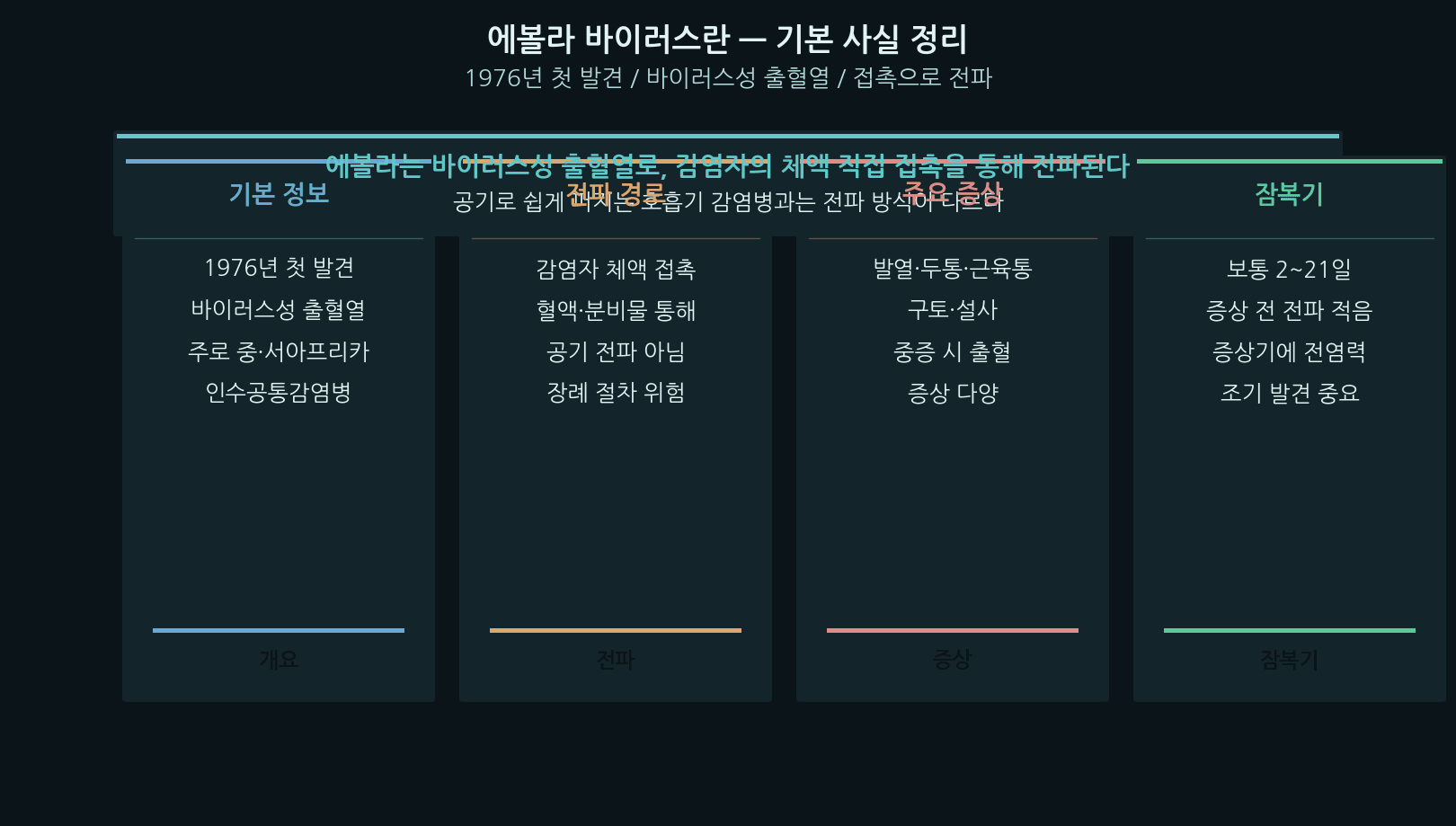
| Item | Detail |
|---|---|
| First identified | 1976 |
| Type | Viral hemorrhagic fever |
| Transmission | Direct contact with infected fluids |
| Symptoms | Fever, headache, myalgia, vomiting; severe cases hemorrhage |
| Incubation | 2–21 days |
What is different this time — the Bundibugyo strain
There are several Ebola virus species. This outbreak is caused by the Bundibugyo strain, first identified in Uganda’s Bundibugyo district in 2007.
This matters because it directly shapes the response. The Zaire strain — which drove the 2014 West Africa epidemic — has approved vaccines and treatments. The Bundibugyo strain currently has no approved vaccine or treatment. Trials are underway to repurpose existing therapeutics, but the challenge is greater. Historical Bundibugyo case-fatality rates have varied widely, from roughly 25% to 50%.
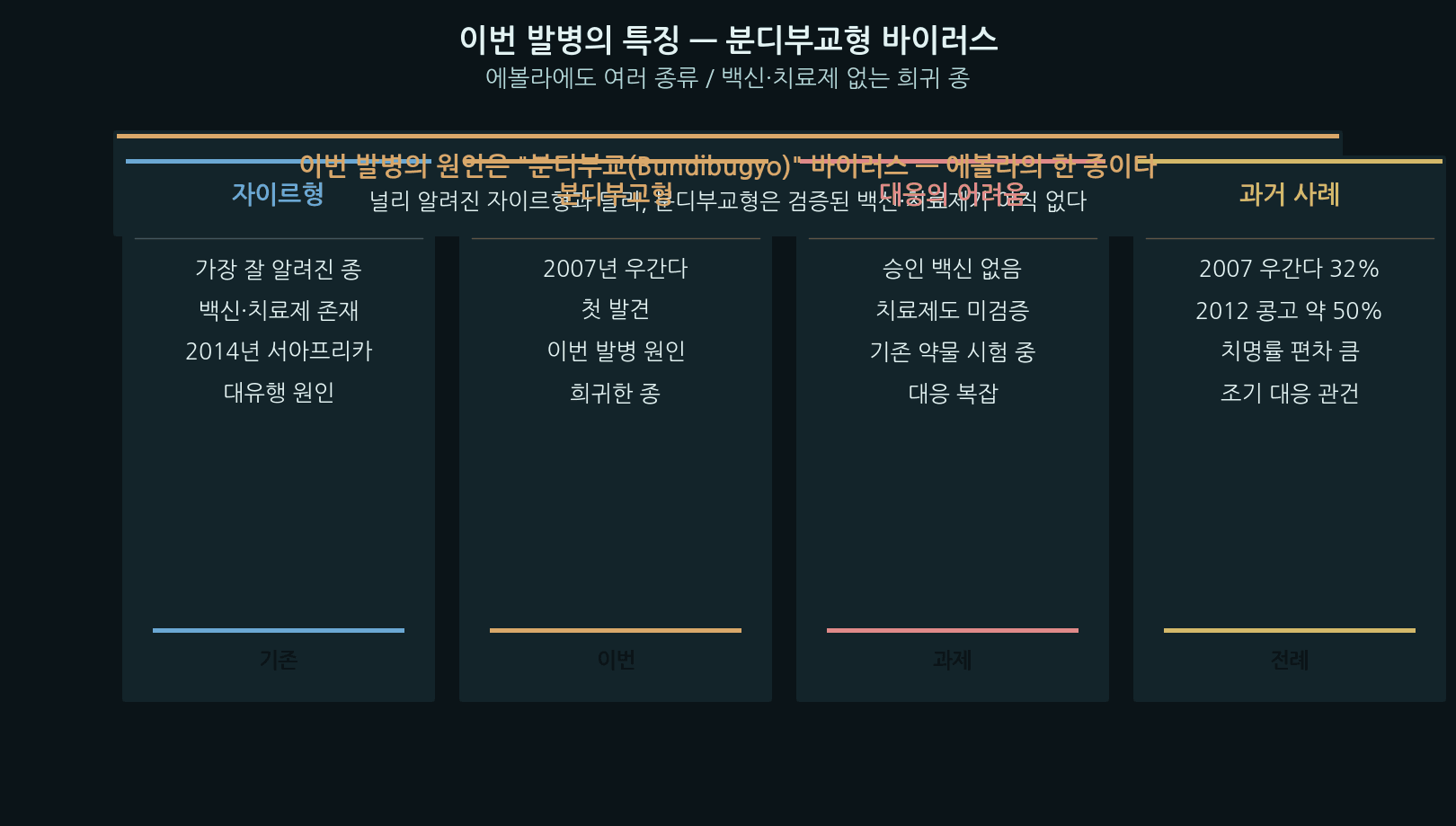
| Item | Zaire strain | Bundibugyo strain |
|---|---|---|
| Identified | 1976 | 2007 Uganda |
| Vaccine / treatment | Approved tools exist | None yet |
| This outbreak | Not applicable | Causative strain |
| Historical CFR | Case-dependent | ~25–50% (varied) |
Spread — how far has it gone
The epicenter is the northeast DRC province of Ituri, with cases confirmed across multiple health zones including Bunia, Mongbwalu, and Rwampara. The concern is that the outbreak has not stayed within Ituri.
Confirmed cases have also been reported in neighboring North Kivu and South Kivu, and travel-related cases have surfaced in the DRC capital Kinshasa. Across the border, five related cases have been confirmed in Uganda’s capital Kampala. WHO has assessed that actual infections may meaningfully exceed reported suspected cases.
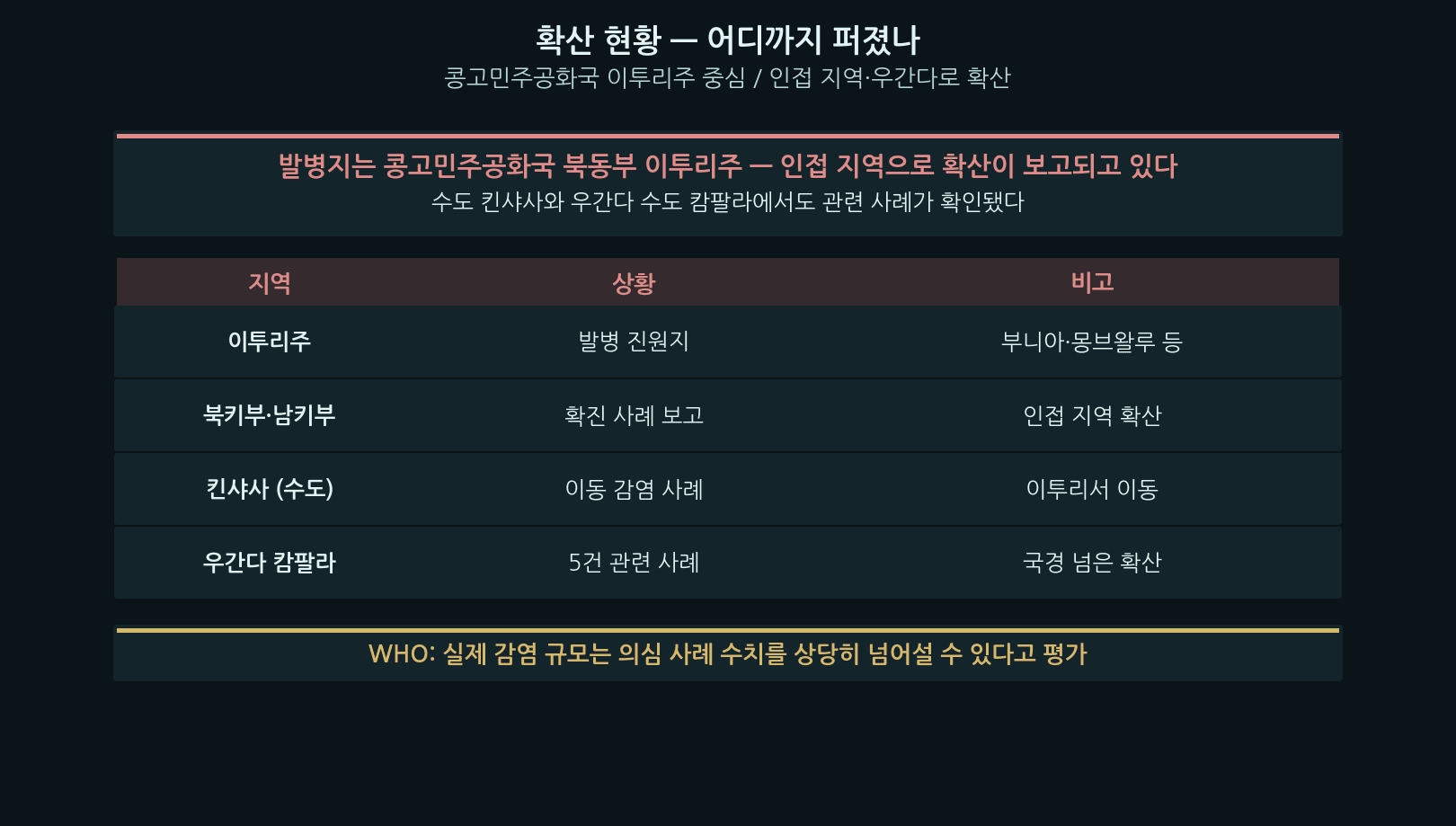
| Area | Status |
|---|---|
| Ituri Province | Epicenter (Bunia, Mongbwalu, etc.) |
| North Kivu / South Kivu | Confirmed cases reported |
| Kinshasa (capital) | Travel-related cases from Ituri |
| Kampala, Uganda | 5 cross-border related cases |
International response — WHO and national authorities
WHO declared the PHEIC on May 16. PHEIC is WHO’s highest-level alert, triggered by major health crises requiring international coordination — previously used for COVID-19 and mpox.
WHO has airlifted diagnostic kits into eastern DRC and convened its emergency committee. The Africa CDC also declared a continent-wide public-health security emergency, reinforcing regional coordination. On the ground, more than 1,000 contacts are being traced and monitored in Ituri alone. The US and several other countries have issued travel advisories and tightened entry screening.
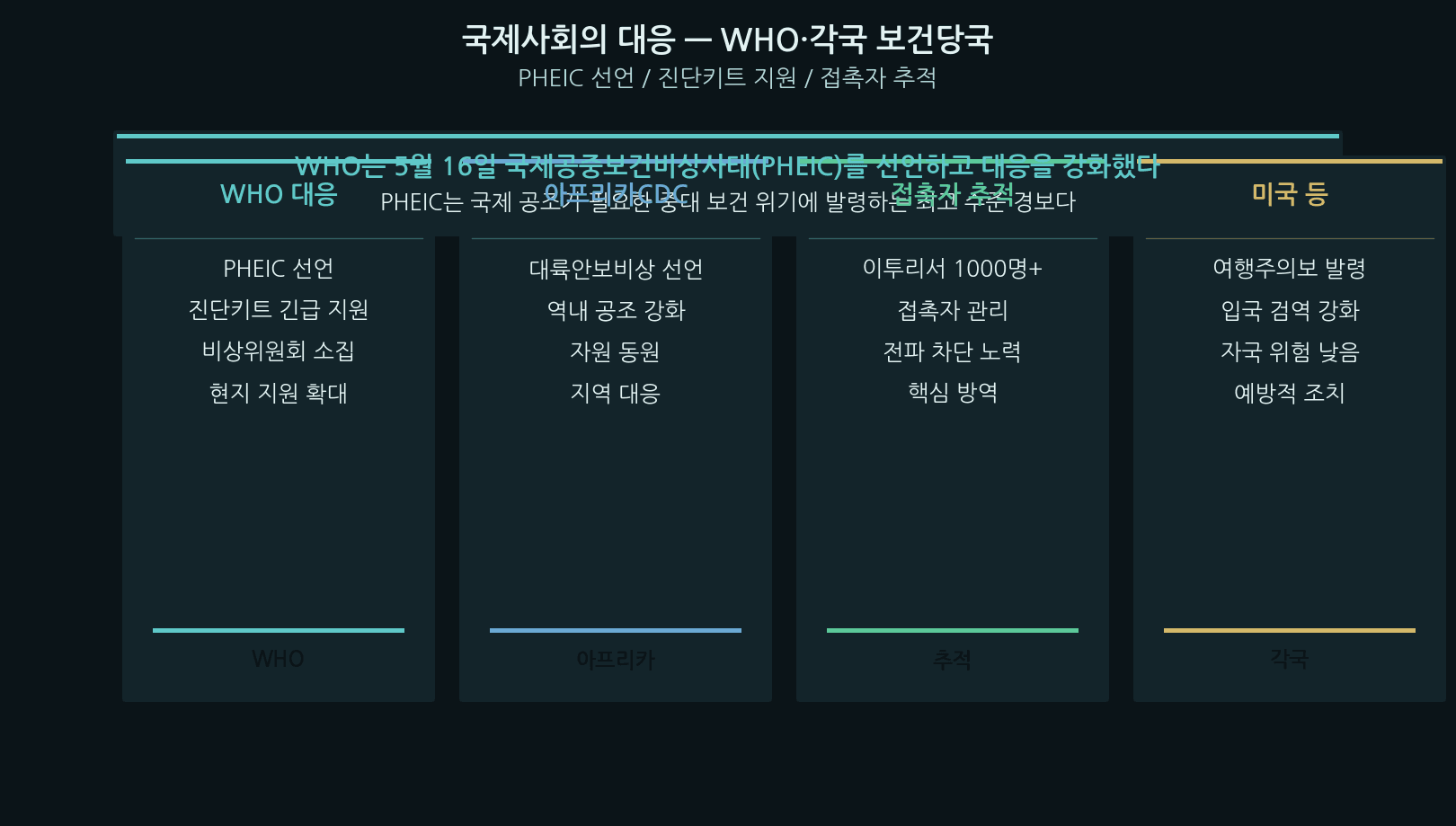
| Actor | Action |
|---|---|
| WHO | PHEIC declaration; diagnostic-kit support; emergency committee |
| Africa CDC | Continent-wide public-health emergency |
| Local response | 1,000+ contacts traced in Ituri |
| US and others | Travel advisories; tighter entry screening |
Vaccine rollout is still months away, and health workers are fighting to break the chain of transmission.
— WHO DRC representative · UN News · May 19, 2026
Impact on Korea — a calm look
For readers in Korea, the most important question is: “Are we safe?” The short answer: no Korea-related cases have been reported. The US CDC also rates domestic introduction risk as low.
Because Ebola requires direct contact with infected fluids, day-to-day transmission risk far from the epicenter is low. Still, with heavy international travel, baseline awareness helps: avoid travel to outbreak areas, and if you return with suspicious symptoms, declare it at entry quarantine rather than self-judging.
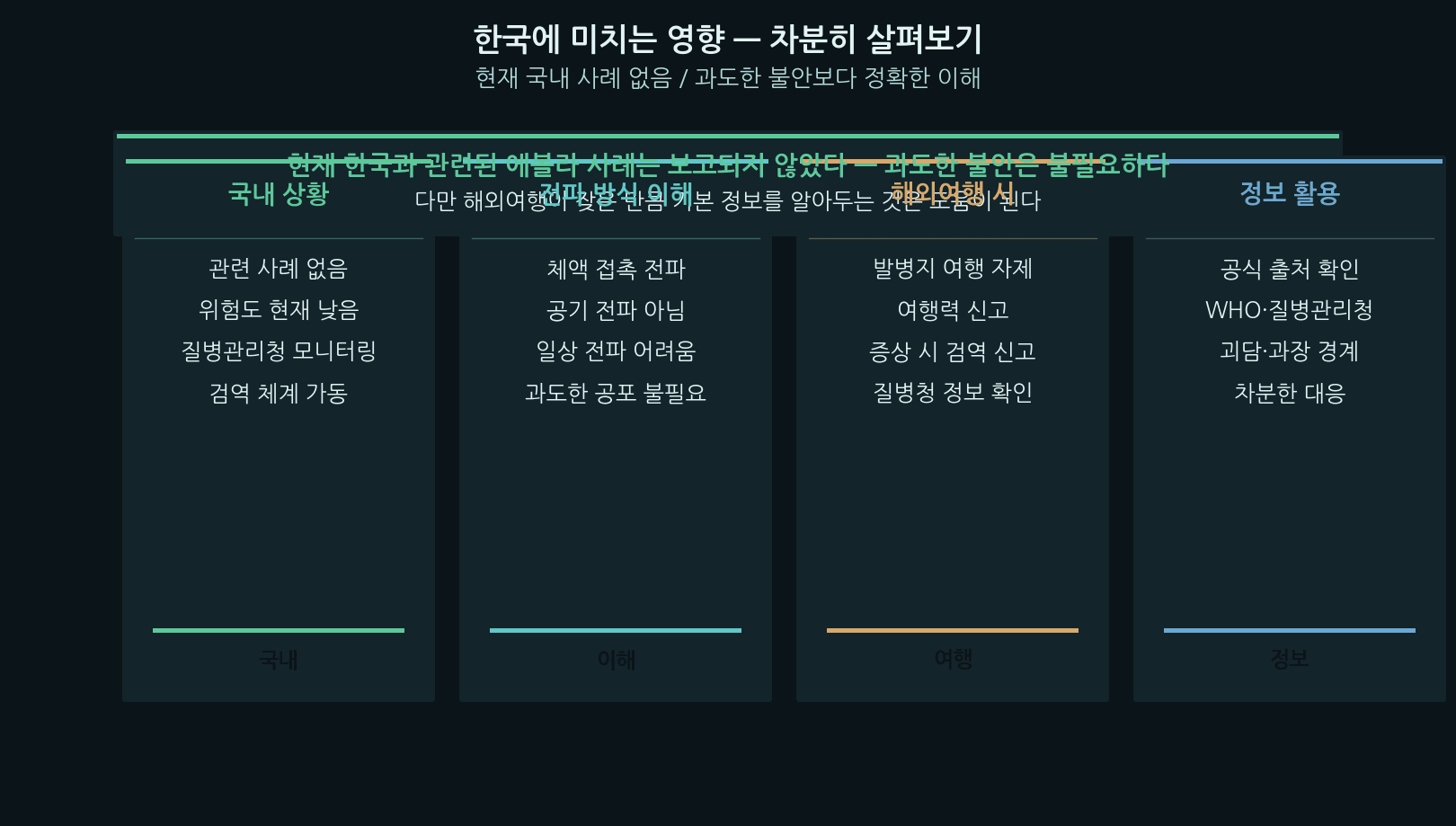
| Item | Current status |
|---|---|
| Domestic cases | None reported |
| Risk level | Low; KDCA monitoring |
| Transmission | Fluid contact — low everyday transmission |
| Recommended | Avoid travel to outbreak areas; declare symptoms on entry |
Basic prevention worth knowing
The core of Ebola prevention is avoiding contact with infected fluids. Ordinary people do not need to do much extra in daily life, but travelers and healthcare workers should know a few essentials.
Hand hygiene is the starting point — soap and water, frequently. If you plan to travel to outbreak regions, check advisories and consider postponing. Returning travelers showing fever or other symptoms should report at entry quarantine rather than self-diagnosing, so testing can start early.
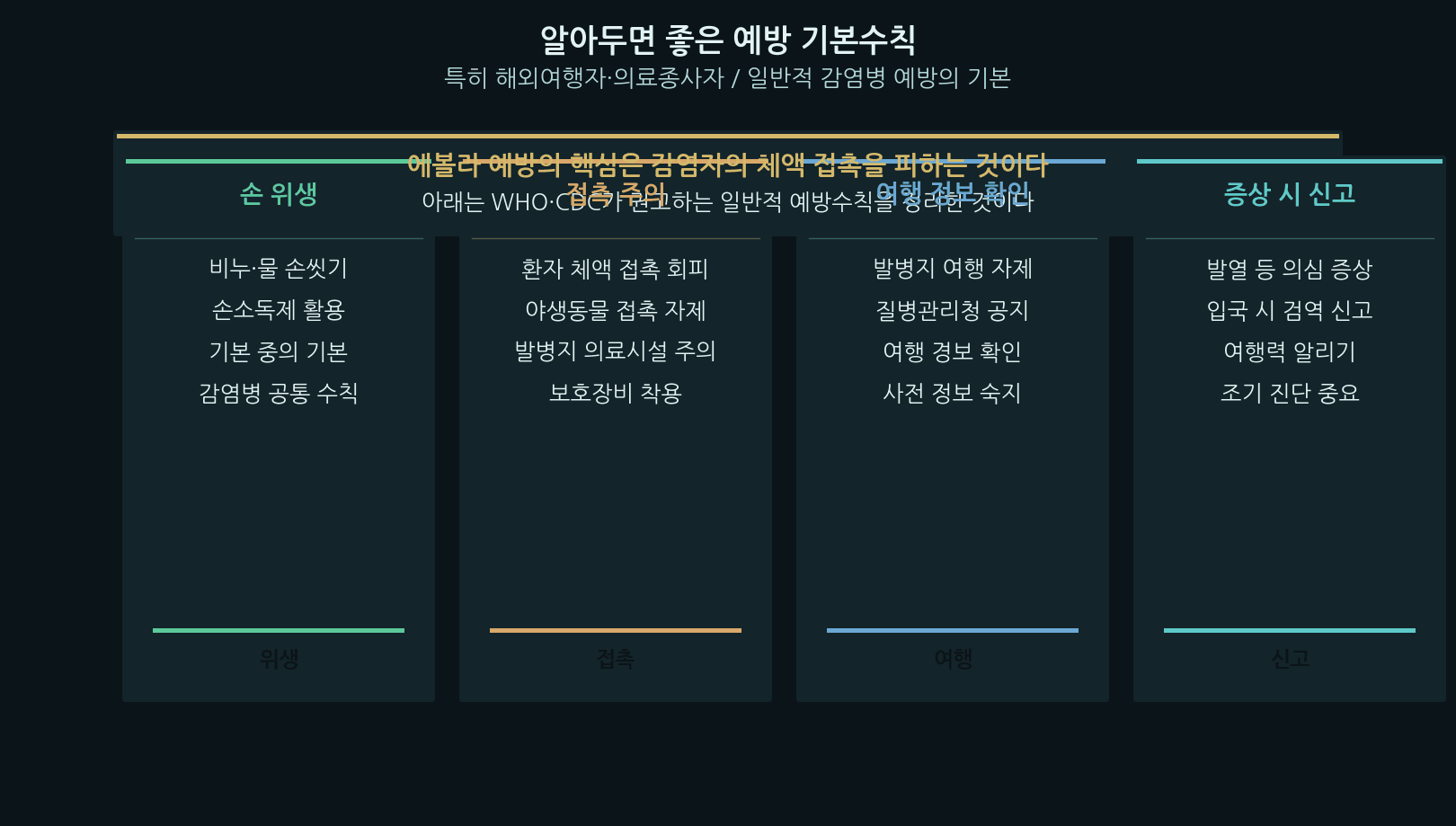
| Rule | Detail |
|---|---|
| Hand hygiene | Wash hands often with soap and water |
| Contact caution | Avoid patient fluids and wild-animal contact |
| Travel info | Defer travel to outbreak regions; check advisories |
| Symptoms | Declare at entry quarantine; share travel history |
Congo Ebola outbreak — five key points
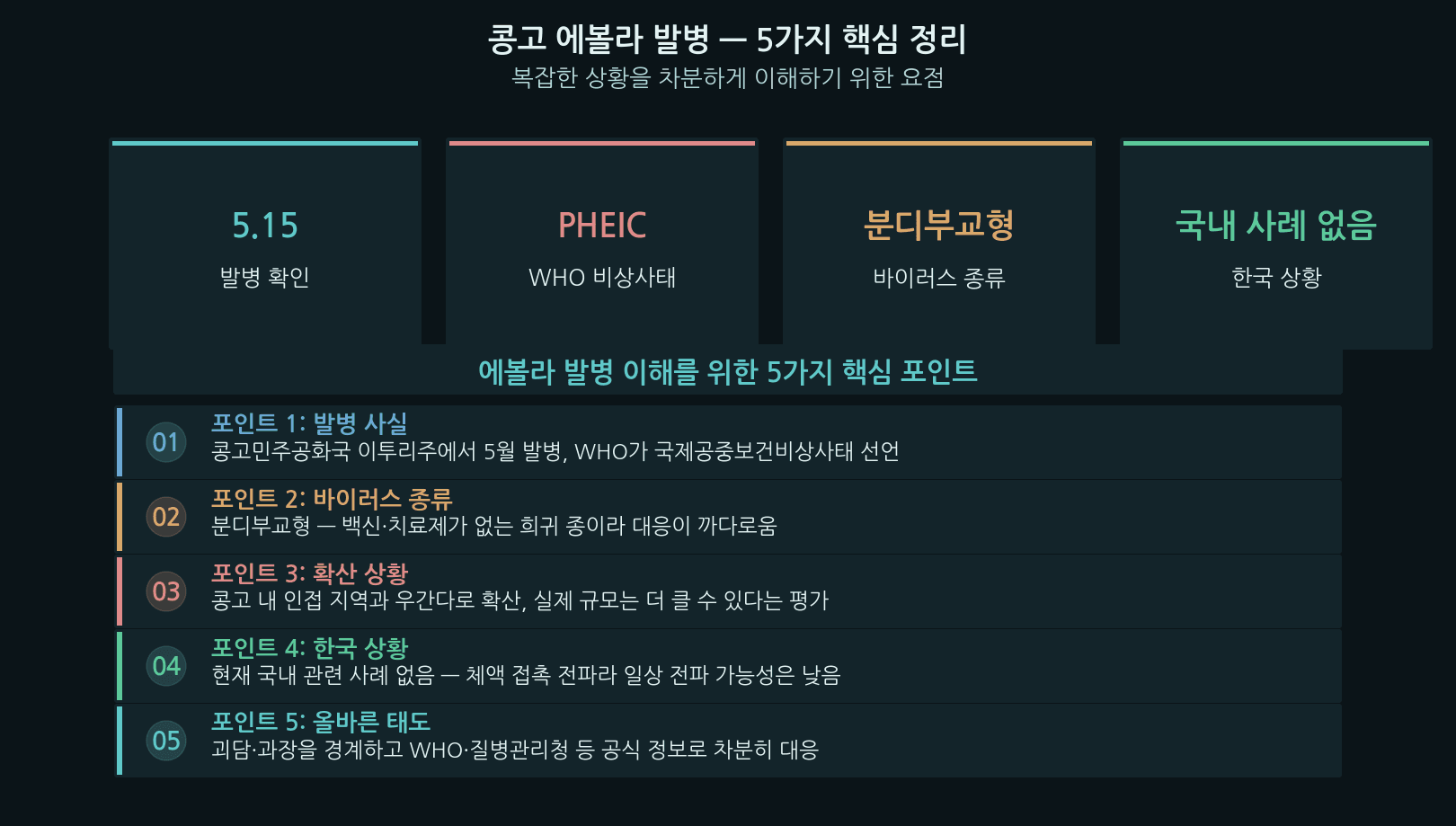
| Point | Detail |
|---|---|
| 1. Outbreak fact | DRC Ituri Province; WHO PHEIC declared |
| 2. Virus | Bundibugyo — no approved vaccine or treatment |
| 3. Spread | To neighboring provinces and Uganda; true scale may be larger |
| 4. Korea | No domestic cases; fluid contact — low everyday transmission |
| 5. Posture | Guard against rumor; trust WHO/KDCA for facts |
□ Virus — Bundibugyo strain; no approved vaccine or treatment
□ Spread — neighboring provinces and Uganda; true scale may exceed reports
□ Transmission — direct fluid contact (not easily airborne)
□ Korea — currently no related domestic cases; risk low
□ Posture — guard against rumor; verify with WHO and KDCA
□ Travel — defer trips to outbreak regions; declare symptoms at entry
Sources
- WHO — Ebola disease caused by Bundibugyo virus, DRC (Disease Outbreak News, May 2026)
- WHO — PHEIC declaration (May 17, 2026)
- US CDC — Ebola Disease: Current Situation (May 23, 2026)
- Europe ECDC — Ebola virus disease outbreak in DRC and Uganda (May 2026)
- UN News — DRC Ebola outbreak: hundreds of suspected cases (May 19, 2026)
- CNN / BBC — DRC Ebola outbreak coverage (May 2026)
This article is for informational purposes based on official health-agency reporting (WHO, CDC, etc.) and does not substitute for medical diagnosis or treatment. Outbreak situations change rapidly; verify the latest with WHO, KDCA, or your local health agency.