Iran MOU close — Brent path, sector winners and losers, and a 5-step playbook for Korean investors
Trending · 2026.05.26
Iran MOU close to signing — after Trump’s ‘largely negotiated’ announcement, how the 60-day ceasefire and free Hormuz passage will move US equities and KOSPI, plus winners and losers, breakdown risks, and a 5-strategy investing playbook.

On May 23, 2026, President Trump announced on Truth Social that an agreement between the United States and Iran had been “largely negotiated.” Around the same time, Axios reported that the two countries were on the verge of an Iran MOU built around a 60-day ceasefire extension and toll-free reopening of the Strait of Hormuz.
If this Iran MOU is signed, the Hormuz blockade unwinds and global crude supply gradually normalizes. That, in turn, creates an inflection point across the entire oil-inflation-rates path and produces a significant ripple effect on both the US stock market and KOSPI. This column lays out the key terms of the MOU, oil scenarios, sector winners and losers, breakdown risk, the Korean market impact, and a 5-strategy playbook.
01. Iran Negotiation Timeline — From War to MOU
The Iran negotiation is a case study in how a military conflict that began with the US-Israeli strikes on February 28, 2026, came within reach of a diplomatic deal in roughly three months. After Iran’s blockade of the Strait of Hormuz on March 2 effectively paralyzed global crude supply, both sides started looking for an exit.
Pakistan brokered a temporary two-week ceasefire on April 8. It briefly collapsed on April 13 after a US naval blockade, then re-entered the final stage on May 22 with Trump’s “largely negotiated” remark. Iran’s foreign ministry has also acknowledged the Phase 1 MOU.
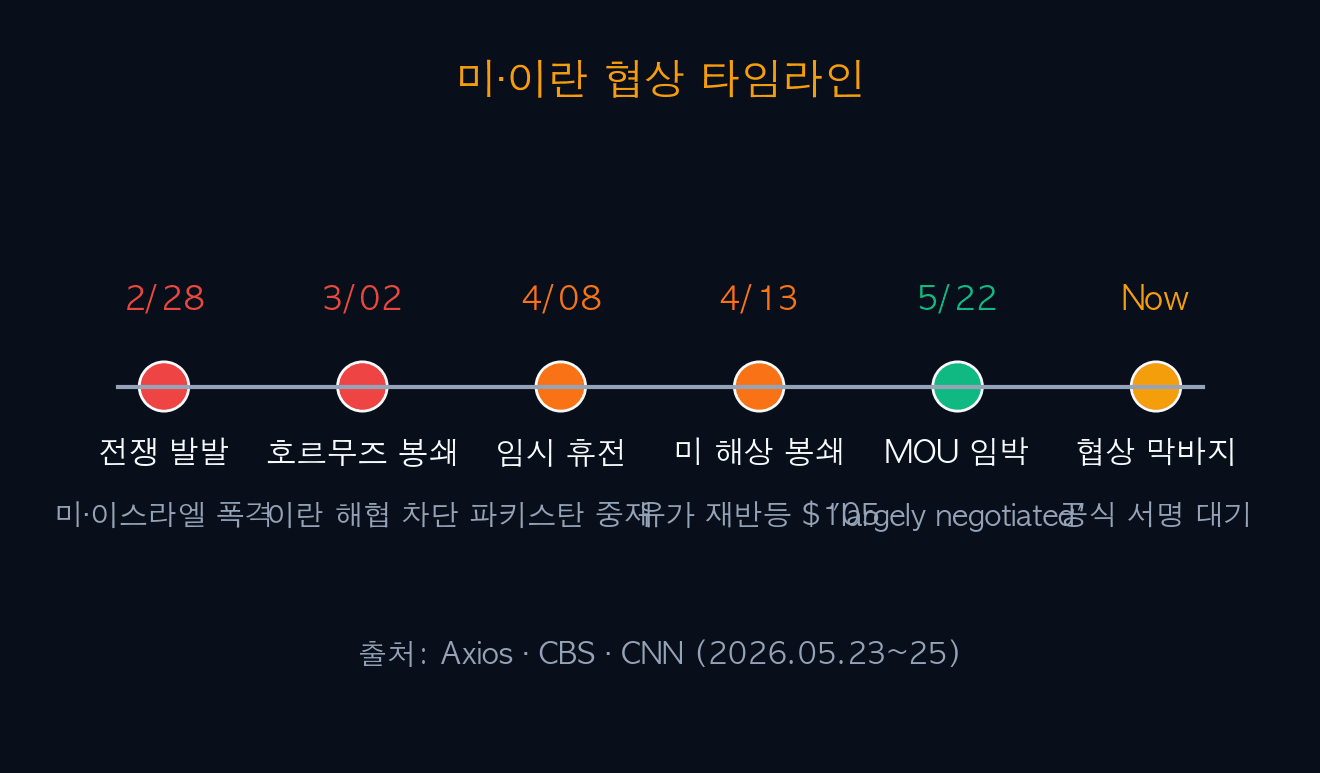
| Date | Event | Brent | Negotiation status |
|---|---|---|---|
| 2/28 | US-Israel strikes on Iran | $72 → $120 | War breaks out |
| 3/02 | Iran blockades Hormuz | $120 held | Blockade tightens |
| 4/08 | Temporary 2-week ceasefire | $120 → $95 | Pakistan mediation |
| 4/13 | US naval blockade | $95 → $105 | Clashes resume |
| 5/22 | Trump: ‘MOU close’ | $105 → $100 | Final stretch |
| Now | Awaiting official signing | — | 60-day MOU pending |
About 20% of the world’s crude oil and 20% of LNG passes through the Strait. Since the blockade, only IRGC-approved vessels have transited (roughly 33 ships per 24 hours). When the MOU takes effect, the corridor reopens in phases — but Barclays estimates it takes at least 4 months for inventories to fully normalize.
02. The Iran MOU Agreement — What’s Inside
The framework of the Iran MOU reported by Axios on May 23, citing multiple US officials, is simple — Iran restores normal passage through Hormuz and halts uranium enrichment in exchange for the US lifting its port blockade and waiving certain sanctions.
The MOU is valid for 60 days and can be extended by mutual agreement. According to Iran’s foreign ministry, the nuclear talks will follow as a second phase within 30 to 60 days. The US side, however, has been clear that if Iran does not engage seriously in the nuclear track, the agreement could collapse even before the 60-day window expires.

| Party | Gives | Receives |
|---|---|---|
| Iran | Free Hormuz transit, mine clearing | US blockade lifted, partial sanctions relief |
| United States | Lifts port blockade, waives sanctions | Hormuz normalized, nuclear talks engaged |
| Global community | Welcomes supply recovery | Oil stability + inflation cooling |
| Oil producers | Normalized crude trade | Revenue recovery |
| Nuclear track | Iran halts uranium enrichment | Long-term stability path |
The MOU has two tracks: a short-term ceasefire and a long-term nuclear deal. The 60-day ceasefire moves oil prices immediately, while the nuclear talks will define Middle East stability for years. Keep the near-term market reaction and the long-term variable mentally separated.
03. Three Oil Scenarios by Negotiation Outcome
The outcome isn’t binary. Three scenarios coexist: deal signed (45%), extended talks (35%), and breakdown (20%). Brent’s path — and the asset reactions that follow — differ sharply by scenario.
If a deal lands, Brent pulls back to $70-90 and airlines, transports and consumer names rally. If talks drag on, Brent ranges in $95-110 and energy and LNG keep the edge. If talks collapse, Brent rockets to $115-130+ — growth stocks sell off and defense and gold take over leadership.

| Scenario | Brent | Probability | Winners | Losers |
|---|---|---|---|---|
| Deal (bull) | $70-90 | 45% | Airlines, transport, consumer | Energy, refiners |
| Extended talks (base) | $95-110 | 35% | Energy, LNG | Consumer slowdown |
| Breakdown (bear) | $115-130+ | 20% | Defense, gold, inverse | Growth stocks crash |
Even with a full reopening of Hormuz, crude inventories will take at least four months to recover.
Barclays Research (2026.05)
04. Oil → Inflation → Rates → Equities — The 4-Step Path
The mechanism through which the Iran negotiation propagates into US equities works in four sequential steps: Hormuz reopens → Brent pulls back to $70-90 → headline CPI cools → the Fed gains room to cut → risk appetite returns.
On May 20, even partial progress on the talks was enough to crater WTI by 5% and push the Dow to a fresh all-time high of 50,580. Run the chain in reverse and a breakdown would mean Brent above $130, CPI re-accelerating, the Fed weighing a hike, and equities correcting 7%. This mechanism is the real source of next week’s volatility.

| Step | Content | Bull case | Bear case |
|---|---|---|---|
| 1. Hormuz | Reopens / Stays closed | Supply recovers | Supply tightens further |
| 2. Oil | $70-90 / $130+ | Energy costs ease | Costs spike |
| 3. Inflation | CPI cools / re-accelerates | More Fed cut room | Fed hike on the table |
| 4. Equities | Risk-on / Correction | +1.8 to 2.2% | -5 to -7% |
Oil moves don’t show up in headlines alone. They feed into CPI and PCE data with a 1-2 month lag, and that data is precisely the input the Fed uses for rate decisions. The Iran negotiation is therefore directly wired into the June and July FOMC meetings — via oil.
05. If the Deal Lands — Winners vs Losers
When a deal is signed, the market moves with clear asymmetry. Sectors that benefit directly from falling oil rally, while safe havens, energy, and defense lose their premium.
Airlines and transport see the biggest margin lift because fuel is a major cost item. Consumer names get a double boost from cooling inflation and recovering sentiment. Semis and tech regain valuation room as rates stabilize. On the other side, refiners and energy take direct hits from falling crude, and defense loses the geopolitical premium it has been carrying.
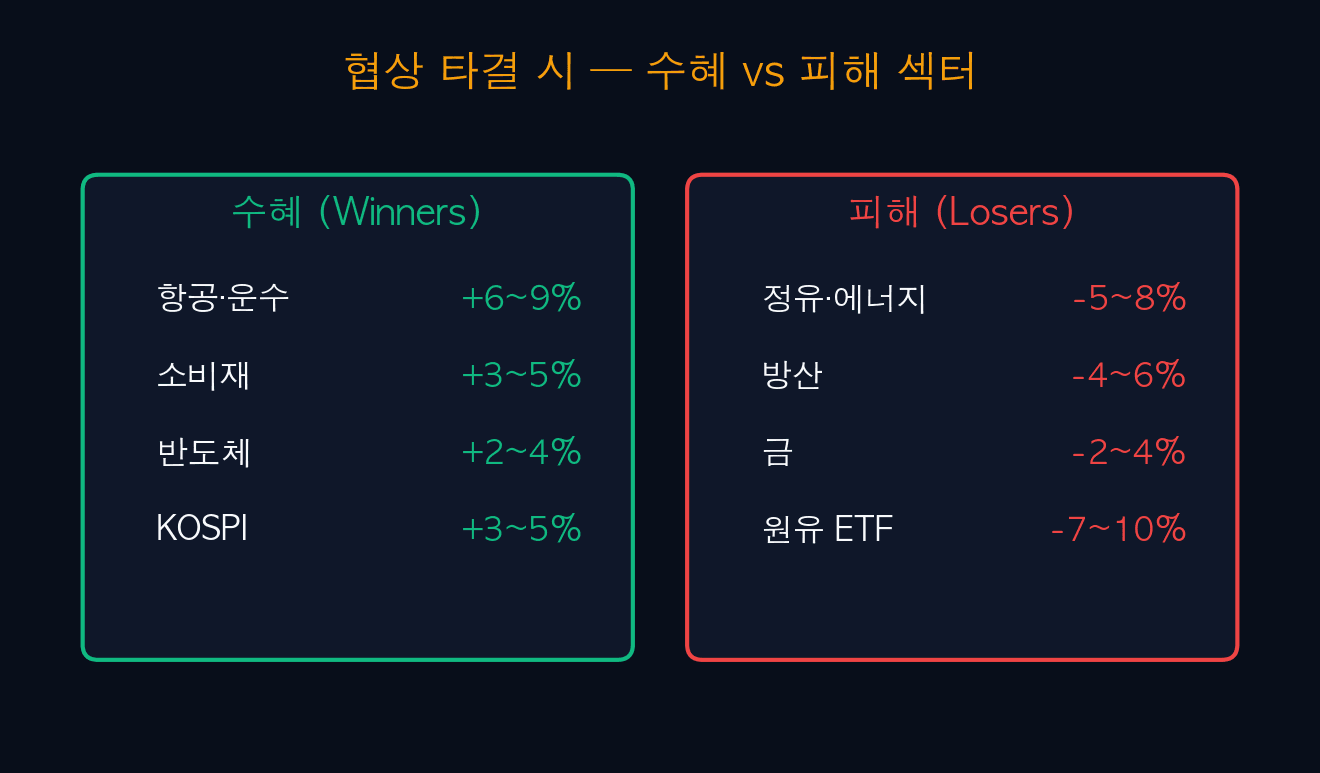
| Sector | Direction | Expected move | Key driver |
|---|---|---|---|
| Airlines & transport | Winner | +6 to +9% | Fuel-cost relief |
| Consumer | Winner | +3 to +5% | Inflation cooling, sentiment up |
| Semiconductors | Winner | +2 to +4% | Rate stability, valuation recovery |
| KOSPI | Winner | +3 to +5% | Foreign inflows + FX stability |
| Refiners / energy | Loser | -5 to -8% | Direct hit from lower crude |
| Defense | Loser | -4 to -6% | Geopolitical premium fades |
| Gold | Loser | -2 to -4% | Safe-haven demand weakens |
| Crude ETFs | Loser | -7 to -10% | Direct oil-price tracking |
In a deal-positive setup, inverse ETFs and ETFs that track crude directly carry a real risk of meaningful losses. Review position sizing before next week opens and lock in clear stop levels.
06. Korean Market Impact — KOSPI, FX, Foreign Flows
Korea is one of the most direct beneficiaries of the Iran negotiation. Its heavy reliance on Dubai crude means that lower oil prices immediately improve the trade balance, and the won/dollar exchange rate also faces downward pressure.
Specifically, every $10 drop in Dubai crude is estimated to improve Korea’s trade balance by roughly $6-7 billion a year. The won/dollar rate, currently in the 1,500 range, could pull back into the 1,440s, and KOSPI — at around 7,270 — could rebound toward 7,700 in a deal scenario.

| Item | Current | If deal lands | Driver |
|---|---|---|---|
| KOSPI | ~7,270 | ~7,700 | Foreign inflows + FX stability |
| USD/KRW | 1,500s | 1,440s | Weaker USD + trade balance |
| Foreign flows | 8 days net-selling | Net-buying flip | Risk-on + KOSPI cheap |
| Dubai crude | $106 | ~$80s | Hormuz reopens |
| Trade balance | Deteriorating | +$6-7B / month | Direct oil effect |
US equities have to travel through the full 4-step path. Korea reacts to just one step — oil. Lower Dubai crude → stronger won → foreign inflows can play out as a domino within a single week.
07. Breakdown Risk — 5 Things to Monitor
The path here is not smooth. The US side has already noted that if Iran doesn’t engage seriously on the nuclear track, the agreement can collapse even within the 60-day window. The breakdown probability is roughly 20%, but the market shock if it happens is large.
Below are the five signals to track. The export of enriched uranium and any new Hormuz transit fee are core issues where neither side is willing to concede.

| # | Risk factor | Current status | Signal to watch |
|---|---|---|---|
| 01 | Export of enriched uranium | Iran refuses | Shift in Iran statements |
| 02 | Hormuz transit fee demand | US refuses | Iranian concession |
| 03 | Iran’s domestic hardliners | Supreme Leader sway | Official statement shifts |
| 04 | Israel acting unilaterally | Military option open | Israeli public remarks |
| 05 | US Congress opposition | GOP hardliners pushing back | Senate / House resolutions |
The asset reaction to a breakdown is fast. Brent above $130, Dow correction of -5 to -7%, and VIX above 25 can all show up within 12-48 hours. Keeping a combined cash/USD/gold position above 30% is the key hedge.
08. Iran MOU Playbook — 5 Investment Strategies
Given the deal (45%) + extended talks (35%) + breakdown (20%) probability distribution, do not make a single bet — work with diversification + scaling + stop levels. The five strategies below treat a deal as the base case while keeping a partial hedge against a breakdown.

| Strategy | Ticker | Code | Stop | Weight | Rationale |
|---|---|---|---|---|---|
| #1 Airlines / travel | Korean Air | 003490 | -8% | 5% | Direct beneficiary of Iran MOU |
| #2 KOSPI ETF | KODEX 200 | 069500 | -7% | 15% | Foreign inflows + FX stability |
| #3 Avoid refiners | S-OIL | — | — | Stand aside | Direct hit from lower oil |
| #4 Defense hedge | Hanwha Aero | 012450 | -10% | 5% | Hedge for breakdown scenario |
| #5 Cash / USD | Cash | — | — | 30%+ | Ammo for the dip |
• STRATEGY 01 Airlines / travel (Korean Air 003490) — Direct beneficiary if the Iran MOU is signed and oil drops 20-30%. Weight 5%, stop -8%.
• STRATEGY 02 KOSPI ETF (KODEX 200 069500) — KOSPI 7,700 retest possible on foreign inflows + FX. Weight 15%, stop -7%.
• STRATEGY 03 Avoid refiners (S-OIL) — Direct hit from lower crude. Stand aside or trim.
• STRATEGY 04 Defense hedge (Hanwha Aero 012450) — Hedge against the 20% breakdown case. Weight 5%, stop -10%.
• STRATEGY 05 Cash / USD — Keep 30%+. Dry powder for quality names if a breakdown pulls the Dow -7%.
□ Track the phased Hormuz reopening (count of IRGC-approved transits)
□ Check daily whether Brent has slipped below $100
□ Monitor the 5 breakdown risks (uranium, transit fee, hardliners, Israel, US Congress)
□ For Korea, watch Dubai crude, USD/KRW, and foreign flows in parallel
□ Scale in — split the position in thirds, three entries, with pre-set stops
References
- Axios — US-Iran 60-day ceasefire MOU close (2026.05.23)
- CBS News — Trump says Iran deal reopening Strait of Hormuz ‘largely negotiated’ (2026.05.23)
- CNN — US and Iran signal progress on peace deal (2026.05.24)
- Yahoo Finance — Potential Iran deal after surging stocks (2026.05.25)
- Barclays Research — Brent crude forecast 2026
- Korea Economic Daily / Newspim — KOSPI foreign flows and FX (2026.05)
- Investing.com — US-Iran ceasefire expectations and equities (2026.05)
This article is for informational purposes only and does not constitute a recommendation to buy or sell any specific security or asset. It is based on public information as of May 26, 2026, and accuracy is not guaranteed as conditions evolve. Market reactions may differ from the scenarios described depending on the outcome of the Iran negotiation. All investing in stocks, ETFs and related products carries the risk of principal loss, and responsibility for any investment outcome rests entirely with the investor.