KOSDAQ jumps 5% on Korea growth fund sellout — KRW 150T policy fund, 12 strategic sectors, and a 5-step playbook
Trending · May 25, 2026 · DIR
A retail-friendly Korean “national growth fund” sold out within 30 minutes — and KOSDAQ jumped 5.17% on May 22. We unpack the 150-trillion-won policy fund’s structure, the four deployment channels, the 12 strategic sectors, beneficiary stocks, and a sober counter-view.
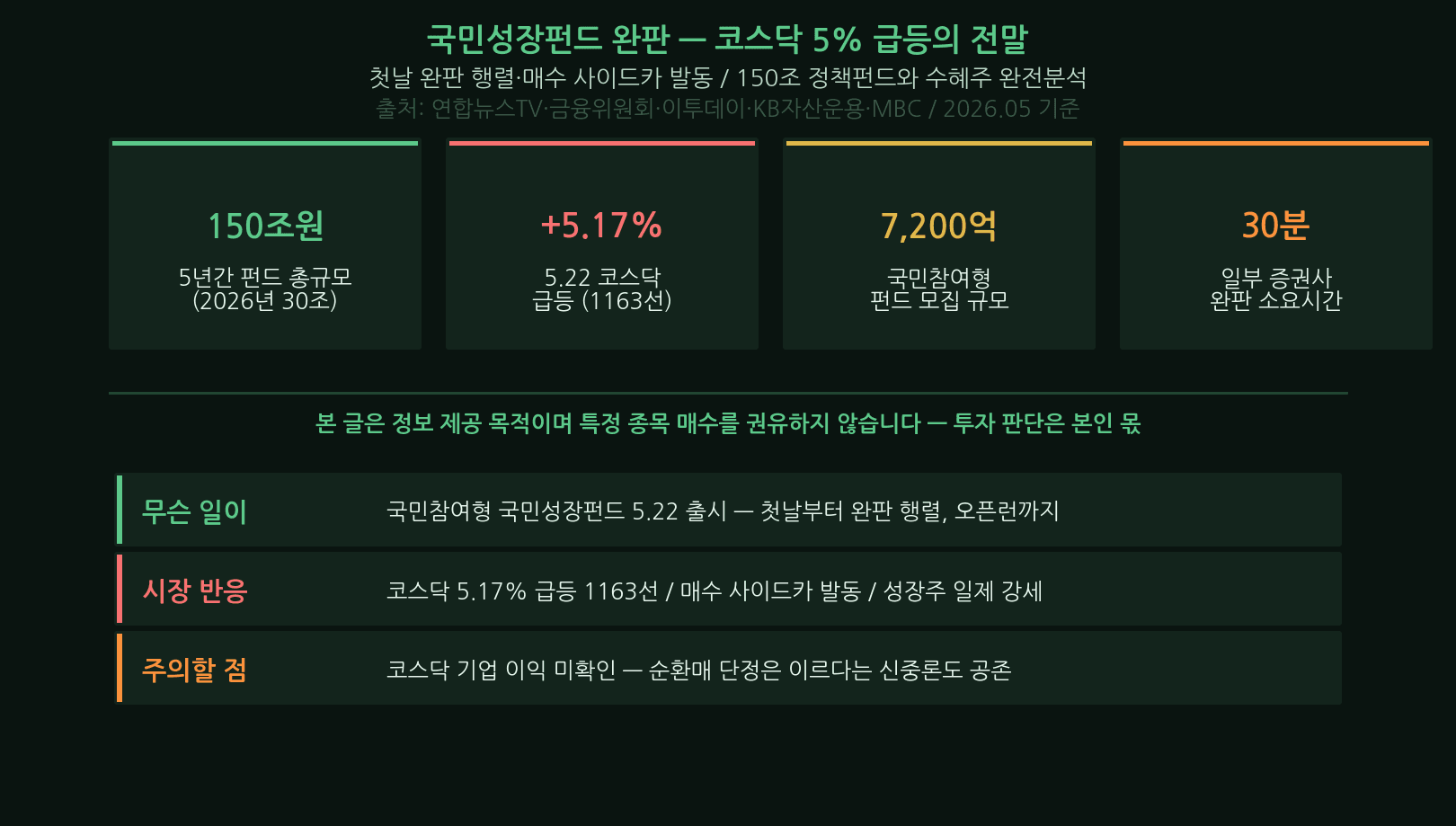
On May 22, 2026, Korean equities delivered a notable move. After months in the shadow of mega-cap chip names, the KOSDAQ jumped 5.17% to close near 1,163 — even tripping the buy-side sidecar early in the session. The trigger: rapid sellouts of Korea’s new “national growth fund.”
The retail-participation tranche of the policy fund drew open-run-style queues, with some brokerages selling out within 30 minutes. This article lays out what the fund is, where the KRW 150 trillion goes, which sectors and stocks rallied, and the cautious counter-view. The official source is the Financial Services Commission release.
What the national growth fund is — KRW 150T policy fund
The protagonist behind the KOSDAQ surge is Korea’s national growth fund — a policy fund the government is assembling to support strategic industries: AI, semiconductors, biotech, and more. The headline scale is KRW 150 trillion over 5 years, with KRW 30 trillion earmarked for 2026 alone.
The structure is “government-led, privately managed.” Within it, a separate retail-participation tranche lets ordinary citizens invest directly. KRW 600 billion is being raised from May 22 to June 11, run as a blind fund through three public-tender managers.
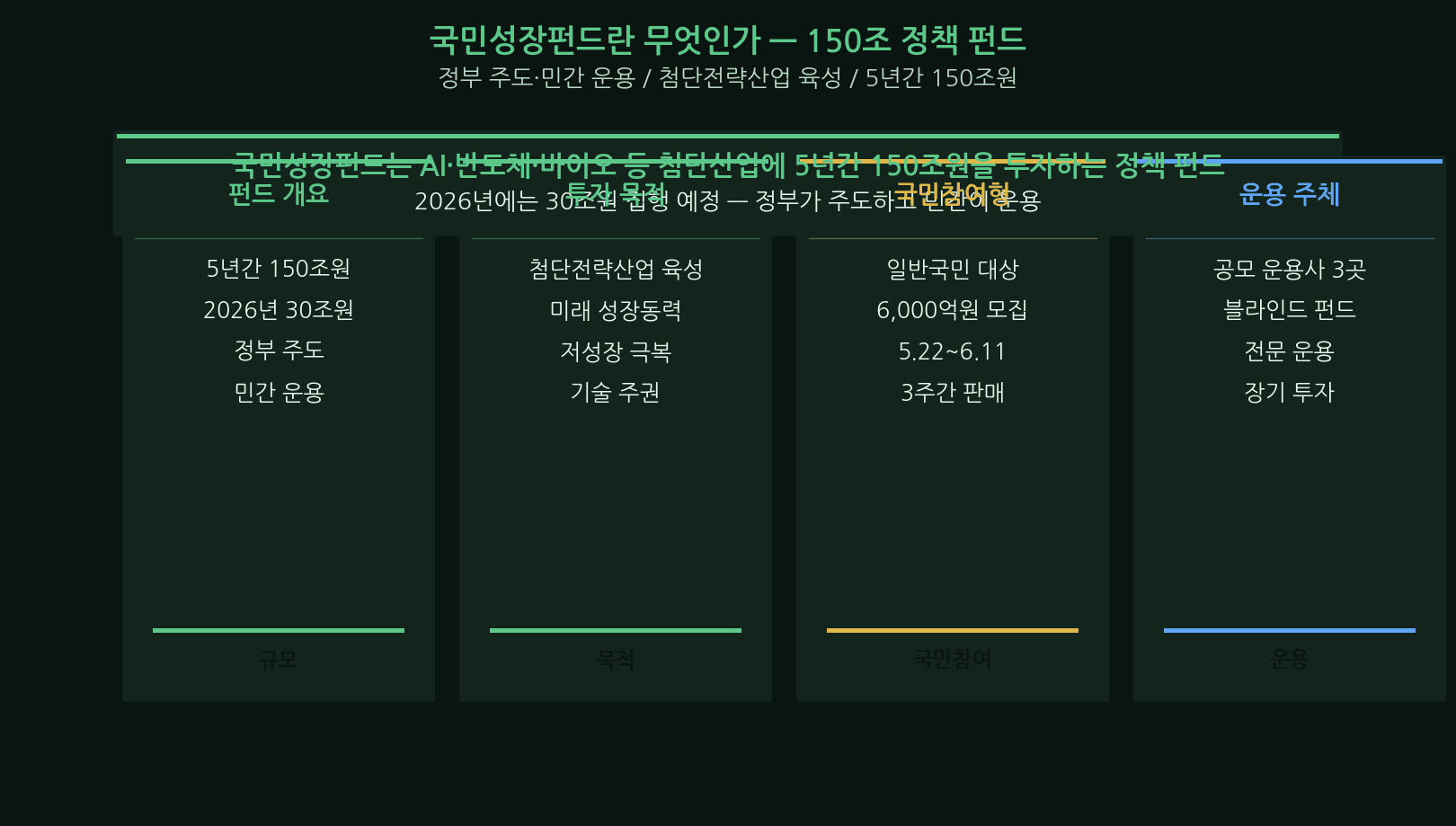
| Item | Detail |
|---|---|
| Total size | KRW 150T over 5 years (2026: 30T) |
| Targets | AI, semis, biotech, strategic sectors |
| Retail tranche | KRW 600B raised May 22 – Jun 11 |
| Managers | 3 public-tender managers, blind fund |
| Nature | Government-led, privately managed |
The national growth fund plans to deploy KRW 150 trillion across the strategic-industry ecosystem over five years.
— FSC release · May 2026
Where the KRW 150T goes — four deployment channels
The KRW 150 trillion flows into strategic industries via four channels, not just buying equities. The intent is to build the entire ecosystem in layers.
First, direct equity — government and policy agencies take stakes in core companies. Second, indirect equity (~KRW 35T) via blind and project funds investing in venture/scale-up firms and regional players. Third, infrastructure financing — AI data centers, power grid, related capex. Fourth, ultra-low-rate loans (~KRW 50T) backing R&D-stretched firms.

| Channel | Detail | Size (est.) |
|---|---|---|
| Direct equity | Policy-agency direct stakes | — |
| Indirect equity | Blind funds / venture investing | ~KRW 35T |
| Infrastructure | AI data centers, power grid | — |
| Ultra-low loans | R&D funding support | ~KRW 50T |
12 strategic industries — where the fund invests (KOSDAQ exposure)
The fund targets 12 strategic industries: semiconductors, secondary batteries, vaccines, displays, hydrogen, mobility, biotech, AI, defense, robotics, content, and critical minerals.
Reported estimates place AI and semiconductors at over KRW 50 trillion — the largest tranche — followed by secondary batteries, biotech, and defense. Many of these sectors are heavily represented on the KOSDAQ, which is why expected inflows lifted broad KOSDAQ sentiment.
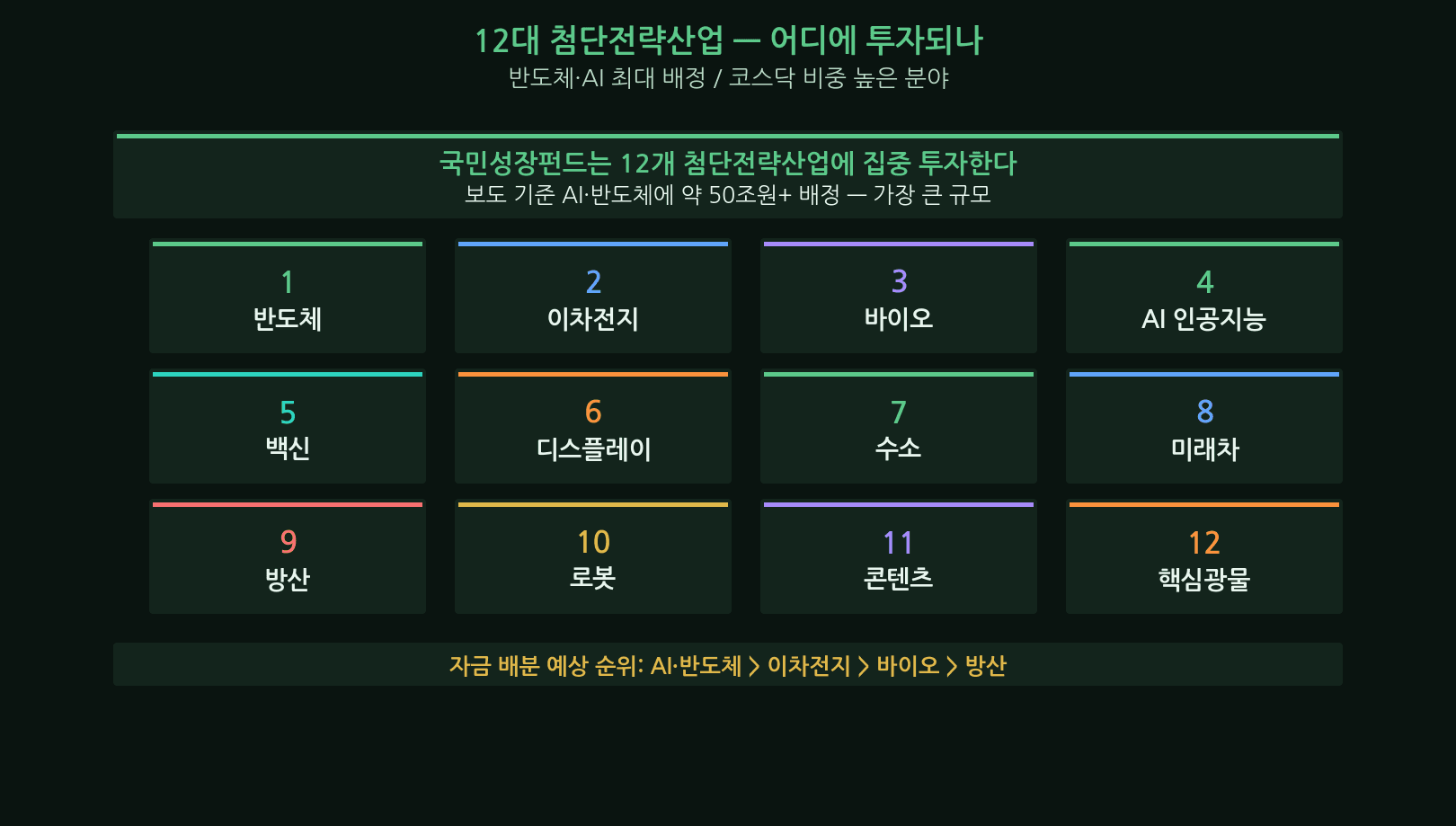
| Group | Industries | Expected allocation |
|---|---|---|
| Top tier | AI, semis | ~KRW 50T+ |
| Priority | Batteries, biotech, defense | Next tier |
| Others | Vaccines, displays, hydrogen, mobility | Allocation varies |
| Newly highlighted | Robotics, content, critical minerals | Separate line items |
KOSDAQ surge — May 22 market reaction
Back to May 22. The KOSDAQ closed +5.17% near 1,163, with a buy-side sidecar tripping intraday. KOSPI, by contrast, barely changed.
The key was the capital rotation. Money that had clustered in mega-cap chips (Samsung Electronics, SK Hynix) shifted into growth names in batteries, biotech, and robotics. Battery leaders Ecopro BM and Ecopro rose more than 11–12%, and chip-equipment maker Jusung Engineering jumped 11.8%. Retail and institutions led the buying; foreigners net-sold roughly KRW 2 trillion on KOSPI to take profits.
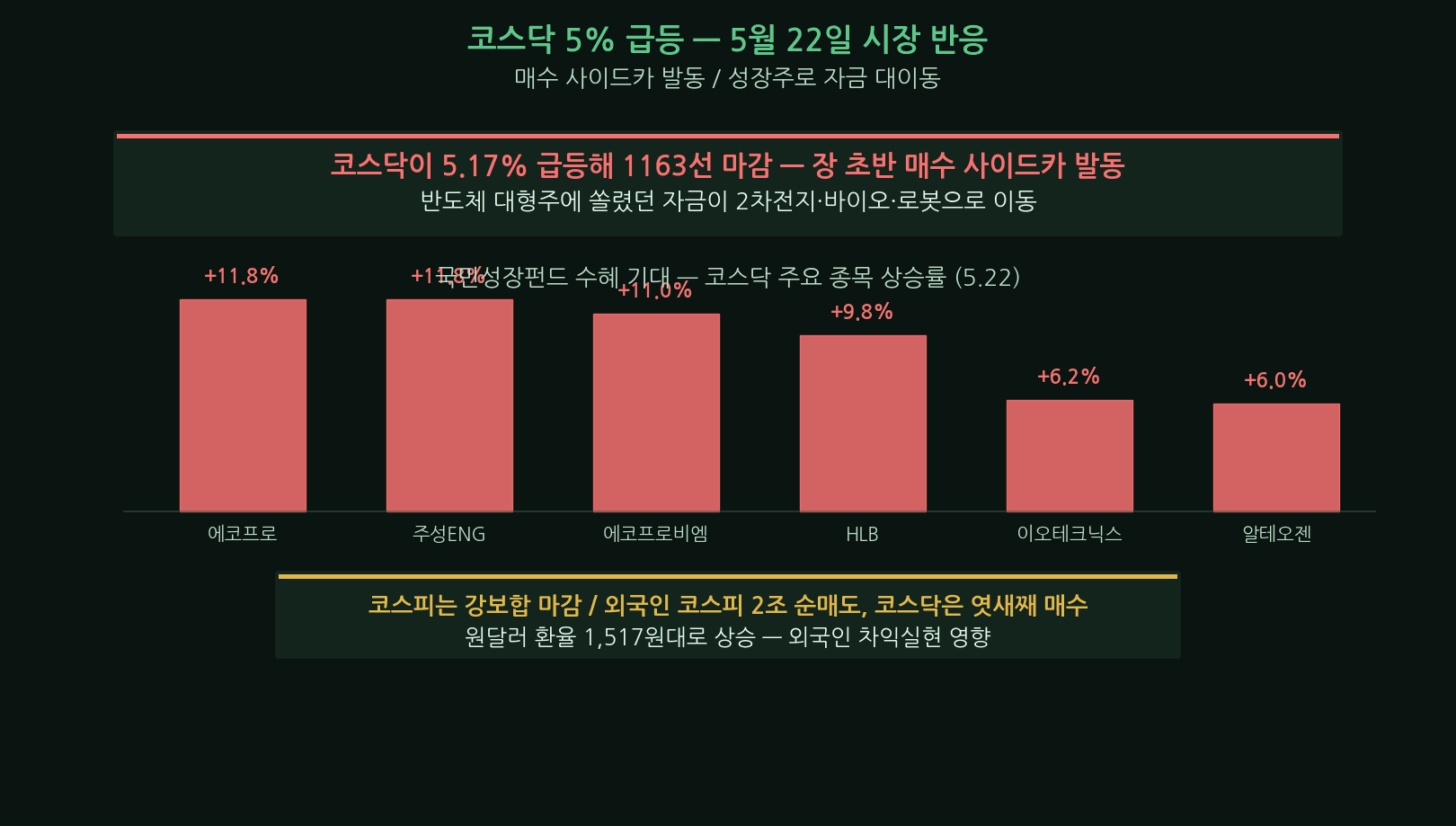
| Stock | 5/22 gain | Sector |
|---|---|---|
| Ecopro | +11.8% | Batteries |
| Jusung Engineering | +11.8% | Chip equipment |
| Ecopro BM | +11.0% | Batteries |
| HLB | +9.8% | Biotech |
With the national growth fund selling out in 30 minutes, expectations of inflows into strategic industries drove an outsized KOSDAQ rally.
— Kang Jin-hyeok, Shinhan Investment · ETtoday · May 22, 2026
Beneficiary sectors — what stood out on the KOSDAQ
Look at the rallying sectors and the common thread is clear: KOSDAQ-heavy strategic growth industries.
In batteries, Ecopro BM and Ecopro led. In bio/pharma, Alteogen, HLB, Samchundang, and Kolon TissueGene saw bursts tied to clinical and pipeline expectations. In chip equipment, Jusung Engineering, EO Technics, and Leeno Industrial drew interest as advanced-process beneficiaries. In robotics, Rainbow Robotics also moved. These are examples of intraday strength — not the fund’s actual holdings, which remain blind.
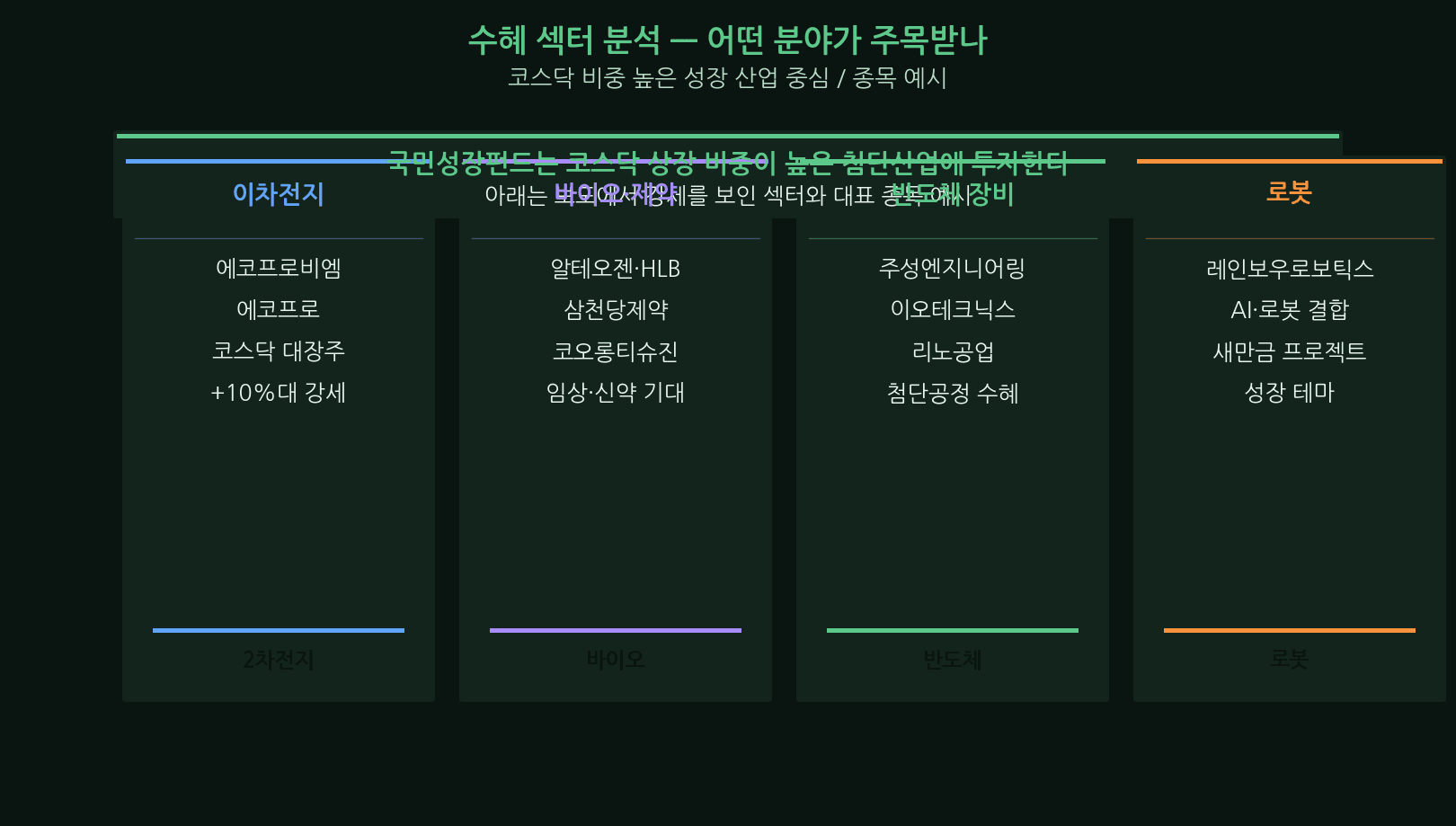
| Sector | Examples | Note |
|---|---|---|
| Batteries | Ecopro BM, Ecopro | KOSDAQ heavyweights |
| Bio / pharma | Alteogen, HLB, Samchundang | Clinical / pipeline plays |
| Chip equipment | Jusung, EO Technics | Advanced-process beneficiaries |
| Robotics | Rainbow Robotics | AI / robotics theme |
Retail tranche — first-loss buffer structure
The retail tranche sold out on day one for a structural reason: a first-loss-absorption (junior buffer) design. Public-funding sits in a junior layer that absorbs losses ahead of retail investors.
Specifically, the KRW 600 billion retail tranche is paired with KRW 120 billion of first-loss public funding, for a total pool of KRW 720 billion. The junior KRW 120 billion absorbs losses first. KRW 220 billion allocated through the top-five domestic banks sold out on day one, and some brokerages cleared online inventory within 10 minutes. Critically, this is not a 100% principal guarantee.
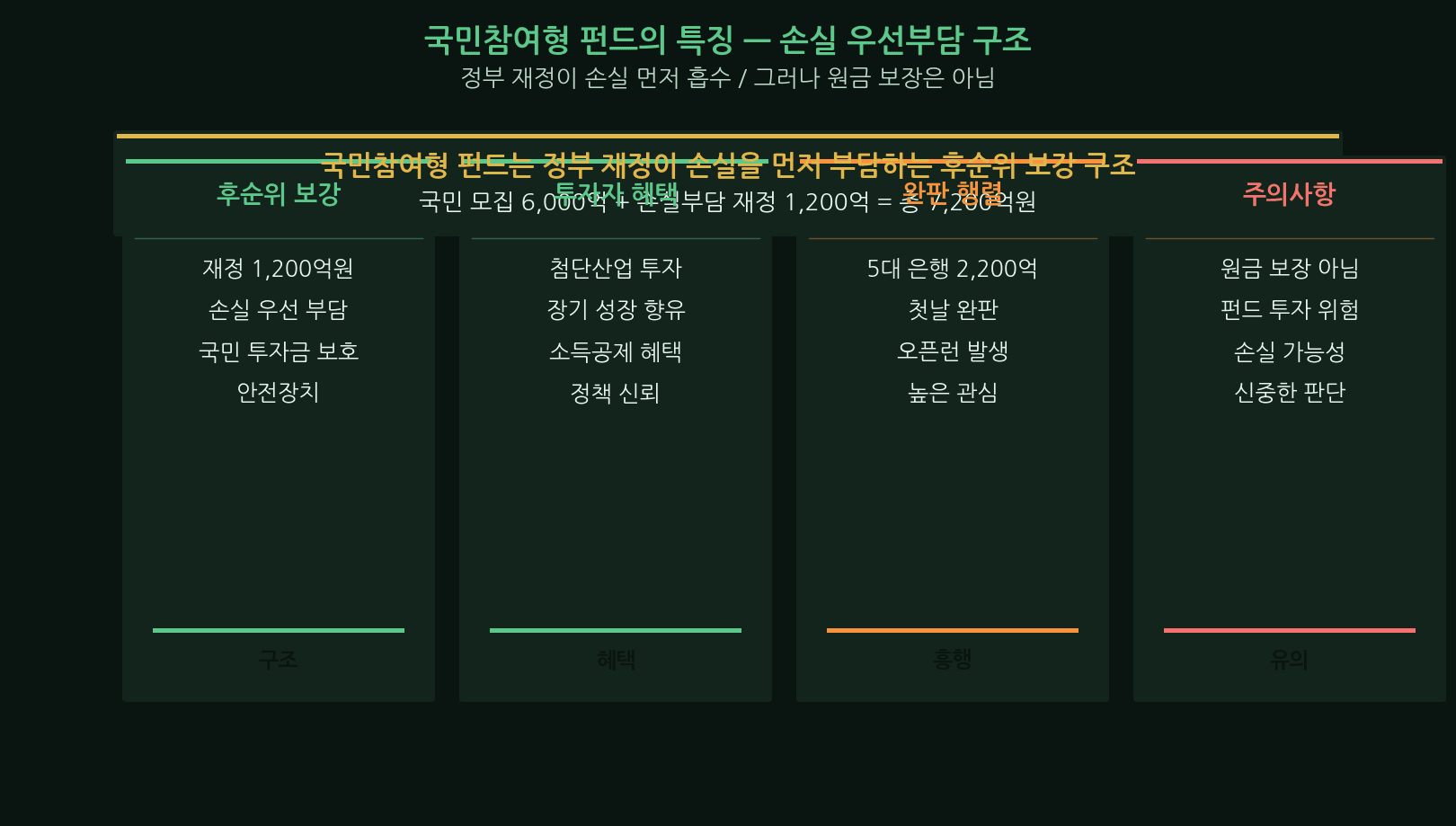
| Item | Detail |
|---|---|
| Retail raise | KRW 600B |
| First-loss public funding | KRW 120B (junior buffer) |
| Total pool | KRW 720B |
| Sellout | 5 banks’ KRW 220B sold out day 1 |
| Caveat | Not principal-guaranteed |
Overheated or opportunity — a balanced view
How should one read the 5% KOSDAQ jump? The market holds both excitement and caution.
On the positive side, KRW 150 trillion of policy capital is heading into long-overlooked KOSDAQ and growth names. Retail and institutional net-buying is a supply/demand signal. On the cautious side, iM Securities argues KOSDAQ earnings have not been stronger than KOSPI’s, so a liquidity-only rotation from KOSPI to KOSDAQ is premature. Liquidity-led moves without earnings backing can be volatile.

| Bullish | Cautious |
|---|---|
| KRW 150T policy capital inflow | KOSDAQ earnings not yet confirmed |
| Re-rating of overlooked KOSDAQ | Too early to declare a rotation |
| Retail / institutional net-buying | Theme overheat, expectations priced |
| Long-term strategic-industry build-out | Foreigners net-sold ~KRW 2T on KOSPI |
KOSDAQ — five moves for Korean investors

| Move | Name | Code | How | Stop | Weight |
|---|---|---|---|---|---|
| 1. Subscribe to fund | Retail tranche | — | By Jun 11; tax benefit eligible | — | Policy |
| 2. Chip equipment | Jusung Engineering | 036930 | Scale in on pullbacks | -10% | 8% |
| 3. KOSDAQ ETF | KODEX KOSDAQ150 | 229200 | Diversified theme exposure | -8% | 15% |
| 4. No chasing | Wait for earnings | — | Act after fundamentals clarify | — | Watch |
| 5. Keep cash | Cash buffer | — | Manage volatility | — | 30%+ |
□ First-loss buffer — not a principal guarantee
□ 12 strategic industries — AI and semis at KRW 50T+
□ KOSDAQ +5.17% — batteries, biotech, robotics led
□ Separate “theme expectation” from “actual fund allocation”
□ KOSDAQ earnings not yet stronger than KOSPI — early to call rotation
□ No chasing; scale in; use stops; keep 30%+ cash
Sources
- Yonhap News TV — “National growth fund sells out, KOSDAQ jumps 5%” (May 22, 2026)
- FSC — Retail-participation national growth fund sales plan release (May 2026)
- ETtoday — “KOSDAQ +5% on national growth fund sellout” (May 22, 2026)
- MBC — “Overlooked KOSDAQ rallies as growth fund sells out” (May 22, 2026)
- KB Asset Management — Explainer on the KRW 150T policy fund
- YTN / Seoul Shinmun — Related coverage (May 2026)
This article is for informational purposes only and does not recommend any specific security or fund. Names mentioned reflect intraday strength on May 22 and may differ from the fund’s actual investments. The retail tranche is not principal-guaranteed and can lose value. Investors bear sole responsibility for their decisions.