What Is the Yellow Envelope Act? From Samsung Strike 100T KRW Crisis to Resolution — Background, 3 Provisions, Debate & Impact
Real-Time Issue · May 21, 2026
What Is the Yellow Envelope Act? From Origins to Samsung’s 100T KRW Crisis — Background, 3 Key Provisions, Debate & Economic Impact
The dramatic resolution of the Samsung Electronics strike in 2026 thrust the Yellow Envelope Act — Korea’s amended Trade Union and Labor Relations Adjustment Act — back into the national spotlight. Google Trends interest hit a perfect score of 100. Here is everything you need to know: origins, key provisions, the pro-and-con debate, and the law’s real economic weight.

1. The Essentials — What Is the Yellow Envelope Act?

The Yellow Envelope Act is the popular name for an amendment to Korea’s Trade Union and Labor Relations Adjustment Act (TULRAA). Its three pillars are: (1) restricting employers’ ability to seek damages from striking workers, (2) expanding the legal definition of legitimate industrial action to cover indirectly employed and subcontracted workers, and (3) broadening the legal definition of “employer” to include prime contractors with real supervisory power.
In May 2026, Google Trends interest in the term “노란봉투법” reached an index of 100 — the maximum measurable level. The trigger: the All Samsung Electronics Labor Union (ASELU), representing roughly 50,000 workers, launched a large-scale strike over wages and performance-bonus formulas. The strike threatened partial shutdown of Samsung’s semiconductor fabs at Hwaseong, Giheung, and Pyeongtaek — and the Yellow Envelope Act set the legal parameters for every move both sides made. The eventual dramatic settlement made the law front-page news.
2. Origins — From a Yellow Envelope to a Law

The law’s name traces back to 2009. During the SsangYong Motors strike, the company pursued sweeping damage claims against workers and their families, totaling roughly 4.7 billion KRW (approximately USD 3.5 million). Many workers lost their homes; the prolonged financial pressure was linked to a tragic wave of suicides among former strikers and their relatives.
A spontaneous citizen fundraising campaign emerged. Supporters sent cash donations inside yellow envelopes — a gesture of solidarity that spread nationwide. The yellow envelope became a symbol of resistance against the weaponization of civil lawsuits against labor. Fourteen years later, in 2023, the symbol gave its name to a law.
- 2009 — SsangYong Motors strike; company files 4.7B KRW in damage claims against workers
- 2010–2022 — Yellow Envelope solidarity campaign; repeated legislative attempts, all blocked
- 2023 — Bill passes the National Assembly, driven by the opposition Democratic Party
- 2024 — Presidential veto, subsequent political compromise; revised bill promulgated and enacted
- 2026 — First large-scale application: Samsung Electronics ASELU strike and settlement
3. Three Key Provisions — What the Law Actually Changes
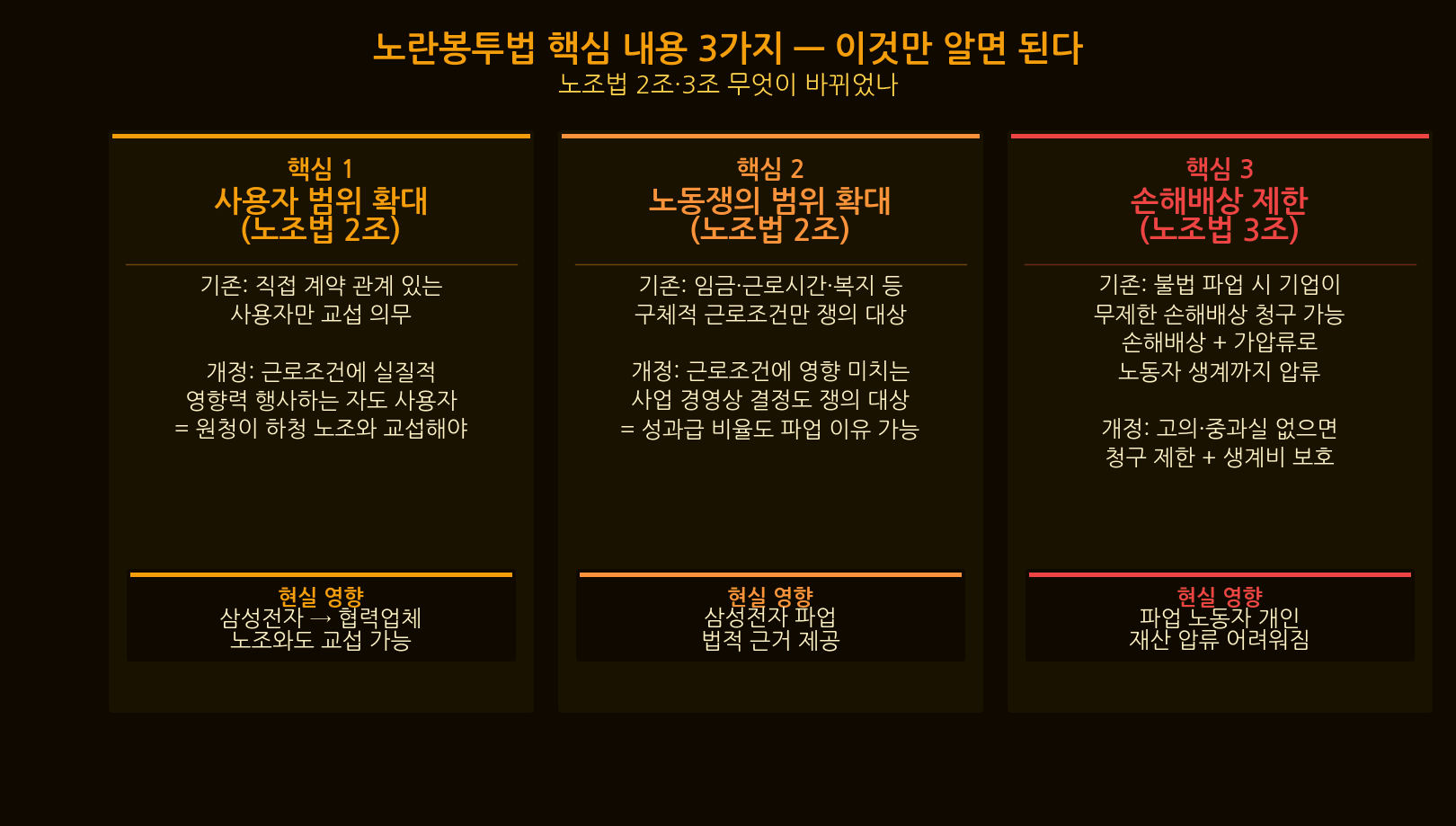
- Restricting Damage Claims: Under the previous TULRAA, employers could seek full compensation from individual workers for all economic losses caused by a strike. The amendment limits such claims to cases where workers acted with deliberate intent or gross negligence. This raises the evidentiary bar dramatically, effectively ending the practice of using multi-billion-won lawsuits as a tool to deter or break strikes.
- Expanding the Scope of Lawful Industrial Action: The old law recognized strikes only among directly employed workers. The amendment extends legal protection to workers in indirect employment, subcontracting, and special-employment arrangements — including delivery drivers, platform gig workers, dispatched workers, and contract-based service employees. This cohort represents more than 30% of Korea’s total workforce, a group previously without meaningful strike rights.
- Broadening the Definition of “Employer”: The amendment redefines “employer” to include any entity that exercises real supervisory and directional authority over workers, regardless of formal contract. In practice, large prime contractors like Samsung Electronics or Hyundai Motor are now potential collective bargaining counterparts for the subcontracted workers they effectively control. This provision drew the fiercest opposition from the business community.
4. The Samsung Electronics Connection

In early 2026, the All Samsung Electronics Labor Union (ASELU) announced an indefinite strike, demanding higher wages and a more transparent performance-bonus formula. With approximately 50,000 union members, the potential production disruption at Samsung’s semiconductor campuses was enormous — threatening output of HBM4 and DDR5 memory chips at a time of intense global AI infrastructure demand.
The Yellow Envelope Act reshaped the negotiating landscape in two decisive ways. First, Samsung’s ability to recoup strike-related losses through individual damage claims was sharply curtailed, removing its most potent deterrent against prolonged action. Second, subcontracted workers at Samsung facilities gained a clearer legal basis to demand direct negotiation with Samsung itself, not just their immediate employer. With both sides facing a less favorable legal environment for escalation, the structural incentive shifted toward settlement — which is precisely what happened. The strike concluded with a negotiated agreement on May 18, 2026.
5. The 100 Trillion KRW Risk — Where Does the Number Come From?

The headline figure of a 100 trillion KRW (approximately USD 74 billion) potential loss requires context. The calculation behind it runs as follows: Samsung’s semiconductor division contributes an estimated ~1 trillion KRW per day in revenue-equivalent output. A full, unmitigated strike lasting 100 days would, in theory, yield ~100 trillion KRW in foregone production value.
In practice, the figure is a worst-case ceiling, not a base case. Several modifying factors apply:
- Essential-worker provisions kept critical fabs running at reduced capacity throughout the dispute; a complete production halt was never realized.
- The figure includes indirect global ripple effects: supply-chain disruption to Nvidia, AMD, and Apple as major customers of Samsung HBM and NAND; downward pressure on Korean exports; and won-currency depreciation risk.
- There is also a market-share risk factor: every week of uncertainty creates an opening for TSMC, SK Hynix, and Micron to capture long-term design wins. The 100T number is less about direct losses and more about the compound strategic cost of prolonged disruption to a company that supplies the backbone of global AI hardware.
6. The Debate — Pro and Con
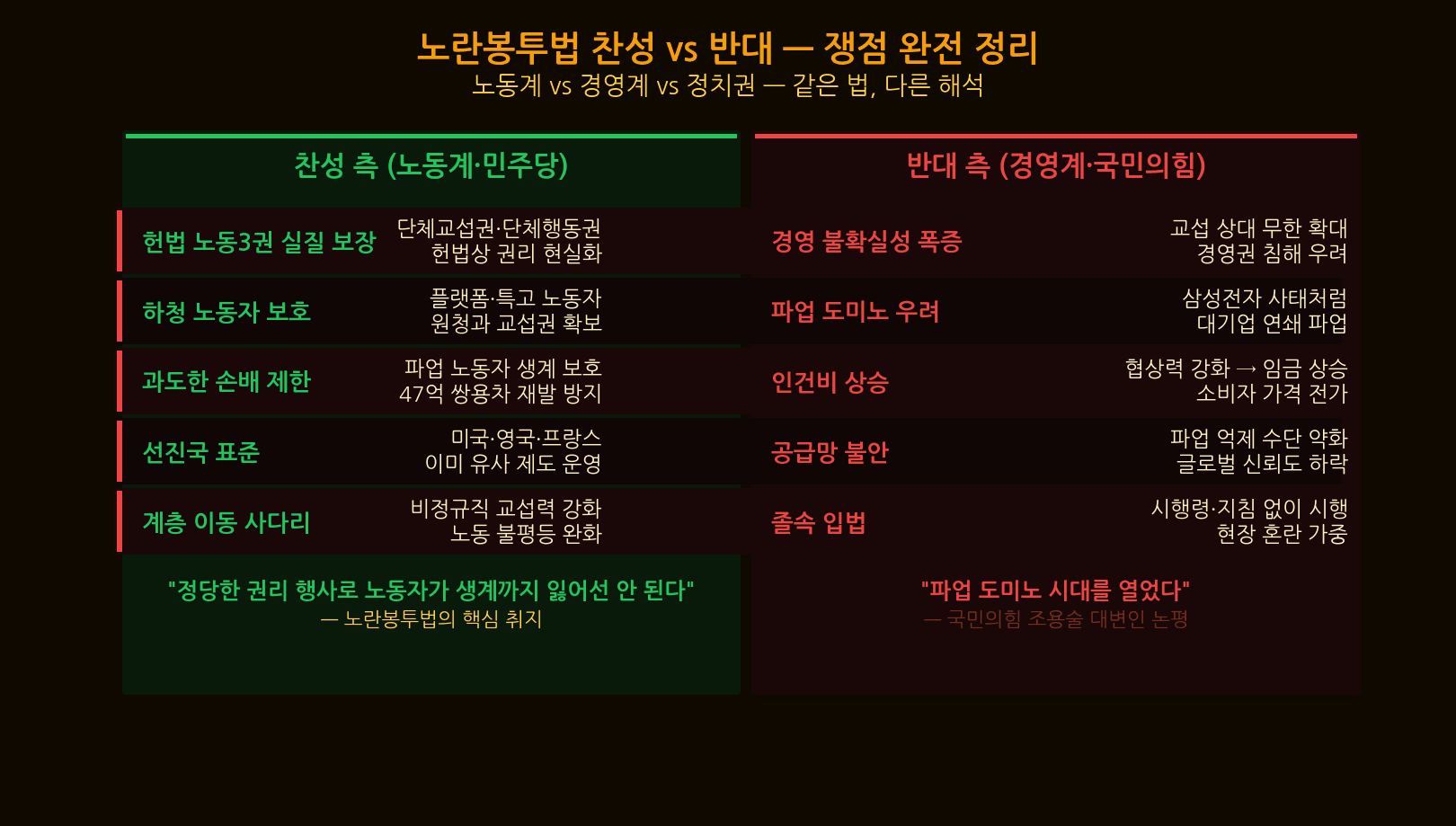
The Yellow Envelope Act divides opinion along lines that go deeper than partisan politics — touching fundamental questions about the balance between labor rights, property rights, and economic efficiency.
Arguments in Favor
- Protecting the constitutional right to strike: Korea’s constitution guarantees workers’ three fundamental rights — to organize, to bargain collectively, and to take collective action. Multi-billion-won damage suits against individuals exercising a constitutional right amount to a de facto nullification of that right.
- Bringing the invisible workforce inside the law: More than 30% of Korean workers are in indirect or atypical employment. Leaving them outside labor law’s protective framework creates a two-tier system that suppresses wages and working conditions across the entire economy.
- Ending the weaponization of civil liability: Documented cases in which employers used damage claims not to recover genuine losses but to financially destroy unions and deter future organizing are a matter of public record. The amendment addresses a specific, well-evidenced abuse.
Arguments Against
- Risk of de facto impunity for illegal strikes: Critics argue that the “gross negligence” standard is so demanding in practice that it effectively immunizes all but the most egregious strike-related destruction from civil liability, creating a moral hazard for violent or destructive industrial action.
- Threat to managerial authority: Requiring prime contractors to bargain with the workforce of thousands of independent subcontractors injects radical uncertainty into corporate governance and supply-chain management, potentially deterring capital investment and hiring.
- Foreign direct investment chilling effect: Several multinational corporations and investor groups have flagged Korea’s evolving labor risk profile. Reports of postponed FDI decisions have surfaced, and some analysts project a measurable decline in inbound FDI over the medium term as investors reprice Korean manufacturing risk.
7. Global Comparison — How Do Other Countries Handle This?

- Germany — Social Partnership (Sozialpartnerschaft): The German model mandates worker representation on supervisory boards of large corporations (Mitbestimmung). Strike rights are robustly protected; damage claims against strikers are vanishingly rare. Indirect workers are integrated into collective bargaining frameworks by statute. Germany’s model is the one most frequently cited by Korean proponents of the Yellow Envelope Act.
- France — Constitutional Strike Right: France enshrines the right to strike directly in its constitution. Civil liability for strike action is limited to cases involving deliberate violence or property destruction. France is sometimes cited by opponents as a cautionary example of how strong strike protections can co-exist with chronic industrial unrest.
- United States — NLRA (National Labor Relations Act, 1935): The NLRA protects the right to strike but permits substantial damage liability for unlawful strikes — including secondary boycotts and sit-down actions. On many dimensions, U.S. labor law is actually less protective of workers than Korea’s post-amendment framework.
- Korea’s Trajectory: Before the amendment, Korea ranked among the OECD countries most permissive of employer damage claims against strikers. The Yellow Envelope Act moves Korea meaningfully toward the German-French end of the spectrum. The short-run friction is real, but cross-national research suggests that institutionally balanced labor relations are associated with higher long-run productivity.
8. Timeline — From SsangYong 2009 to Samsung 2026

- May 2009 — SsangYong Motors restructuring strike, 77-day factory occupation. Company subsequently files 4.7B KRW in damage claims.
- 2014 — Yellow Envelope solidarity campaign formally launched by civic groups to support affected workers and families.
- 2019–2022 — Multiple legislative attempts in the National Assembly, all defeated or stalled by the ruling conservative coalition.
- September 2023 — Bill passes the National Assembly under opposition leadership. President exercises the right to demand reconsideration (veto).
- Early 2024 — Political compromise reached; revised bill promulgated. Law enters force.
- January–May 2026 — ASELU (~50,000 members) strikes at Samsung Electronics. Semiconductor fab output at Hwaseong, Giheung, and Pyeongtaek partially disrupted. Yellow Envelope Act frames the legal contest.
- May 18, 2026 — Dramatic settlement reached. Samsung and ASELU agree on wage increases and a revised performance-bonus calculation methodology.
9. Conclusion — 5 Things Every Citizen and Investor Should Know
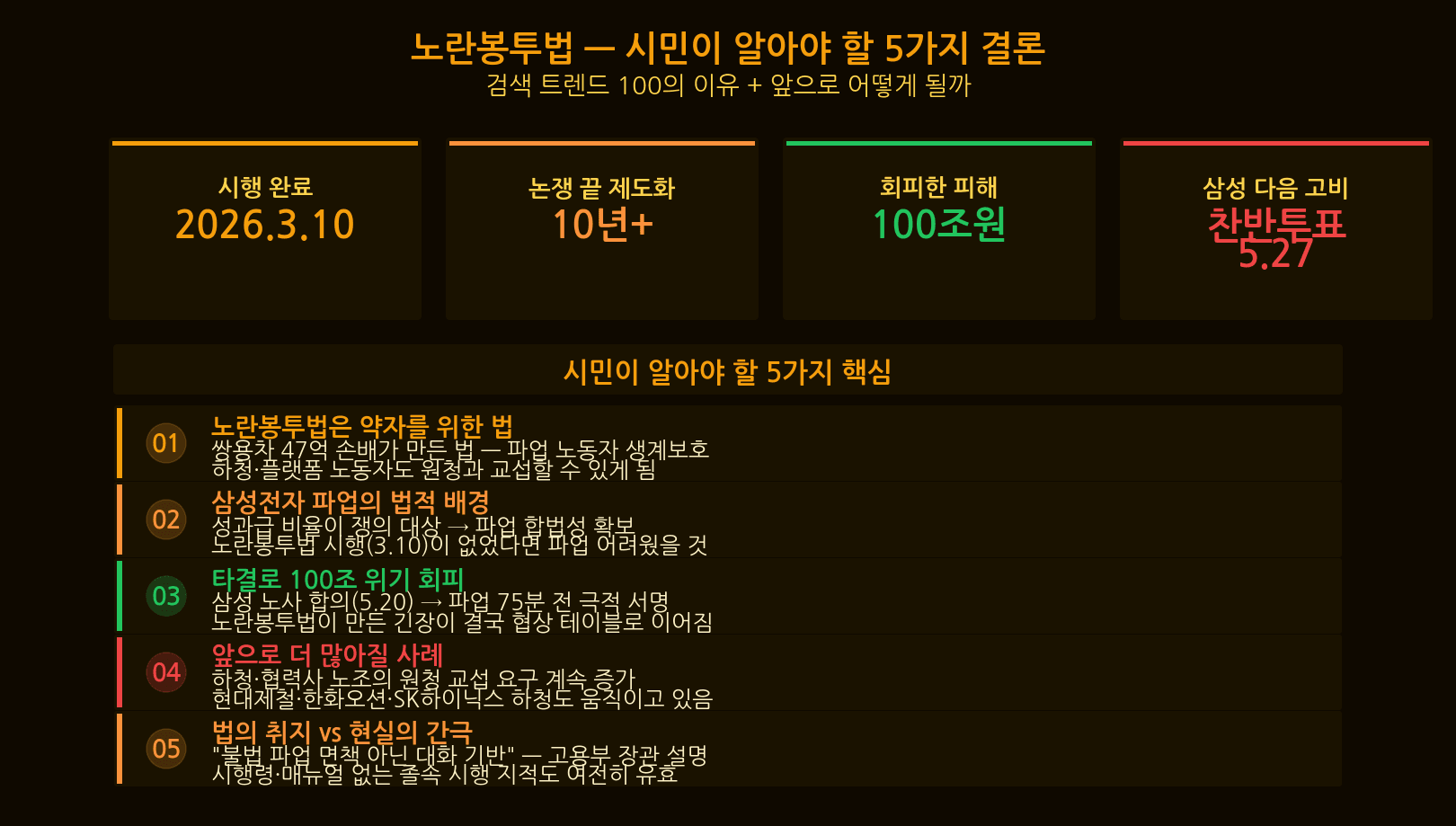
- The law is in force — and it has teeth. This is not a bill under debate or a law suspended by the courts. It is active legislation, and the 2026 Samsung settlement is its first large-scale proof of concept. Every future major labor dispute in Korea will play out under its framework.
- It restricts damage claims; it does not eliminate them. Deliberate or grossly negligent damage remains actionable. The battleground shifts to defining those standards through litigation and precedent — watch the courts over the next several years.
- Equity investors in Korean manufacturing must reprice labor risk. For shareholders in Samsung Electronics, Hyundai Motor, LG Energy Solution, and other large manufacturers, the law has durably altered the strike probability distribution and the balance of bargaining power. Risk models that predate 2024 are outdated.
- Platform and gig workers are the next organizing frontier. Legal recognition of indirect workers’ right to strike and bargain is a structural invitation for organizing across Korea’s delivery, logistics, and IT-services sectors. Expect heightened labor activity in these industries through the late 2020s.
- Long-term, Korea may be converging toward a more stable labor equilibrium. Cross-national evidence consistently shows that economies with institutionally balanced labor relations — where workers have real but bounded power — achieve higher sustainable productivity than those characterized by either pure employer dominance or unchecked union power. The Yellow Envelope Act is a painful but potentially necessary step in that direction.
📌 Want more real-time issue coverage?
All Real-Time Issues →
This content was produced in accordance with getdir.app’s publishing guidelines. Editorial Standards