SpaceX IPO Complete Guide — SPCX Lists on Nasdaq June 12
Real-Time Issue · May 22, 2026
SpaceX IPO Complete Guide — SPCX Lists on Nasdaq June 12
Record $75B Raise · $2T Valuation · How Korean Investors Can Participate · 6 Key Risks

![[비비PICK] 리에티 LUNO RT 4056 선글라스](https://img1a.coupangcdn.com/image/affiliate/banner/8f965ee3220144b9189234e8256f5677@2x.jpg)
S-1 Filing — SpaceX’s Financials Revealed for the First Time
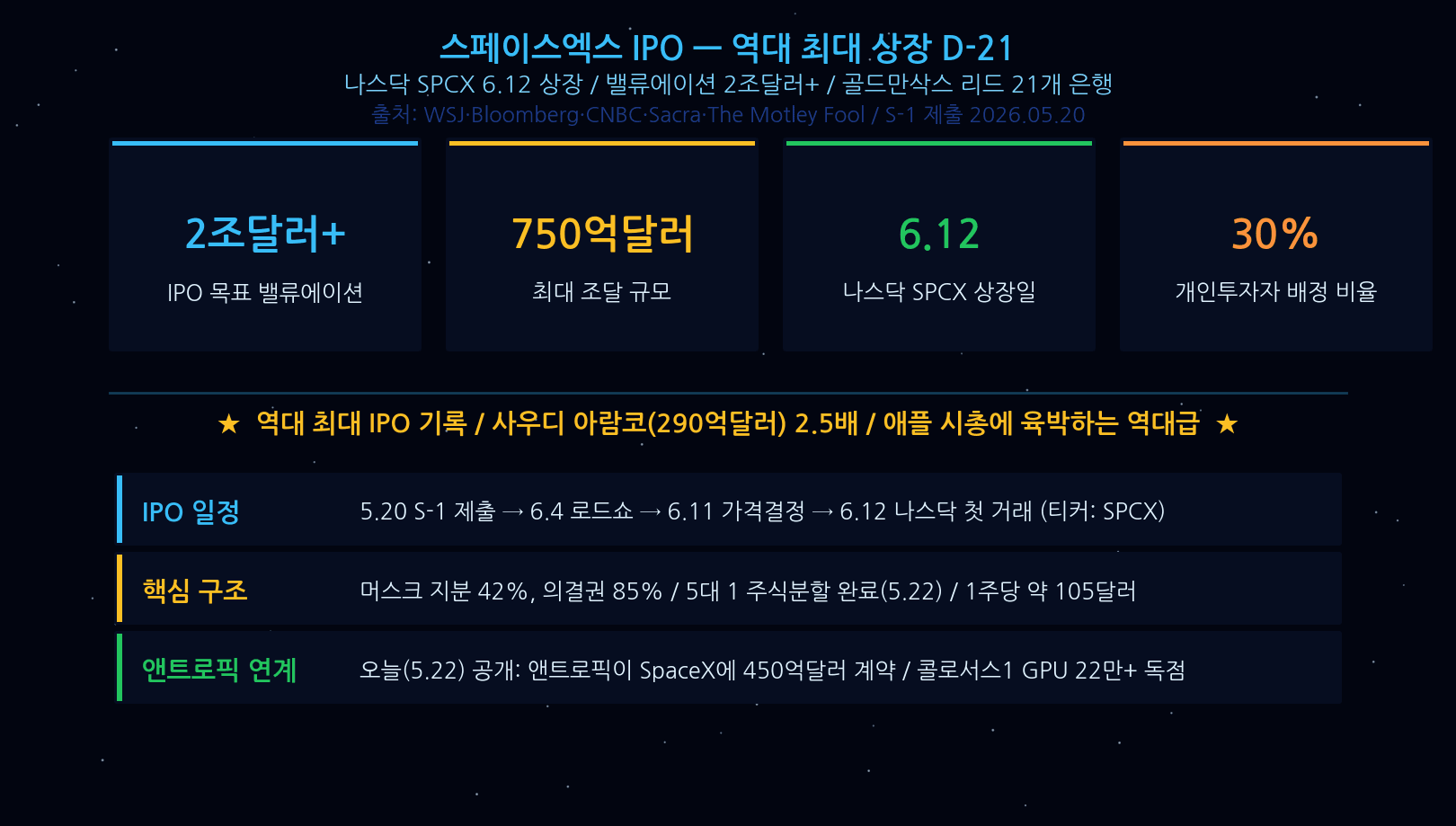
SpaceX will list on Nasdaq as ticker SPCX on June 12, 2026. Target valuation: up to $2T (~₩2,800T). Target raise: $75B — 2.6x Saudi Aramco’s previous record of $29B. The 685-page S-1 filed May 20 reveals: 2025 total revenue of $18.7B, with Starlink contributing $11.4B (61%) at a 63% EBITDA margin. GAAP net loss of $4.94B due to xAI merger costs. Today also saw disclosure of the $45B Anthropic-SpaceX computing contract.
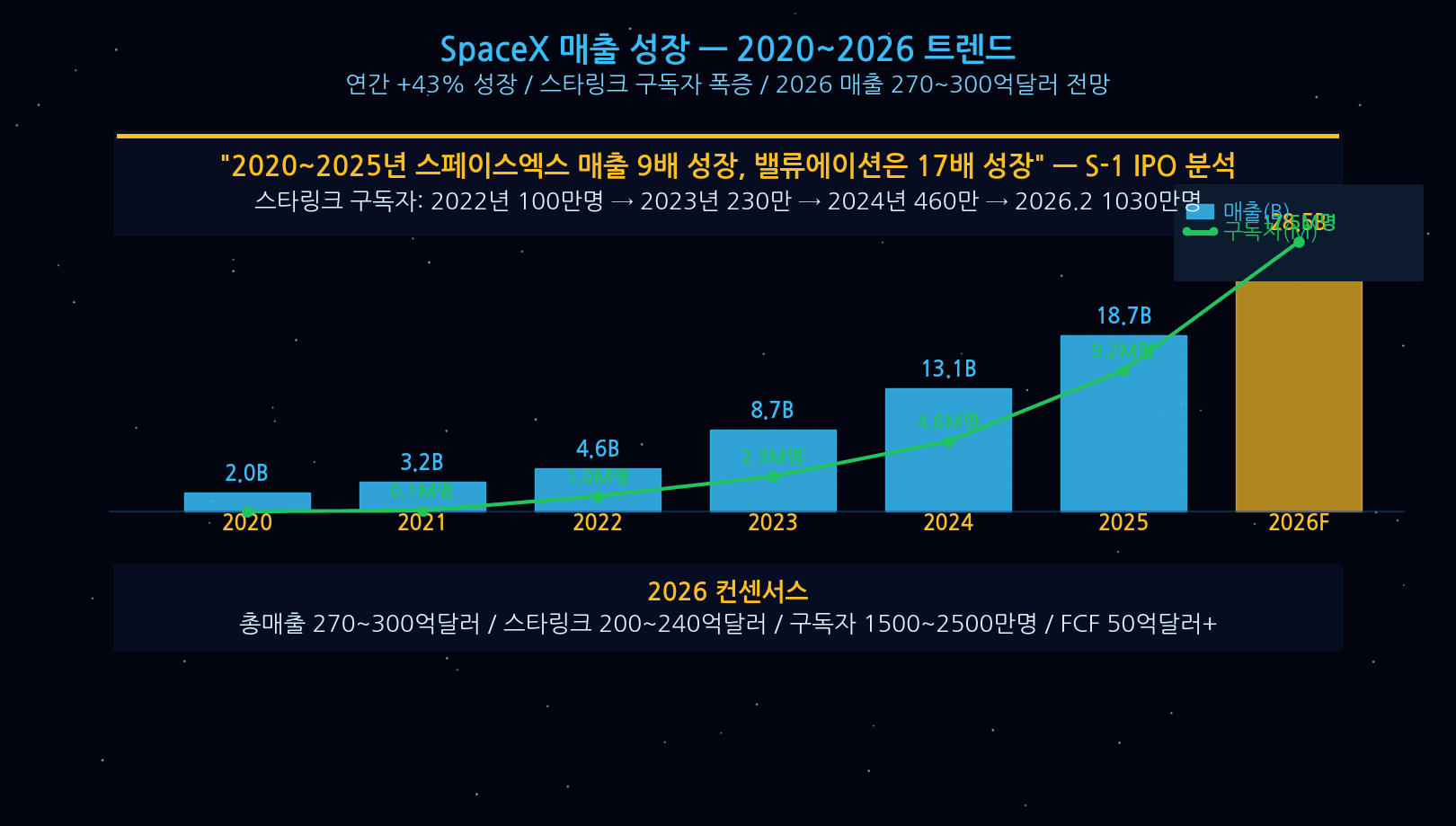
Revenue Growth Trajectory — 2020 to 2026
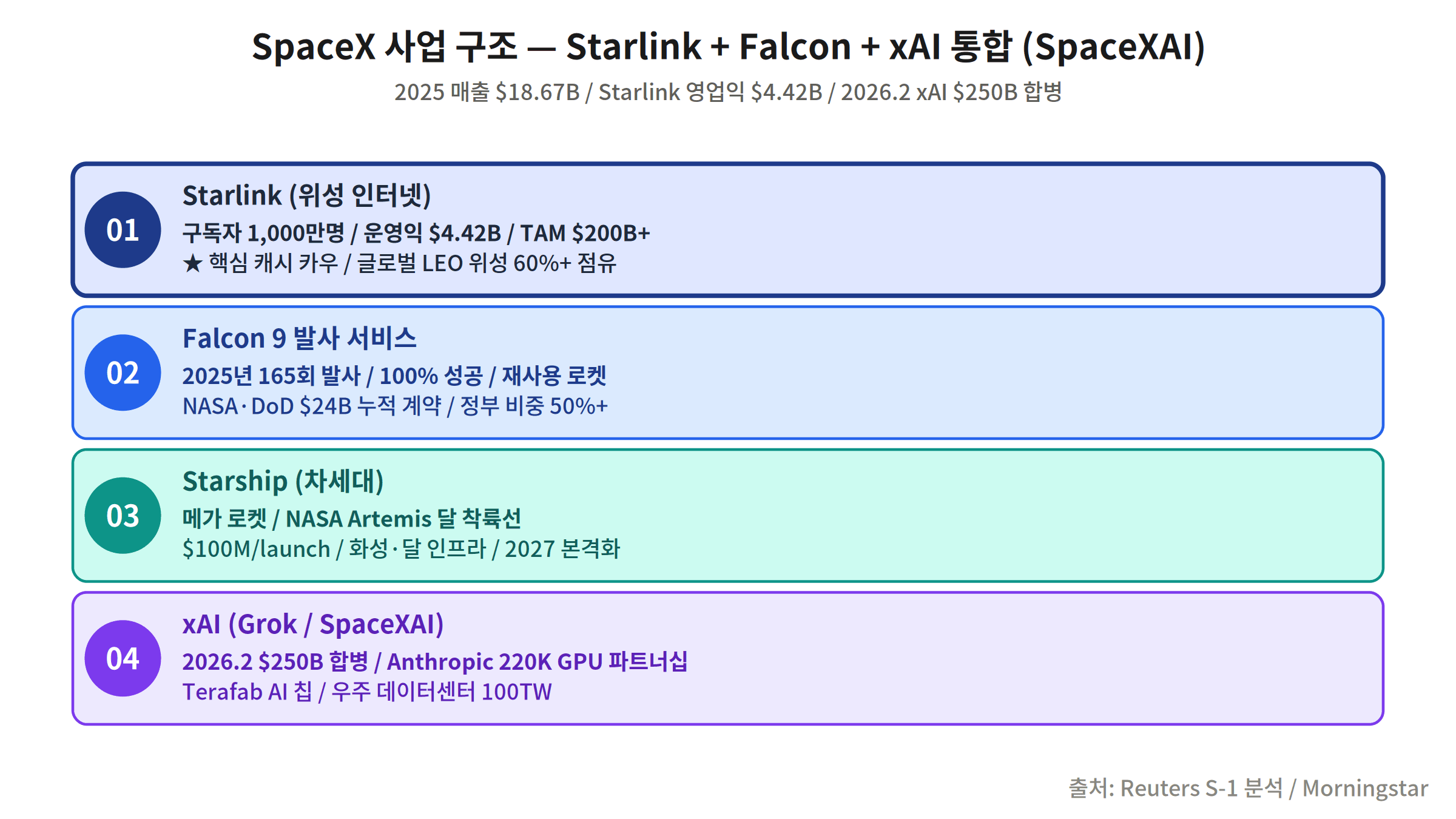
SpaceX is three completely different businesses: Starlink (63% EBITDA margin, cash engine), the Launch business (slow growth), and xAI/AI (burning $2.5B/quarter). Revenue trajectory: 2020 $2B → 2022 $4.6B → 2024 $13.1B → 2025 $18.7B (+43%) → 2026F $27–30B. Starlink subscribers: 1M (2022) → 9.2M (2025) → 15–25M target (2026F). Morgan Stanley’s Adam Jonas: “Starlink alone is worth more than $500B.”
Starlink — The Core Value Driver
Starlink’s 63% EBITDA margin exceeds Google Search (57%). It is satellite monopoly infrastructure — a structural moat comparable to Microsoft’s Windows dominance. Segment breakdown 2025: Consumer $7B, B2B (aviation/maritime) $2B, Direct-to-Cell (new), Defense/Starshield $3.2B. 2026F: B2B $3.5B (aviation 10x growth), D2C $5B+, Defense $4B. The economics: once the satellite is in orbit, marginal cost per subscriber approaches zero. Scale compounds the moat.
Is the $2T Valuation Justified?
EV/EBITDA at 156x (industry: 10–15x), P/S at 113x (industry: 3–5x) — extreme by any measure. The 113x P/S is 3x more expensive than Nvidia at the peak of the AI boom (30x). Starlink alone on a DCF basis is worth $500–800B. The remaining $1T+ must be justified by Starship commercialization optionality. Historically, companies listing at 100x+ P/S almost never sustain that price over 5 years. That is the defining risk.
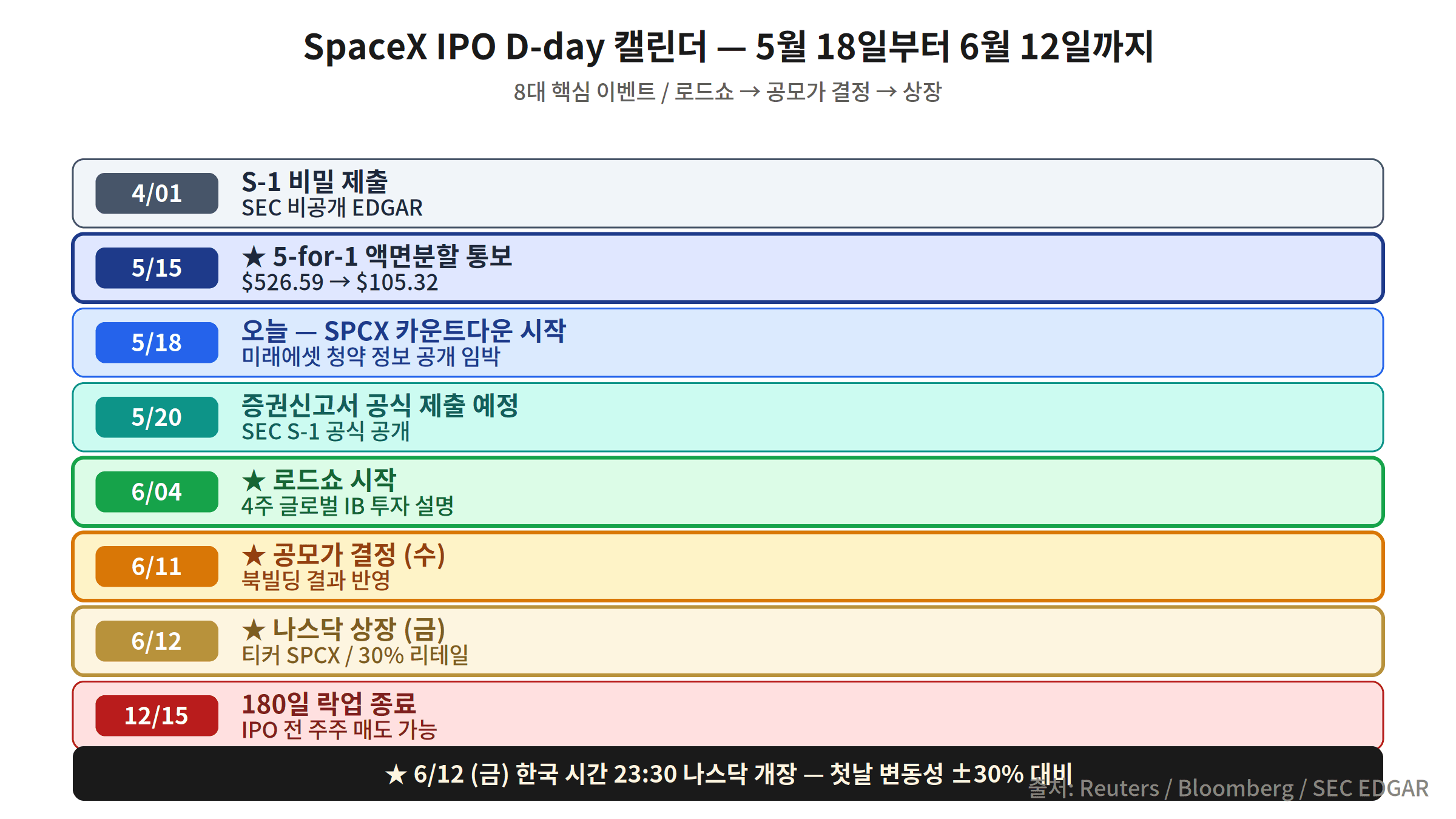
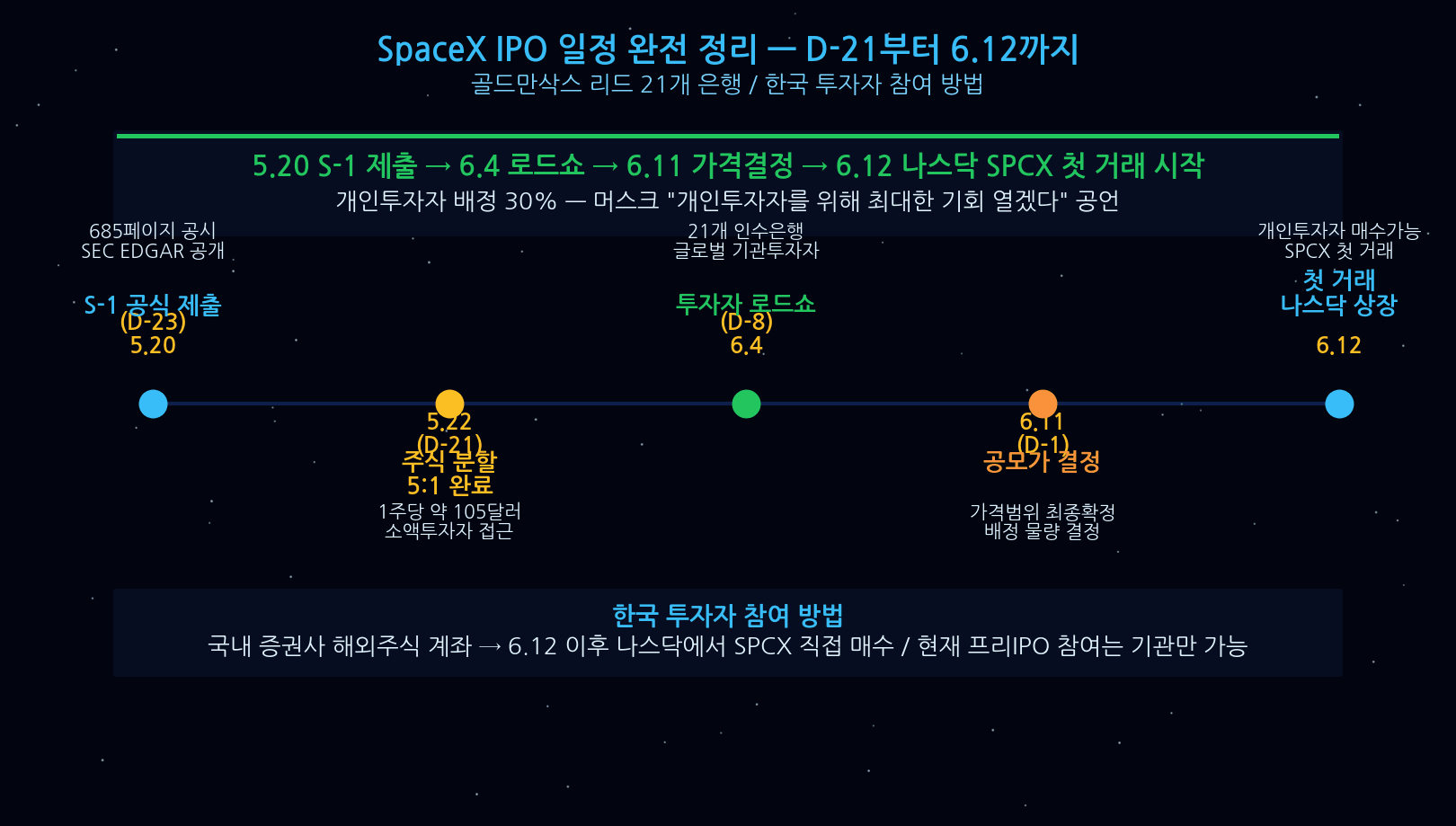
IPO Timeline — D-21 Countdown
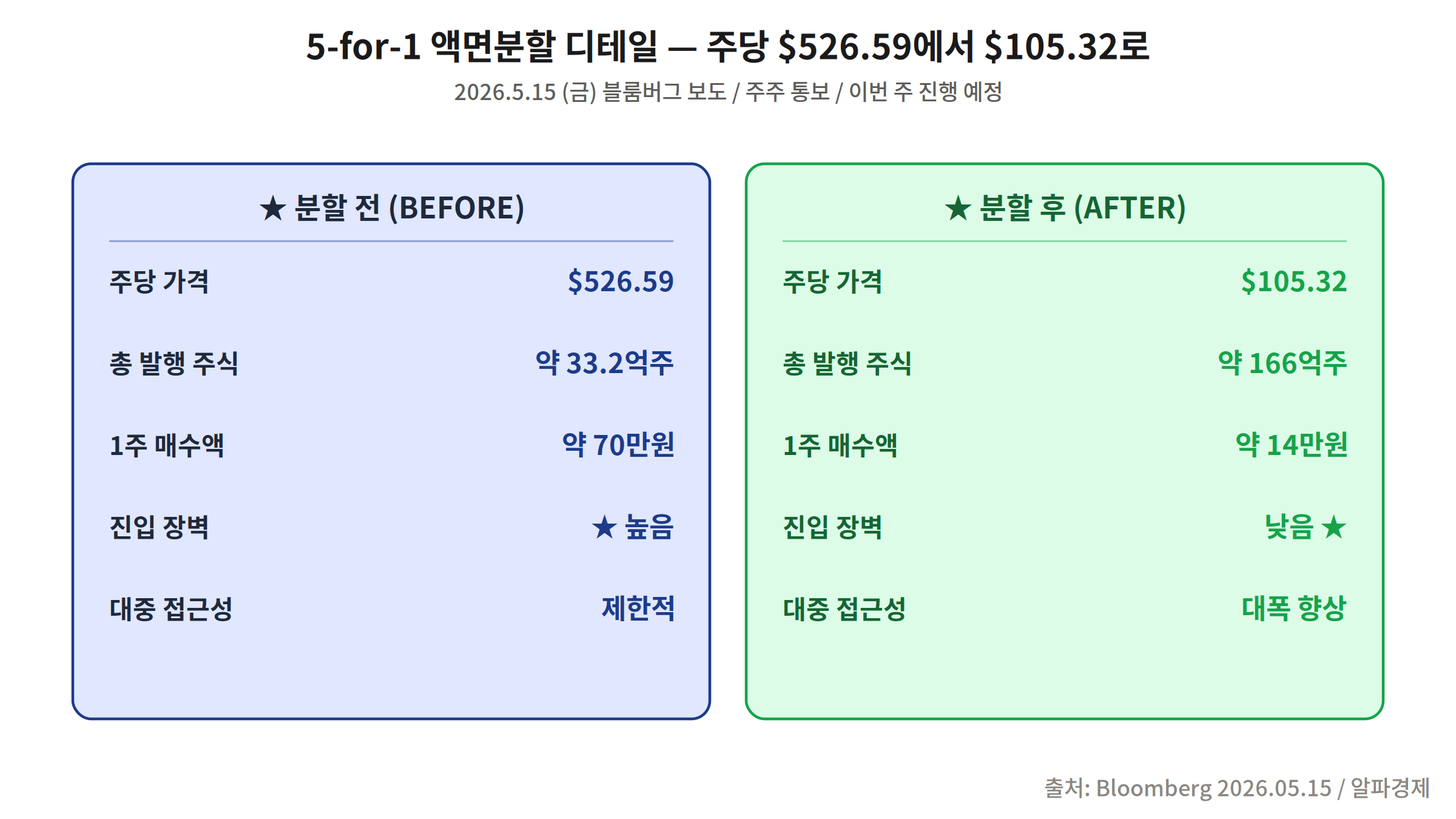
May 20: S-1 filed (complete). May 22: 5-for-1 stock split complete (~$105/share). June 4: investor roadshow. June 11: final IPO price set. June 12: SPCX first trade on Nasdaq. For Korean investors: open overseas stock account now; avoid chasing on day one; wait for the post-listing pullback. Major Korean brokerages (Mirae Asset, Samsung Securities, Kiwoom) are expected to enable SPCX trading from June 12.
6 Key Investment Risks — A Cold-Eyed View
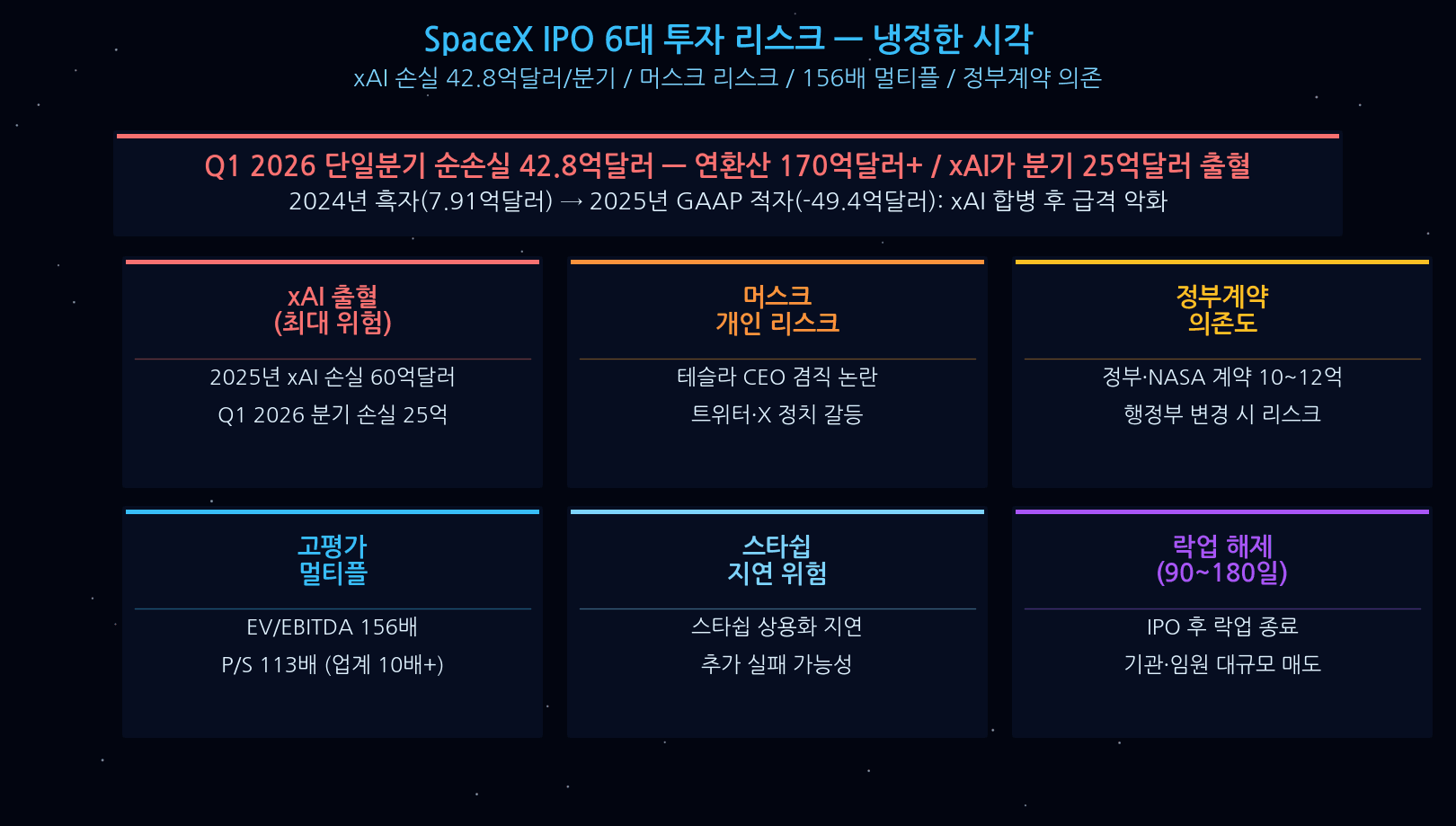
Six risks every investor must understand: ① Q1 2026 net loss of $4.28B in a single quarter ($2.5B/quarter from xAI). ② Profitability collapsed: 2024 net income +$791M → 2025 net loss -$4.94B. ③ 113x P/S is extreme even relative to AI-era valuations. ④ Elon Musk concentration risk (political exposure, multiple business distractions). ⑤ Starship commercialization delays would undermine the growth story. ⑥ Ongoing xAI integration cost uncertainty. Enter small; set stop-losses.
Historical IPO Comparison — Where SpaceX Stands
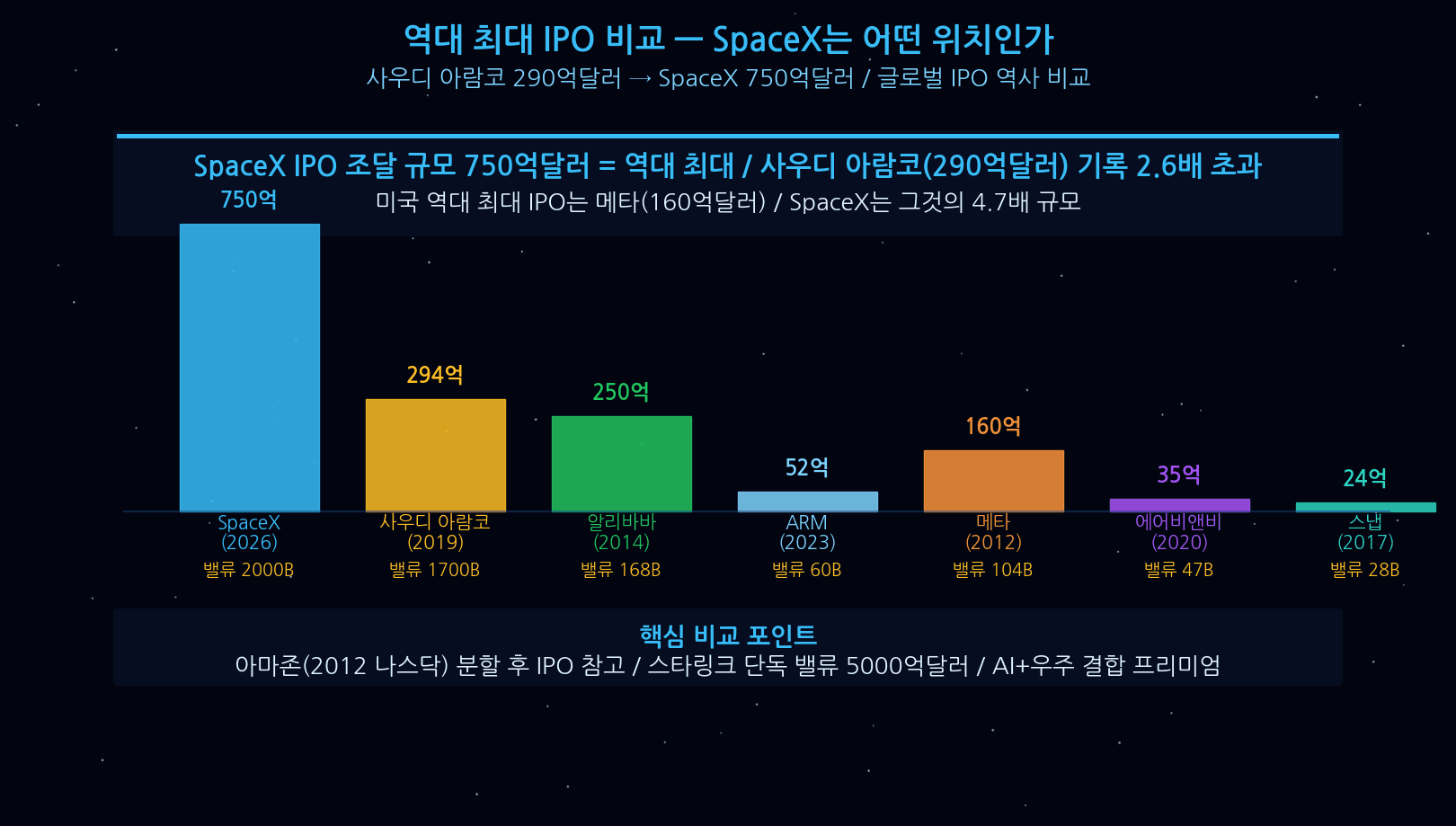
The previous record for the largest IPO was Saudi Aramco (2019) at $29B. SpaceX’s $75B target raise is 2.6x that record — the largest equity offering in human history. By valuation, $2T would place SpaceX alongside Microsoft, Apple, Nvidia, Aramco, and Alphabet in the global top-6. If achieved, SPCX would immediately reshape the Nasdaq market-cap rankings on day one of trading.
5 Investment Strategies for Korean Investors
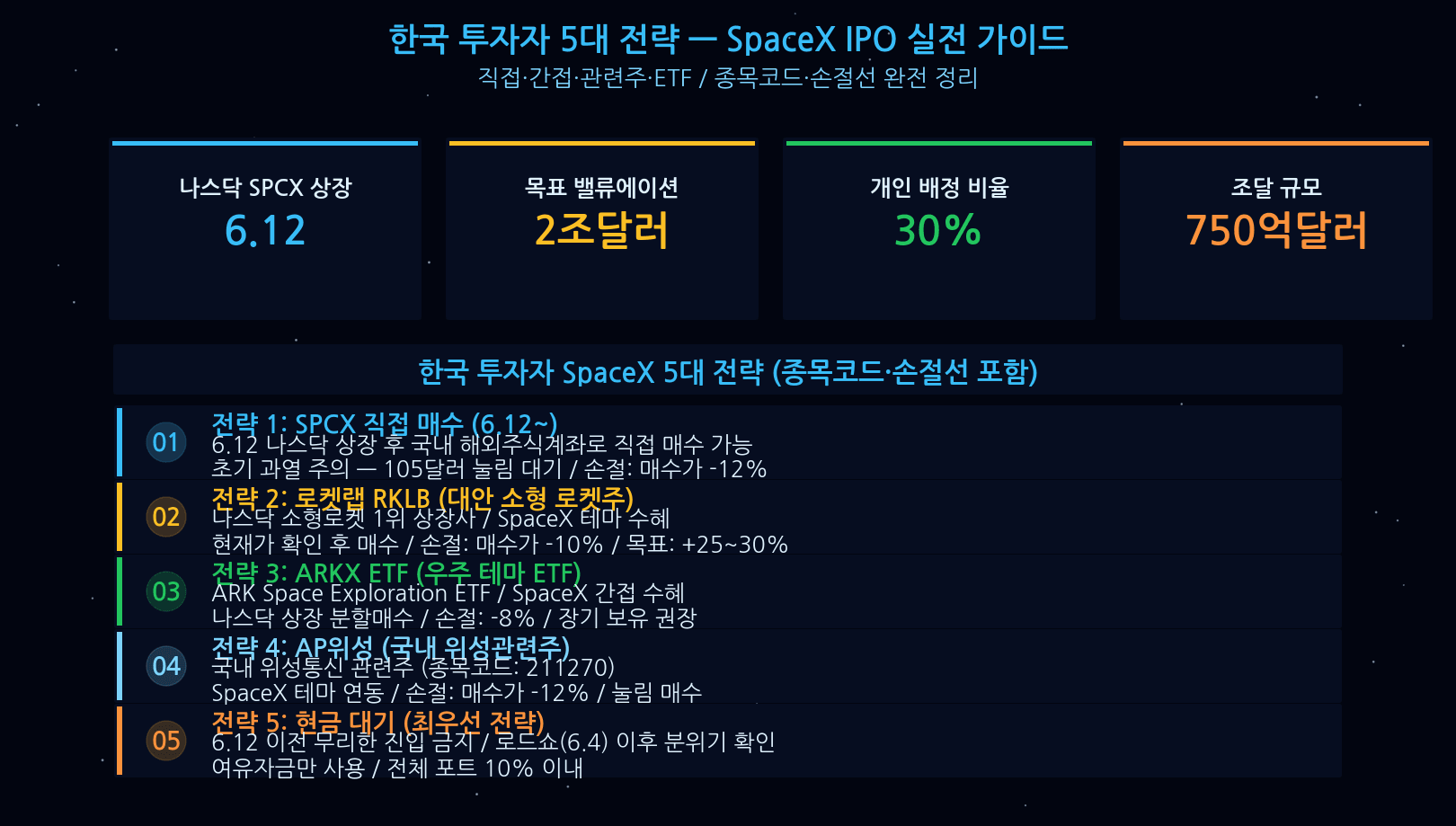
Five strategies for the SpaceX IPO: ① SPCX direct — buy the $105–120 pullback after June 12, not the open; stop-loss -12%; weight 5–10%. ② Rocket Lab (RKLB) — SpaceX competitor and indirect beneficiary; split entry on support, stop-loss -10%; weight 5%. ③ ARKX ETF — diversified space theme; dollar-cost average, stop-loss -8%; weight 5–8%. ④ Palantir (PLTR) — defense + AI overlap; confirm support, stop-loss -10%; weight 5%. ⑤ Hanwha Aerospace (012450) — Korean space beneficiary; buy on dips, stop-loss -10%; weight 3–5%.
Conclusion — Should You Buy on June 12?
SpaceX is one of the most genuinely interesting companies in human history, with Starlink as a real cash-flow engine. But 113x P/S and xAI’s $2.5B/quarter burn are real, cold risks. Do not chase on day one. Wait for the post-listing pullback of 10–15% before entering. Always set a stop-loss. The thesis: betting on humanity’s space era is compelling — but keep it under 10% of your portfolio and size accordingly.
SpaceX IPO — Subscription Guide for Korean Investors
Direct subscription to the SpaceX IPO is largely unavailable to Korean retail investors — the offering is structured around US institutional investors. However, SPCX will trade openly on Nasdaq from June 12, accessible through Korean overseas brokerage accounts. The first rule of the SpaceX IPO: do not chase on day one. Wait for the inevitable 10–15% post-listing pullback before entering. Mirae Asset, Samsung Securities, and Kiwoom Securities are all expected to enable SPCX trading from launch day.