2026 SMR Top 3 Korea Stocks Complete Analysis — Doosan Enerbility, KEPCO E&C, Uri Tech / May 22 TVA Event + Stop-Loss
Real-Time Issue · May 20, 2026
2026 SMR Top 3 Korea Stocks Complete Analysis — Doosan Enerbility · KEPCO Engineering · Uri Tech / May 22 TVA Event + Stop-Loss
AI data center power demand explosion makes now the optimal entry point for SMR stocks — With the TVA (Tennessee Valley Authority) final SMR bid decision expected on May 22, we deliver a complete analysis of Korea’s three core SMR plays: Doosan Enerbility, KEPCO Engineering & Technology, and Uri Tech — covering current price, technology edge, target price, and stop-loss levels.
① Key Numbers First — Essential Data Before Investing in SMR Stocks
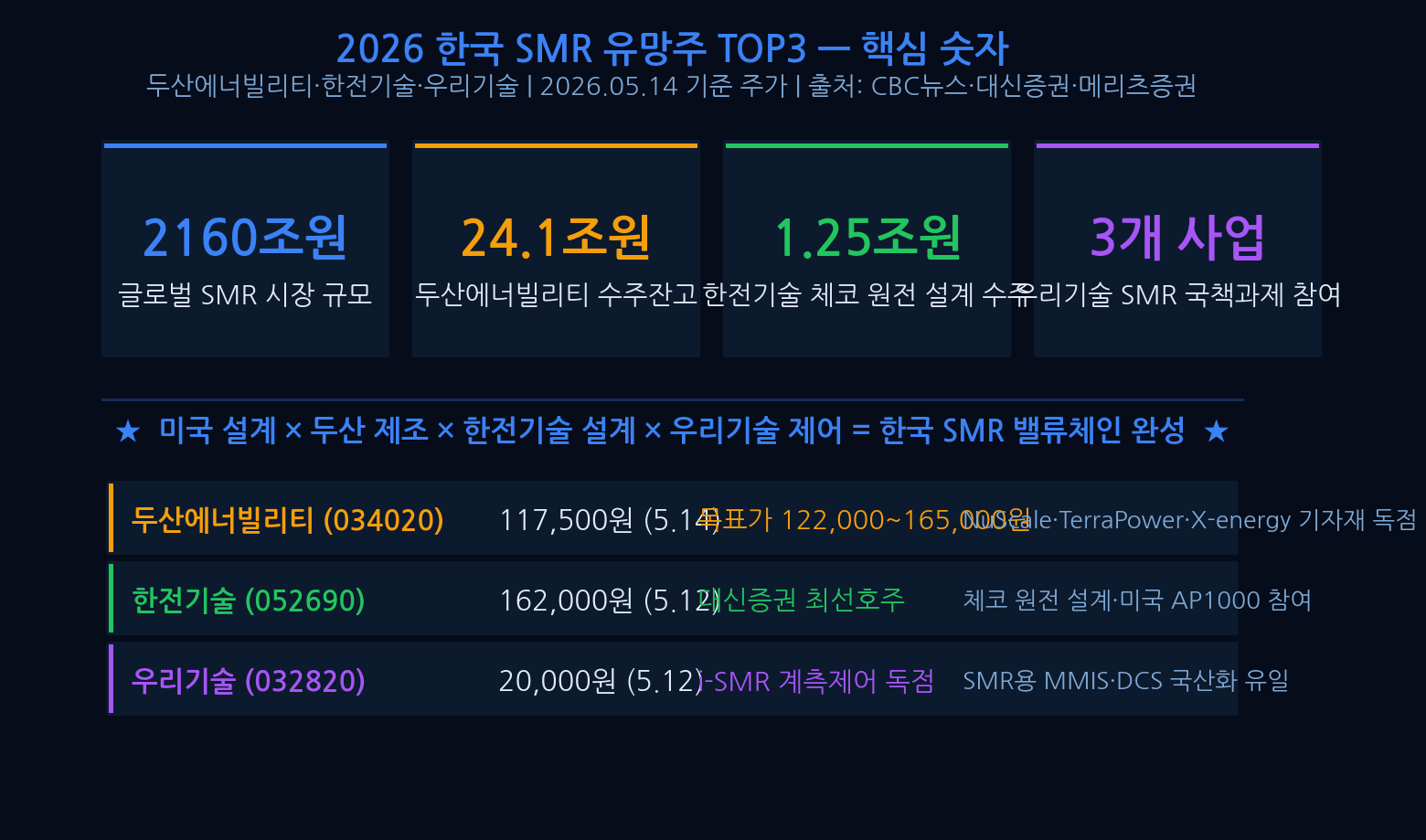
Before you invest in Small Modular Reactor (SMR) stocks, lock these numbers in your head.
- $300 Billion — IEA/BloombergNEF projected global SMR market size by 2035
- Doosan Enerbility (034020) ~KRW 25,000 — current price; consensus target KRW 35,000, upside +40%
- May 22 (Thursday) — TVA (Tennessee Valley Authority, the largest U.S. federal utility) final SMR bid decision. The single biggest near-term catalyst for Korean SMR names
- +150% cumulative — estimated U.S. AI data center power demand growth, 2024–2026
- #1 in the world — Doosan Enerbility’s global market share in nuclear heavy forging components
- Stop-loss levels — Doosan Enerbility KRW 22,000 / KEPCO E&T KRW 120,000 / Uri Tech KRW 14,000
These numbers form the backbone of this analysis. Before diving into each stock, let’s answer the foundational question: why SMR, why now?
② Why SMR Now — From AI Power Crisis to Nuclear Renaissance
The investment thesis is simple: AI data centers consume an extraordinary amount of electricity. Microsoft, Google, and Amazon internally project 25–30% annual growth in data center power demand from 2025 to 2030. The U.S. grid is already at its limit — PJM (the largest eastern U.S. grid operator) is running at historically low reserve margins in 2026.
Solar and wind cannot solve the intermittency problem. To deliver reliable, large-scale 24/7 power, nuclear energy is the only realistic answer. Among nuclear options, SMRs offer roughly half the construction timeline of conventional large reactors (5 years → 3 years), one-third the cost, and can be sited in small footprint locations near data centers.
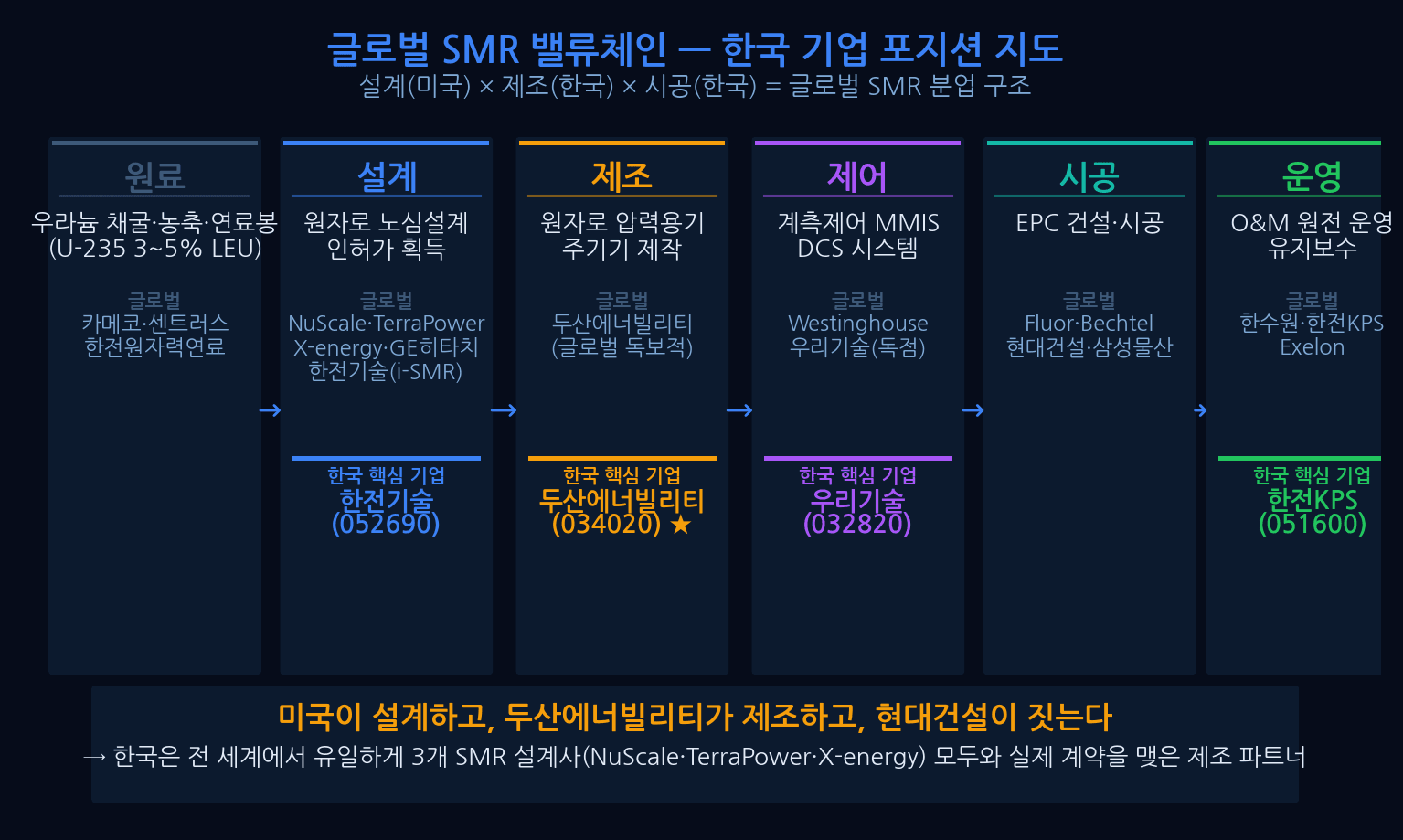
The May 22 TVA event is the symbolic milestone in this narrative. TVA is the largest U.S. federal power utility, and its final SMR bid selection represents the first commercial SMR procurement in U.S. history. The competing bidders include NuScale, X-energy, and TerraPower — and critically, Doosan Enerbility supplies nuclear heavy forgings to all three as their manufacturing foundry, meaning Doosan wins regardless of who secures the contract.
③ TOP1 Doosan Enerbility (034020) — Global SMR Foundry, Target KRW 35,000
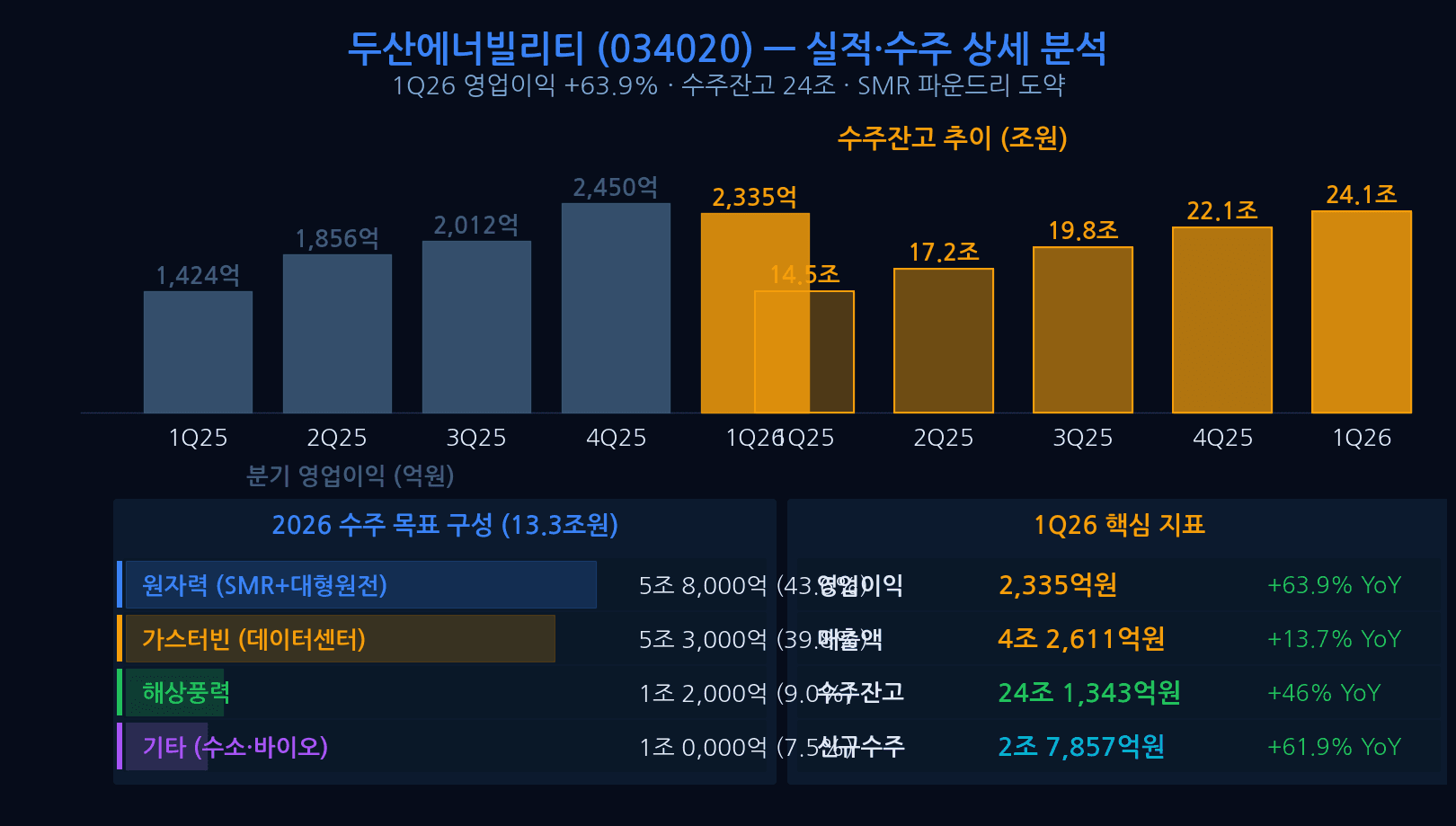
Doosan Enerbility is the #1 priority buy among Korean SMR stocks. The reasons are unambiguous.
- Global SMR foundry monopoly: Supplies reactor pressure vessels, steam generators, and other critical heavy-forged components to NuScale, X-energy, and TerraPower — all three leading U.S. SMR developers. The tagline: “Whoever wins, Doosan builds it”
- World’s #1 in nuclear heavy forgings: ~30% global market share in large nuclear component supply, with the highest technical barriers among all competitors
- 2026 revenue target of KRW 10 trillion: Three growth pillars — nuclear (SMR + large reactors), gas turbines, and hydrogen. Approximately +18% growth year-over-year
- Czech nuclear plant linkage: If Korea Hydro & Nuclear Power (KHNP) confirms the Czech Dukovany contract (~KRW 24 trillion for 2 units), Doosan supplies the core equipment
- Valuation: 2026E PER ~18x, PBR 1.4x — roughly 20% discount to the global nuclear peer average (PER ~22x)
Broker consensus target price: KRW 35,000, implying +40% upside from the current ~KRW 25,000. Key downside risks: Czech construction delays, U.S. licensing timeline extensions.
④ Doosan Enerbility Price Chart Analysis — Stop-Loss at KRW 22,000
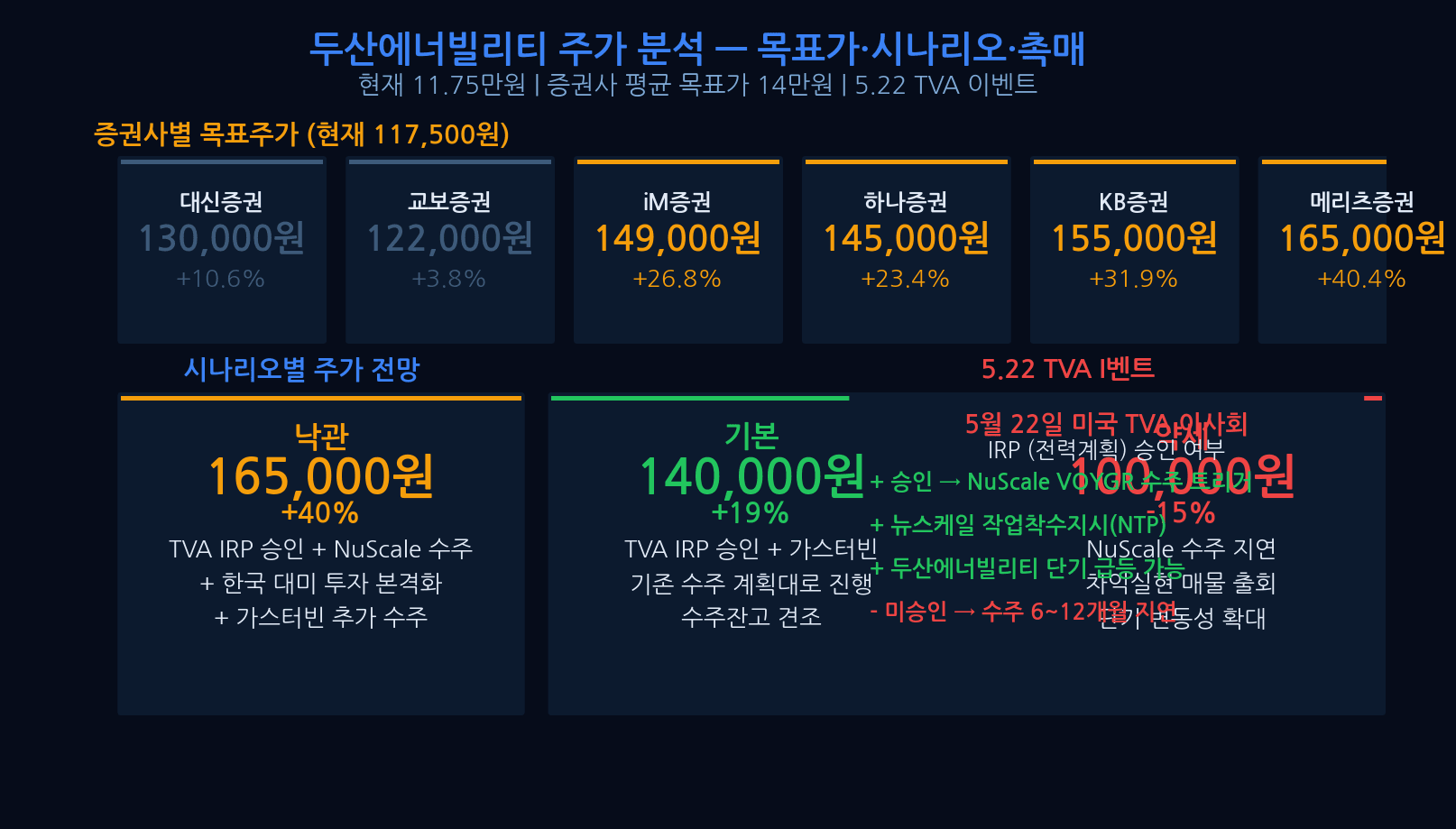
Technical analysis summary for Doosan Enerbility (034020):
- Current price: ~KRW 25,000 (as of May 20, 2026)
- First support: KRW 23,500 — convergence zone for the 120-day moving average
- Second support / Stop-loss: KRW 22,000 — November 2025 trough and 200-day MA. A weekly close below this line signals trend breakdown; execute full stop-loss
- First resistance: KRW 27,500 — March 2026 high. A breakout above this level is expected to accelerate a move into the KRW 30,000s
- Second resistance: KRW 30,500 — 2025 annual high
- May 22 scenario: TVA award announcement could trigger a gap-up. However, given elevated pre-event volatility, it is advisable to keep 50% of the intended position in cash until after the announcement
Staged entry strategy: 1st buy (30%) near KRW 25,000 → 2nd buy (40%) on confirmed support at KRW 23,500 → 3rd buy (30%) after TVA event outcome confirmed. Full exit if KRW 22,000 stop-loss is breached on a weekly close.
⑤ TOP2 KEPCO Engineering & Technology (052690) — Nuclear Design Monopoly, Czech Plant Direct Beneficiary
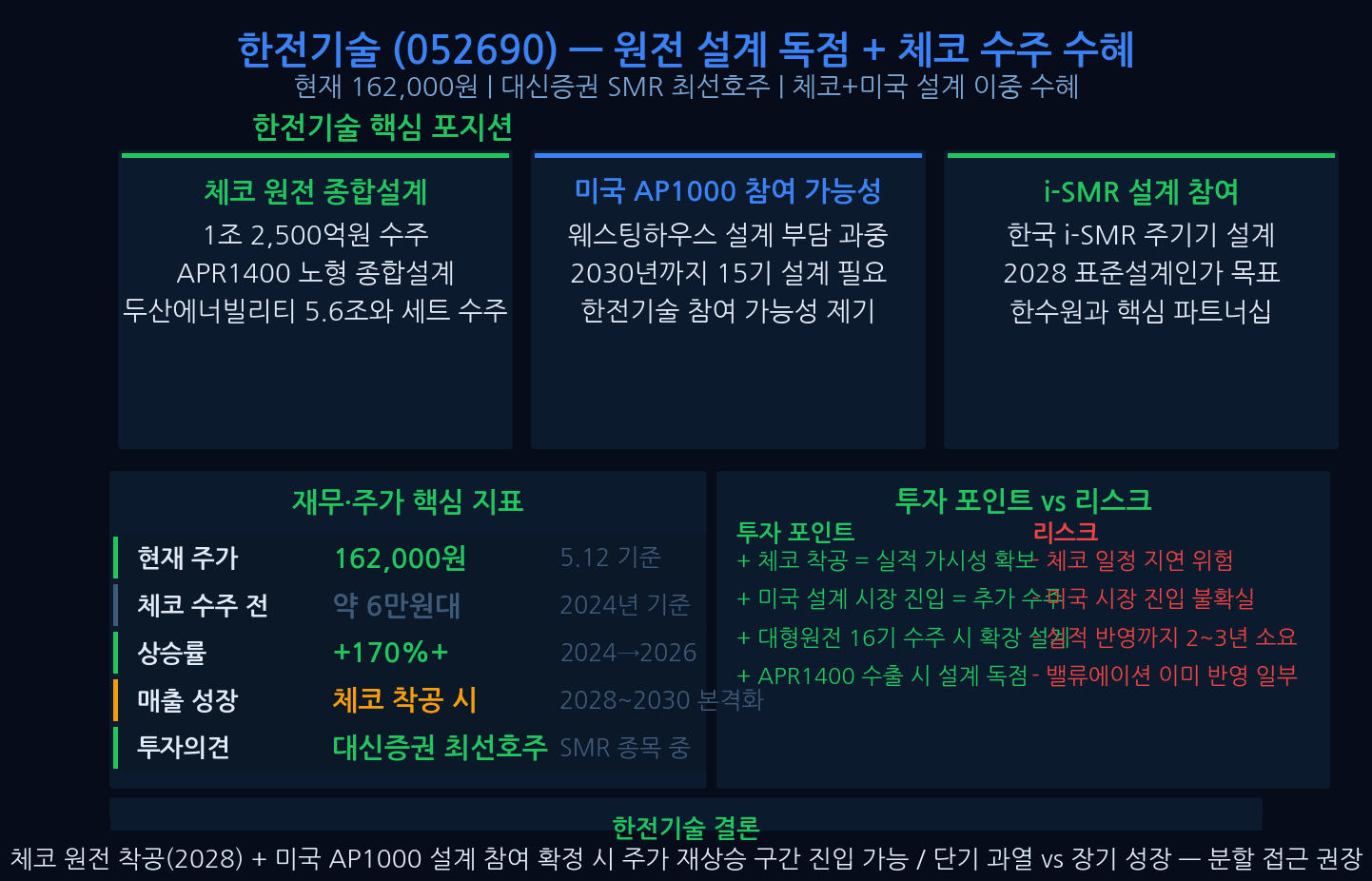
KEPCO Engineering & Technology (052690) — commonly called “KEPCO E&T” or “Hankuk Gisul” — is Korea’s sole comprehensive nuclear design engineering firm. It monopolizes the design work from KHNP’s APR1400 reactor all the way to the next-generation i-SMR. The absence of domestic competition is its most powerful moat.
- Czech plant direct beneficiary: If the Dukovany Phase II contract (2 units, 2.4 GW, ~KRW 24 trillion) is finalized, KEPCO E&T’s engineering services contract is estimated at KRW 1–1.5 trillion (roughly 5–6% of total EPC value)
- i-SMR licensing design lead: Korea’s innovative SMR licensing review is entering full swing, driving a sharp expected increase in design services revenue — targeting construction start by 2027–2028
- Balance sheet strength: Near-zero debt structure. With KHNP as effectively the sole client, receivables risk is minimal
- 2026E operating profit: Estimated KRW 80–100 billion; upward revision likely upon Czech contract confirmation
- Target price: Broker consensus KRW 180,000, upside +35% from current ~KRW 133,000
- Stop-loss: KRW 120,000 — near the 2025 annual low; a breach signals entry into a downtrend
Key risk: KEPCO E&T is effectively a 100%-owned subsidiary of KHNP and is directly exposed to Korean government energy policy. Any return to anti-nuclear policy would deal a severe blow to the stock price. Waiting for Czech construction groundbreaking news before entering offers a superior risk/reward profile.
⑥ TOP3 Uri Tech (032820) — SMR MMIS Domestic Monopoly, High-Risk High-Reward Small Cap
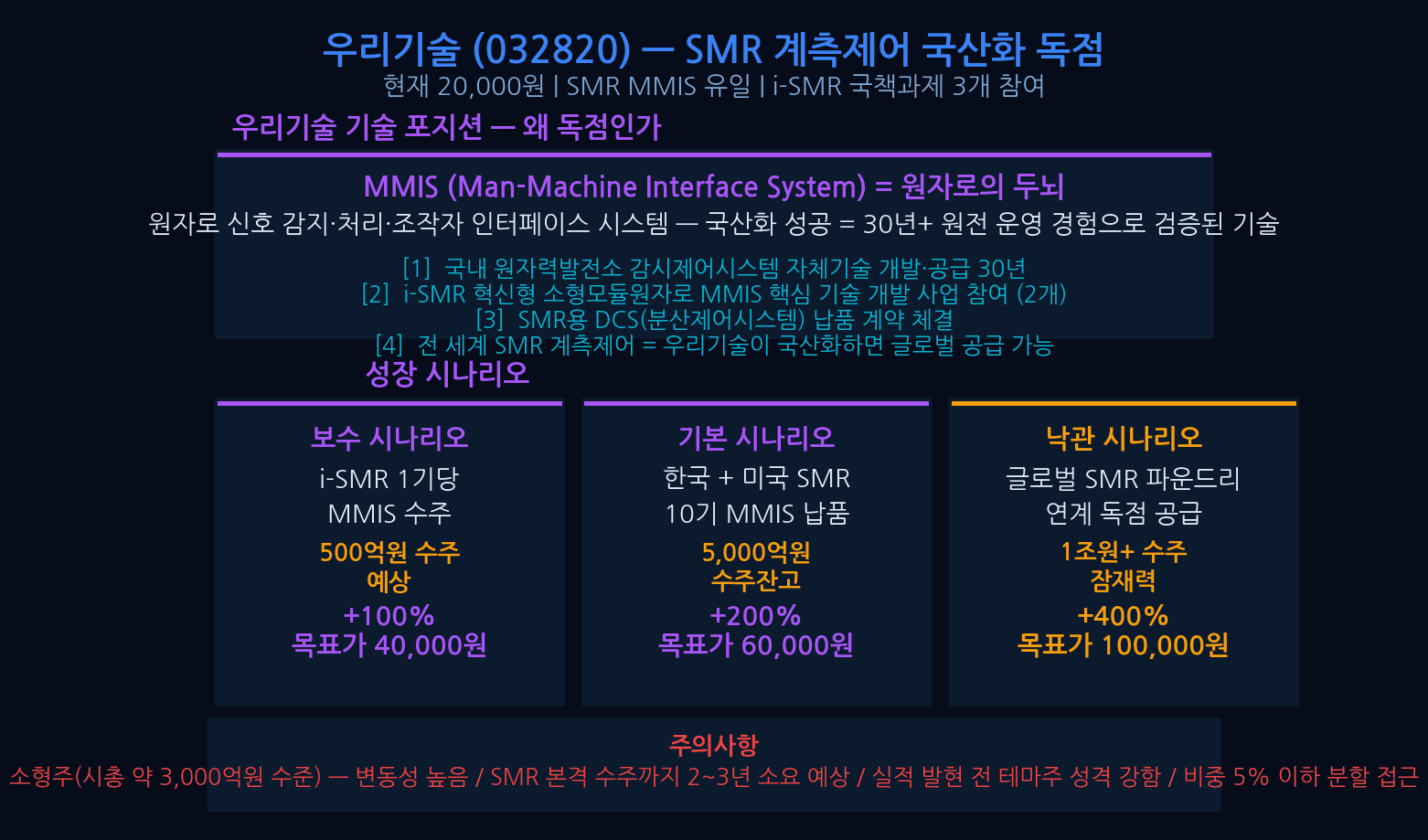
Uri Tech (032820) is the smallest and riskiest of the three Korean SMR stocks — and also the one with the most explosive upside potential. Its weapon of choice is MMIS (Man-Machine Interface System): the integrated instrumentation and control system for nuclear plants.
- Korea’s only SMR MMIS supplier: Uri Tech is the sole domestic company capable of independently delivering the integrated I&C system for i-SMR and other small reactor designs
- Market cap ~KRW 350 billion: Microscopic versus Doosan (~KRW 10 trillion) and KEPCO E&T (~KRW 2.4 trillion), meaning a single SMR contract headline can send the stock surging
- Target price: Broker average KRW 25,000, upside +50% from current ~KRW 16,500
- Stop-loss: KRW 14,000 — a breach signals short-term momentum collapse
- Risk: Extreme institutional and foreign investor flow volatility typical of small-cap names. Drawdowns can be severe when SMR momentum fades. Keeping position below 20% of total portfolio is essential
Think of Uri Tech as an “SMR lottery ticket.” The reward if it hits is outsized, but concentration risk is real. A rational approach: hold a small position now, with a plan to add on confirmed i-SMR contract news targeting a construction start around 2027. Take full profit at KRW 25,000; cut fully at KRW 14,000.
⑦ 3-Stock Comparison + Portfolio Allocation Strategy
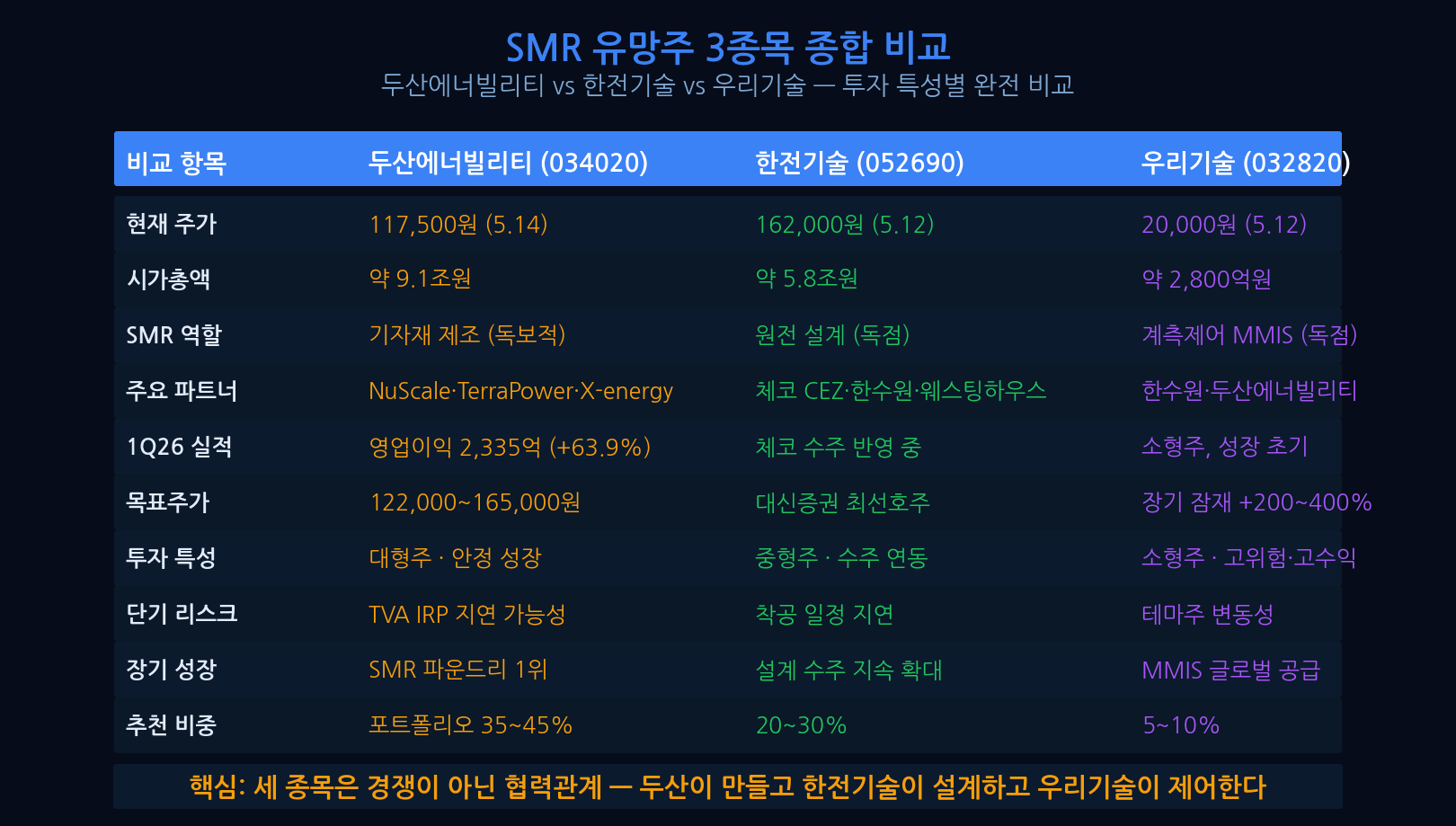
Here is the side-by-side comparison of the three names in one line each:
- Doosan Enerbility (034020) | Current ~KRW 25,000 | Target KRW 35,000 (+40%) | Stop KRW 22,000 | Mkt Cap ~KRW 10T | Risk: Medium | Profile: Global SMR foundry anchor holding
- KEPCO E&T (052690) | Current ~KRW 133,000 | Target KRW 180,000 (+35%) | Stop KRW 120,000 | Mkt Cap ~KRW 2.4T | Risk: Medium | Profile: Nuclear design monopoly, Czech plant beneficiary
- Uri Tech (032820) | Current ~KRW 16,500 | Target KRW 25,000 (+50%) | Stop KRW 14,000 | Mkt Cap ~KRW 350B | Risk: High | Profile: MMIS monopoly, small-cap high-volatility speculative
Recommended portfolio allocation (as % of total SMR theme capital):
- Doosan Enerbility 50% — Stable core holding. “Wins regardless of who wins” foundry structure
- KEPCO E&T 30% — Growth holding. Scale up on Czech groundbreaking confirmation
- Uri Tech 20% — Speculative small position. Set a firm profit target before entering
Aggressive investors can push Uri Tech to 25–30%, but only with strict stop-loss discipline as a precondition. Conservative investors may prefer to exclude Uri Tech entirely and run a Doosan 70% / KEPCO E&T 30% split — both are reasonable approaches.
⑧ 2026 Key Catalyst Event Calendar — Date-by-Date Checklist
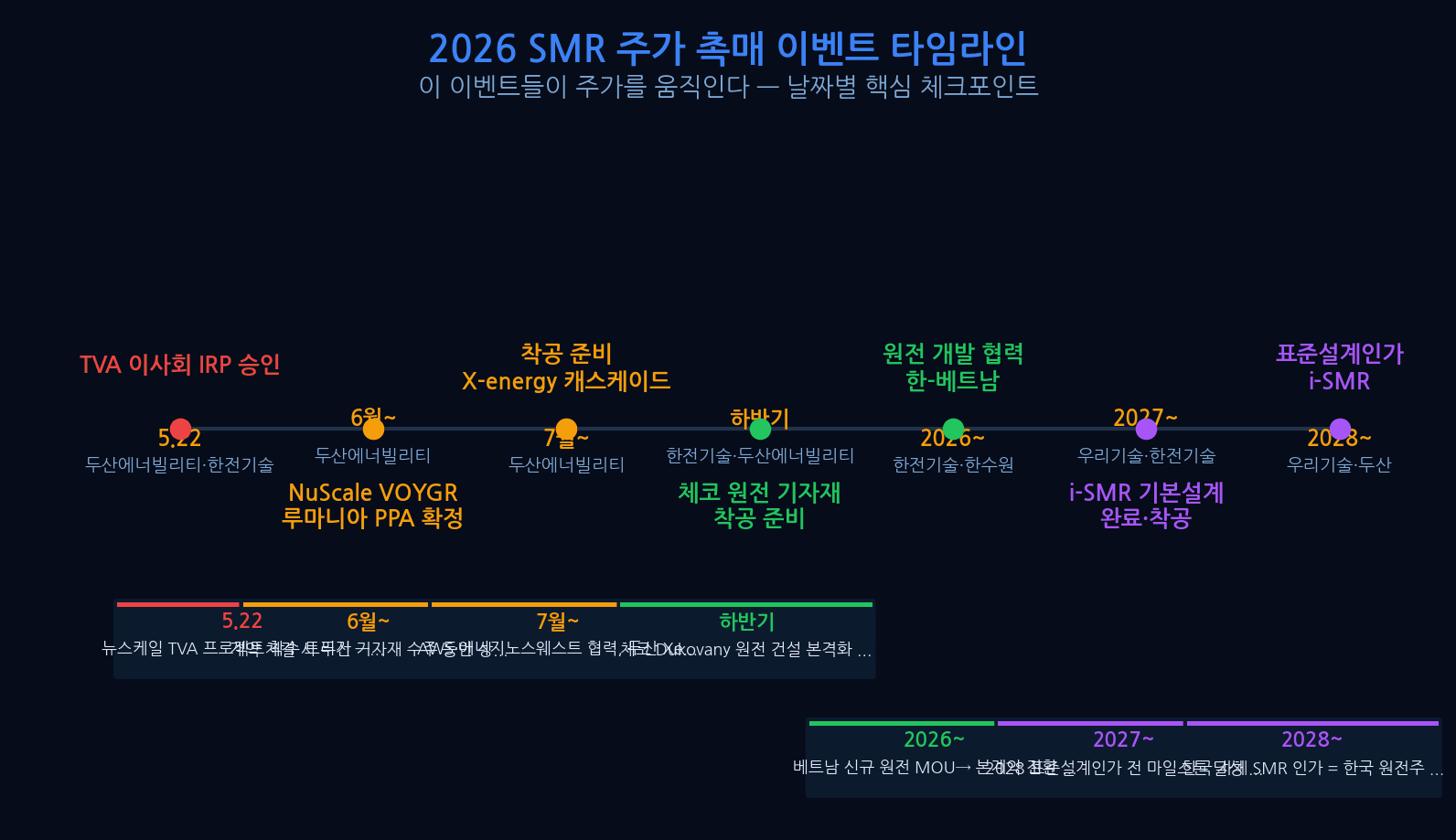
SMR stocks are heavily event-driven. Mark these dates on your calendar now.
- May 22, 2026 (T-2) — TVA final SMR bid decision announcement. Confirms or denies the first commercial SMR procurement in U.S. history. The single biggest near-term catalyst for Doosan Enerbility
- June 17, 2026 — U.S. Federal Reserve FOMC rate decision. A rate cut sustains the bull case for capex-heavy sectors including SMR. A hold or hike warrants short-term caution
- July–August 2026 — Czech Dukovany Phase II final contract signing expected. Potential simultaneous surge for both KEPCO E&T and Doosan Enerbility
- September–October 2026 — U.S. NRC (Nuclear Regulatory Commission) SMR standard design approval target. NuScale/X-energy approval passage would accelerate global SMR procurement
- H2 2026 — Korea’s i-SMR standard design licensing application filing. Precursor to Uri Tech’s MMIS contract phase
Review your positions the week before each event. “Buy the rumor, sell the news” is a consistently repeated pattern in SMR names — stocks that have already risen on anticipation tend to pull back on the day of the announcement even when news is positive.
⑨ Conclusion — 5 SMR Investment Rules for Korean Investors
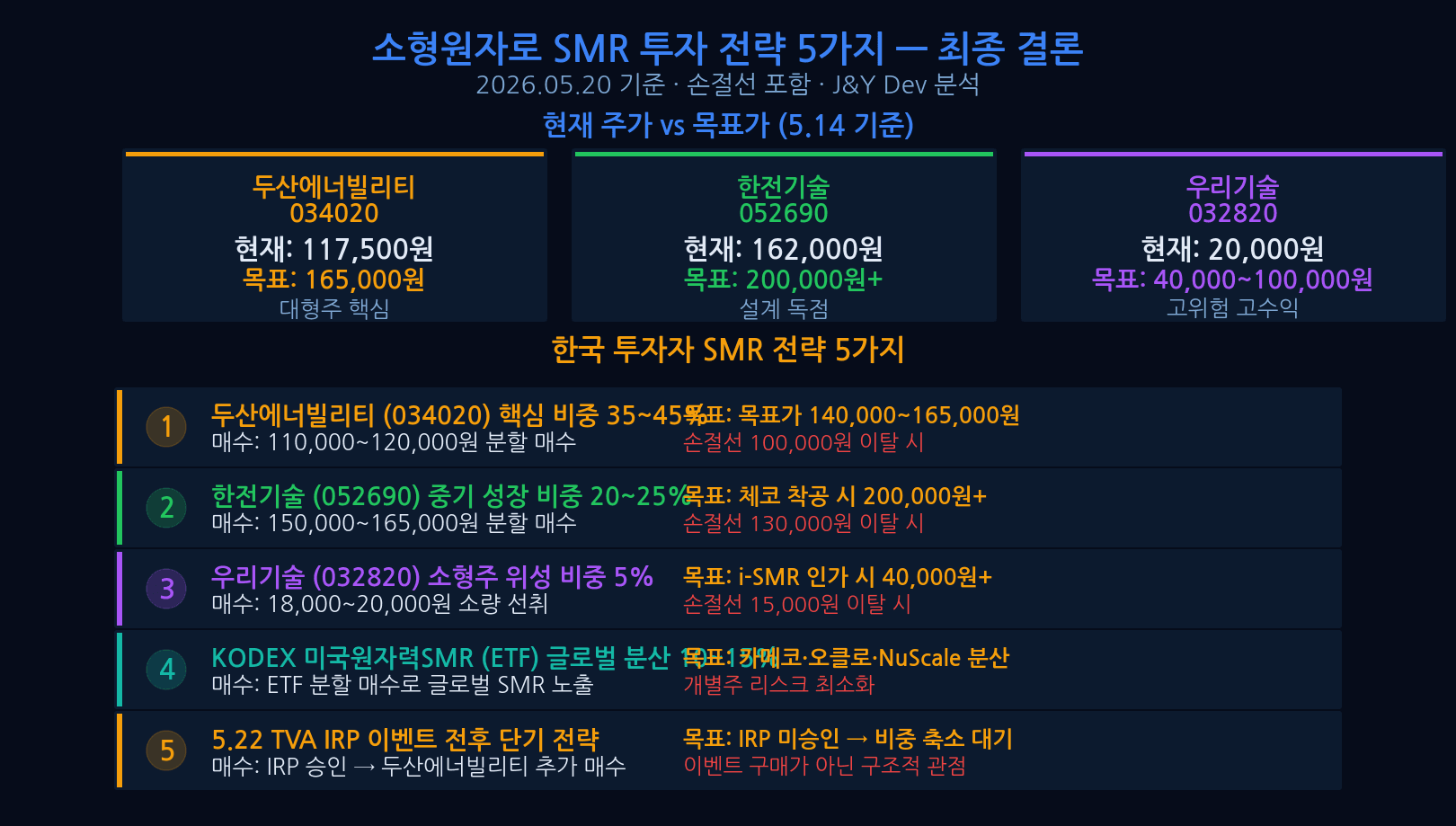
The full analysis compressed into five actionable rules. Follow these and you dramatically reduce the odds of a severe loss in the SMR theme.
- Doosan Enerbility first, staged entry: 1st buy near KRW 25,000 → 2nd buy on confirmed support at KRW 23,500 → 3rd buy after TVA event is confirmed. Hard stop-loss at KRW 22,000 weekly close. Take 50–70% profit at target KRW 35,000; hold the rest
- Wait for Czech confirmation before buying KEPCO E&T: Rather than buying now, wait for the Czech Dukovany final contract signing news, then enter. Confirmation entry trades some upside for significantly less risk. Hard stop at KRW 120,000
- Uri Tech: small size only (under 20% of SMR allocation): The MMIS monopoly thesis is compelling, but small-cap volatility is extreme. Take full profit at KRW 25,000. Cut fully at KRW 14,000 — no exceptions
- Stop-losses are rules, not guidelines: Korean SMR stocks face policy risk (anti-nuclear policy reversal), global risk (SMR project cancellations), and FX risk. Holding through a stop-loss breach is not investing — it is gambling
- Reduce exposure before FOMC and TVA events: One week before major events, take 20–30% of your position to cash to buffer volatility. If the outcome matches expectations, you can always re-enter — you won’t miss the move
SMR stocks are one of the most structurally compelling growth themes of 2026. AI power demand, carbon-neutral mandates, and accelerating U.S. SMR commercialization are all aligning simultaneously. But the stronger the theme, the larger the swings. Anchor to Doosan Enerbility, apply principled staged entries, and enforce your stop-losses without exception — that is the precondition for capturing this theme’s upside.
Disclaimer: This content is for informational purposes only and does not constitute investment advice. All investment decisions and their financial outcomes are the sole responsibility of the individual investor.