Rubio Visits India for Quad Summit — China Containment and Korea’s Dilemma
Real-Time Issue · May 23, 2026
Rubio Visits India for Quad Summit — China Containment and Korea’s Dilemma
US-India-Japan-Australia alliance / Korea’s participation dilemma / Defense beneficiaries

Rubio Arrives in India — Quad Summit Pre-Coordination
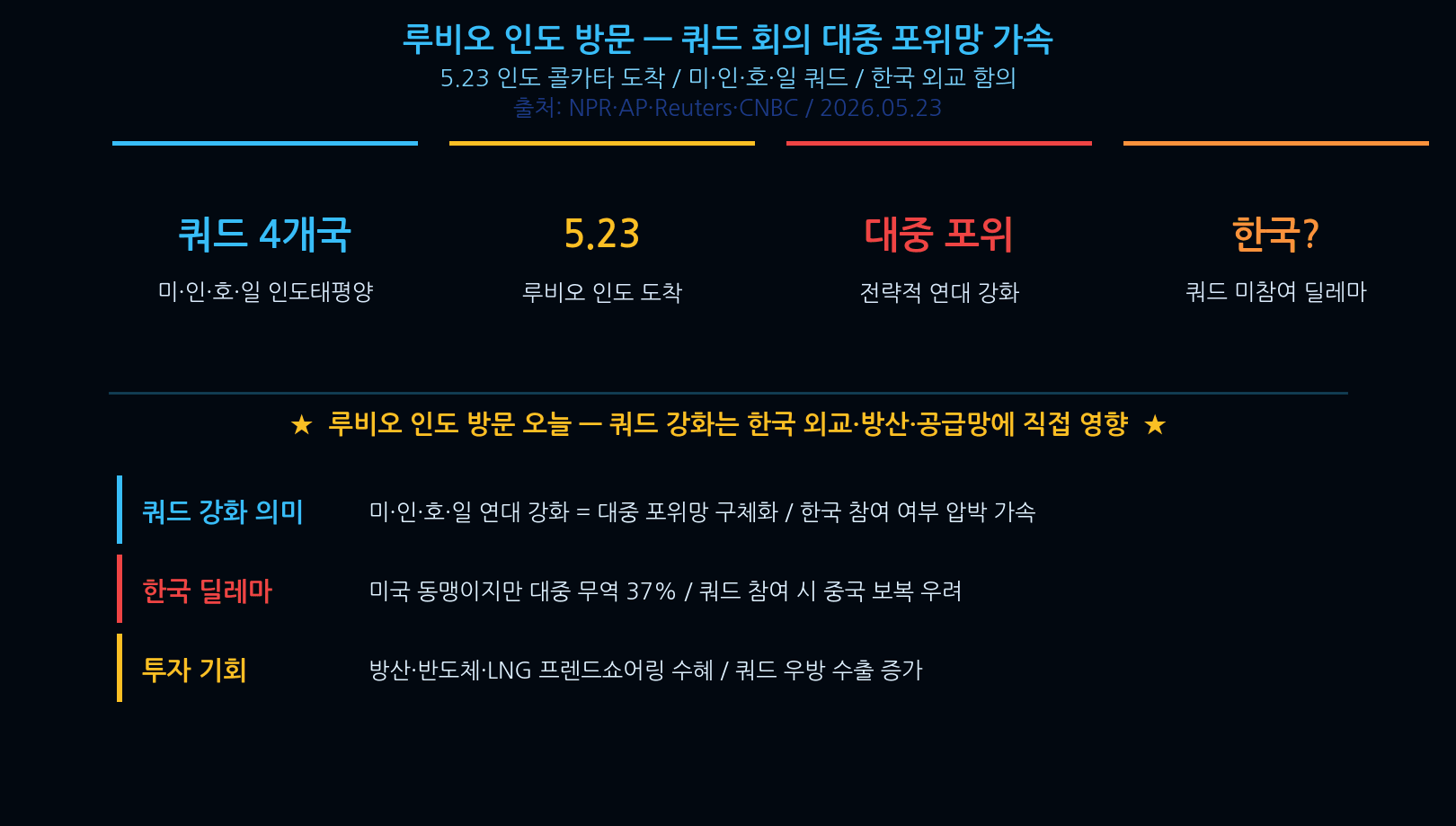
On May 23, 2026, US Secretary of State Marco Rubio arrived in Kolkata, India for pre-coordination ahead of the four-nation foreign ministers’ meeting (US-India-Japan-Australia) — i.e., the Quad summit. The Quad summit is fundamentally a China containment framework. Under the banner of a “free and open Indo-Pacific,” member nations share semiconductor supply chains, military cooperation, and frontier technology.
What Is the Quad Summit — Complete Primer
The Quad summit originated in 2004 from Indian Ocean tsunami relief coordination, was formalized in 2007 (then briefly suspended), and was revived under Trump’s first term in 2017. Members: US, India, Australia, Japan. Core agenda: semiconductor supply chains, undersea cables, military exercises, frontier tech sharing. Beijing condemns it as “an Asian NATO” and reacts strongly against every Quad summit.
Korea and the Quad — Should Korea Join
Korea sits at the heart of a strategic dilemma around the Quad summit. The US is a core ally — but China is the top trading partner (37% of trade). Joining the Quad summit outright risks economic retaliation reminiscent of the 2017 THAAD episode. Korea currently does not participate in the Quad summit; it joined only IPEF (Indo-Pacific Economic Framework). Strategic ambiguity remains the explicit posture.
Rubio Visit Agenda — Key Topics on the Table
Rubio’s agenda items for the Quad summit prep: ① Bilateral with India’s Foreign Minister. ② Semiconductor cooperation — expanding Indian manufacturing (creating opportunities for TSMC and Samsung). ③ Military cooperation — Indian Ocean naval exercises, securing export sea lanes. ④ Supply chain — friend-shoring restructuring, with potential Korean participation. India plays the US and China against each other, maximizing leverage from both sides.
Quad Supply Chain Restructuring — Korea’s Opportunity
Quad friend-shoring opens opportunities for Korea. ① Semiconductors — expanded US/India investment (Samsung, SK Hynix). ② Batteries — Australia/India raw materials (LG Energy, Samsung SDI). ③ Defense — Australia/Japan export demand (Hanwha Aerospace, LIG Nex1). ④ Energy — diversified LNG sourcing (KOGAS). Transitioning from China dependency costs time and money, but long-term supply chain stability is worth the investment.
Quad Strengthening — Market Beneficiary Analysis
A stronger Quad summit creates geopolitical winners. Direct beneficiaries — defense (Hanwha Aerospace 012450). Core beneficiaries — semiconductors (Samsung 005930). Indirect beneficiaries — shipping/energy (HMM 011200, KOGAS 036460). Korean defense exporters stand to gain meaningfully from rising arms demand among Quad-aligned partners. They are direct beneficiaries of the Indo-Pacific military cooperation buildup.
US-China Confrontation vs. Korean Diplomacy — The Art of Balance
Korea must balance a US security alliance with deep Chinese economic dependence. Trump demands stronger alliance commitments while simultaneously applying pressure via tariffs and base-cost demands. Xi keeps economic-retaliation cards (THAAD-style) constantly in play. Korea’s best path: issue-based cooperation rather than full Quad membership (semiconductors, maritime security), full IPEF use, and maintained trade channels with China.
5 Strategies for Korean Investors — Quad Strengthening Era
Five investor strategies for the Quad summit era. ① Hanwha Aerospace (012450) — direct defense export beneficiary, DCA, stop-loss -10%. ② Samsung (005930) — key India-expansion beneficiary, enter on 300K breakout, stop -8%. ③ LIG Nex1 (079550) — missile export beneficiary, DCA on support, stop -10%. ④ KOGAS (036460) — LNG diversification winner, stop -8%. ⑤ KODEX India Nifty 50 (200250) — direct India exposure, stop -10%.