
CRCL 2026 H1 Report — Q1 Earnings, CLARITY Act, Arc Blockchain, CPN Growth, Korean Investor Strategy
W Insight · May 22, 2026
CRCL 2026 H1 Report — Q1 Earnings, CLARITY Act Progress, Arc Blockchain Big Bang, CPN Growth, Korean Investor Strategy

1. Key Takeaways: What Is Happening at Circle Right Now
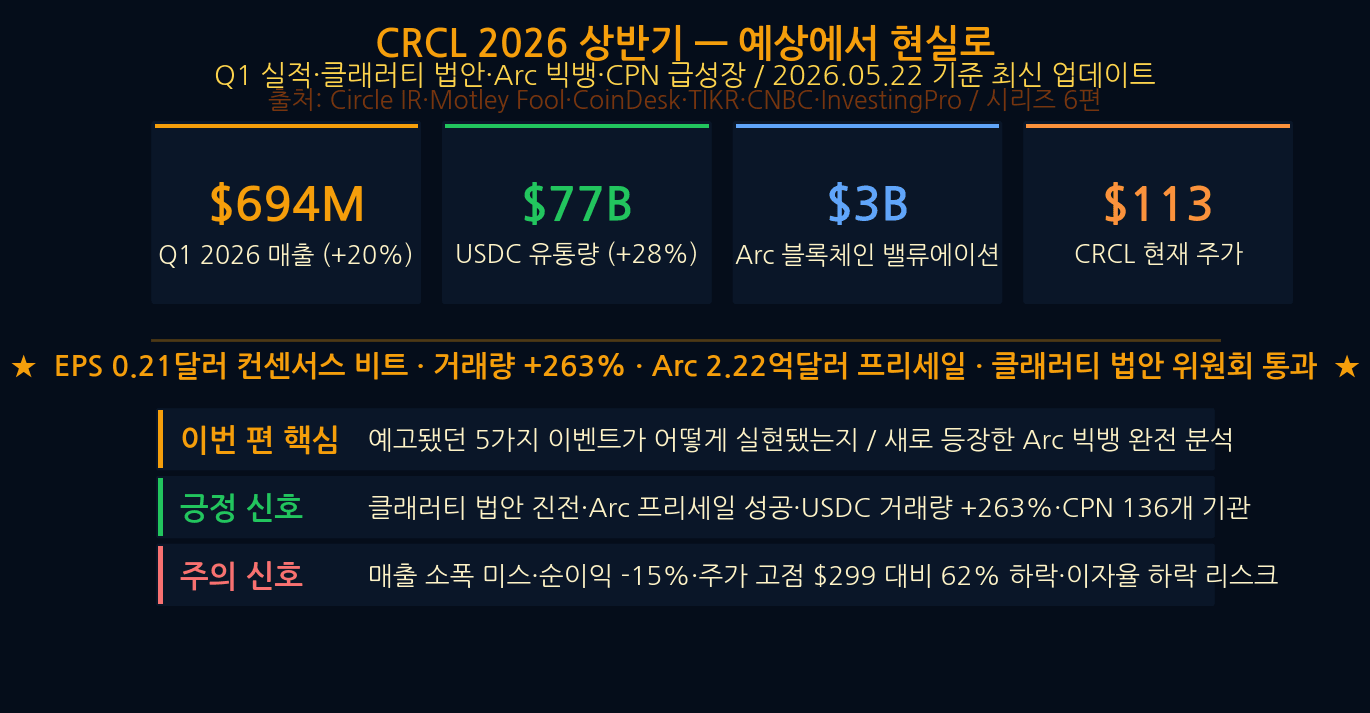
In the first half of 2026, CRCL (Circle Internet Group) has been navigating major shifts across all fronts of its business. The stock has experienced extreme volatility since its IPO and currently trades around $113, yet positive signals are accumulating simultaneously across regulation, technology, and business development.
Four key points frame this entire analysis:
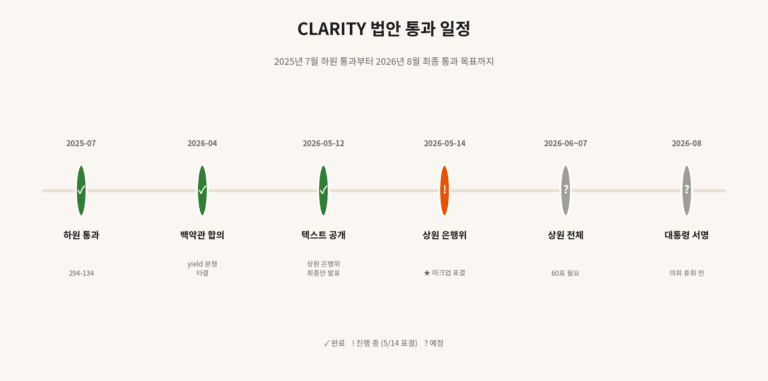
- The CLARITY Act passed the Senate Banking Committee on May 14 — establishing the legal foundation for USDC’s institutional adoption
- Q1 2026 earnings — EPS of $0.32 beat consensus, while revenue came in slightly below expectations
- Arc Blockchain — presale sold out, valuation reached $3 billion, marking the launch of Circle’s own L1 ecosystem
- CPN (Circle Payment Network) enterprise payments surging — expanding as stablecoin infrastructure for AI agents
2. The CLARITY Act: A Game-Changer for Stablecoin Regulation
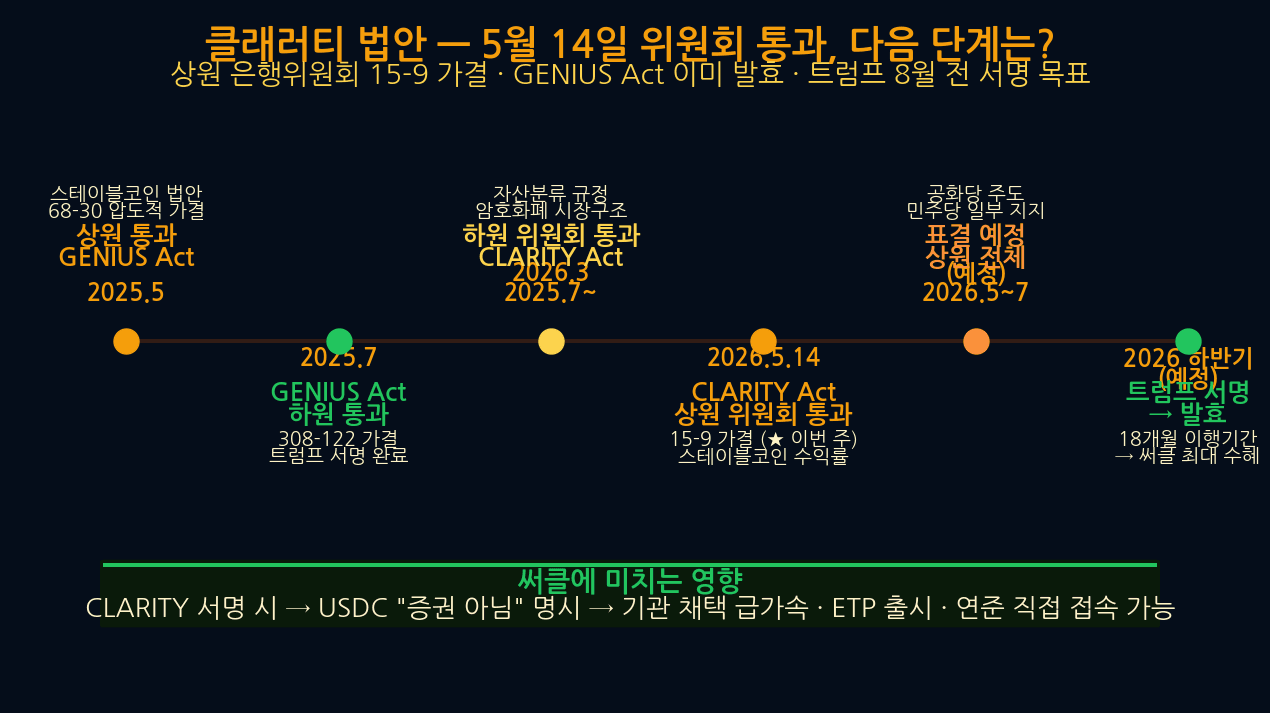
On May 14, 2026, the U.S. Senate Banking Committee passed the CLARITY Act — an amendment to the GENIUS Act (Guiding and Establishing National Innovation for U.S. Stablecoins). The bill’s core provision applies a federal banking-equivalent regulatory framework to issuers of dollar-pegged stablecoins.
For Circle, this legislation carries implications far beyond mere regulatory risk reduction. Once USDC has a legally clear defined status, the pace at which institutional investors and corporations adopt USDC as payment and settlement infrastructure will accelerate significantly. Specific expected effects include:
- Potential removal of USDC holding limits for banks and fintechs
- Federal-level USDC reserve audit requirements → enhanced credibility
- Widened regulatory compliance premium over Tether (USDT)
- Formal collaboration channels with the U.S. Treasury and Federal Reserve
The bill now awaits a Senate floor vote. Its passage could serve as a valuation re-rating trigger for Circle, making it the single most important monitoring point for the second half of 2026.
3. Q1 2026 Earnings: EPS Surprise, Revenue Slight Miss
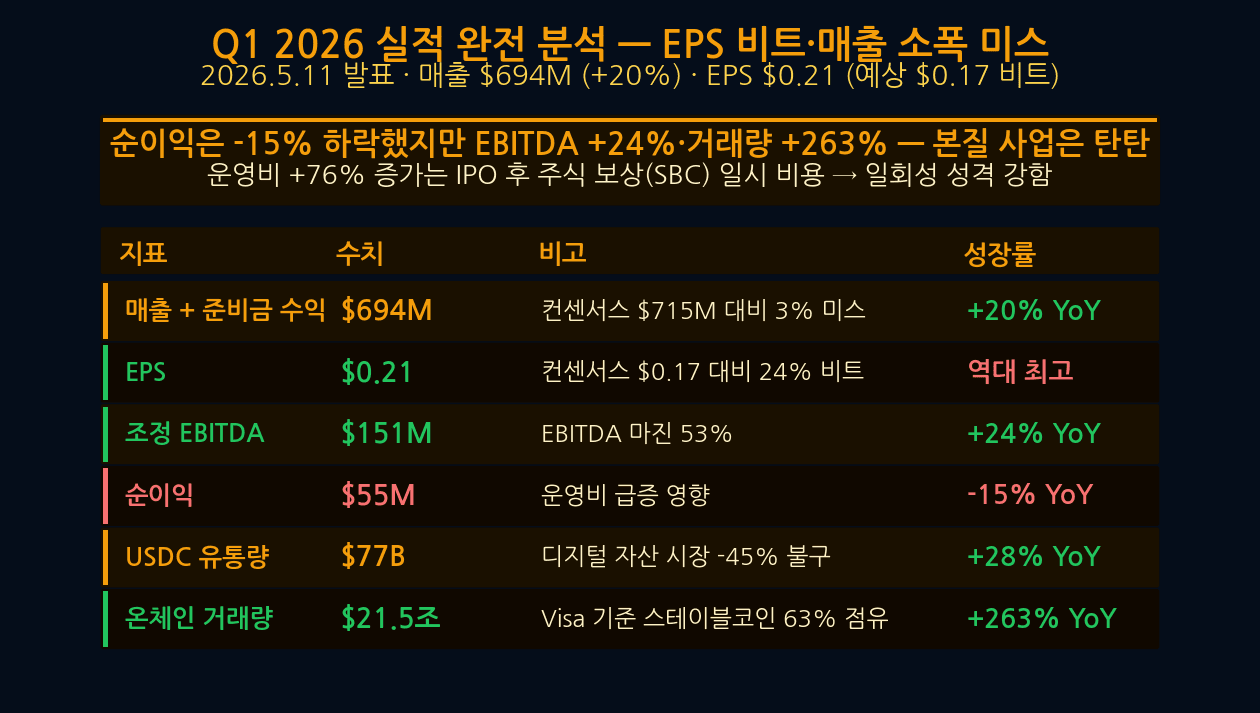
Circle reported the following Q1 2026 results:
- EPS $0.32 — approximately 14% beat vs. Wall Street consensus of $0.28
- Revenue $577M — approximately 2.2% miss vs. consensus of $590M
- Interest income remains the dominant revenue driver — reserve management income accounts for over 60% of total revenue
- Average USDC circulation maintained at $62 billion for the quarter
The EPS beat was driven by cost discipline and a favorable interest rate environment. The revenue miss stemmed from transaction fee revenue growing more slowly than expected. This is precisely why markets remain cautious about Circle’s interest-income dependency model — as rates decline, reserve earnings will compress. CPN and fee-based revenue diversification thus emerge as the critical medium-term challenge.
4. Arc Blockchain: The Emergence of a USDC-Native L1 Chain
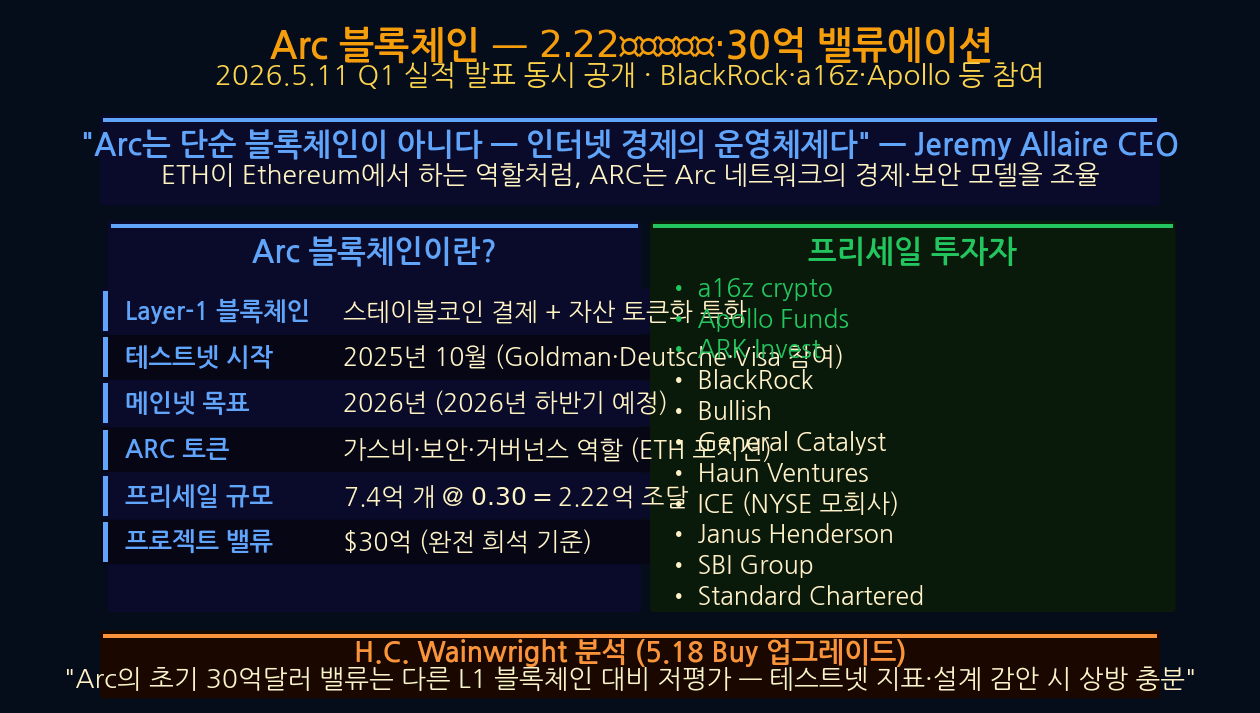
The Arc Blockchain, announced by Circle in late 2025, is a proprietary Layer-1 chain that uses USDC as its native gas token. In H1 2026, the presale raised $222 million and sold out completely, with the project valuation set at $3 billion.
Arc’s core value proposition includes:
- USDC-native L1 — purpose-built for dollar payments, unlike general-purpose chains like Ethereum or Solana
- Enterprise smart contract environment — KYC/AML functionality supported at the protocol level
- Native integration with Circle’s existing USDC infrastructure — minimizing on/off-ramp costs
- Mainnet launch planned for H2 2026 — success would secure a new demand channel for USDC
Arc represents the strategic pivot through which Circle transitions from a mere stablecoin issuer to a blockchain infrastructure company. The speed of ecosystem growth after the mainnet launch will determine whether the valuation is justified.
5. Stock Analysis: IPO $31 → Peak $299 → Current $113
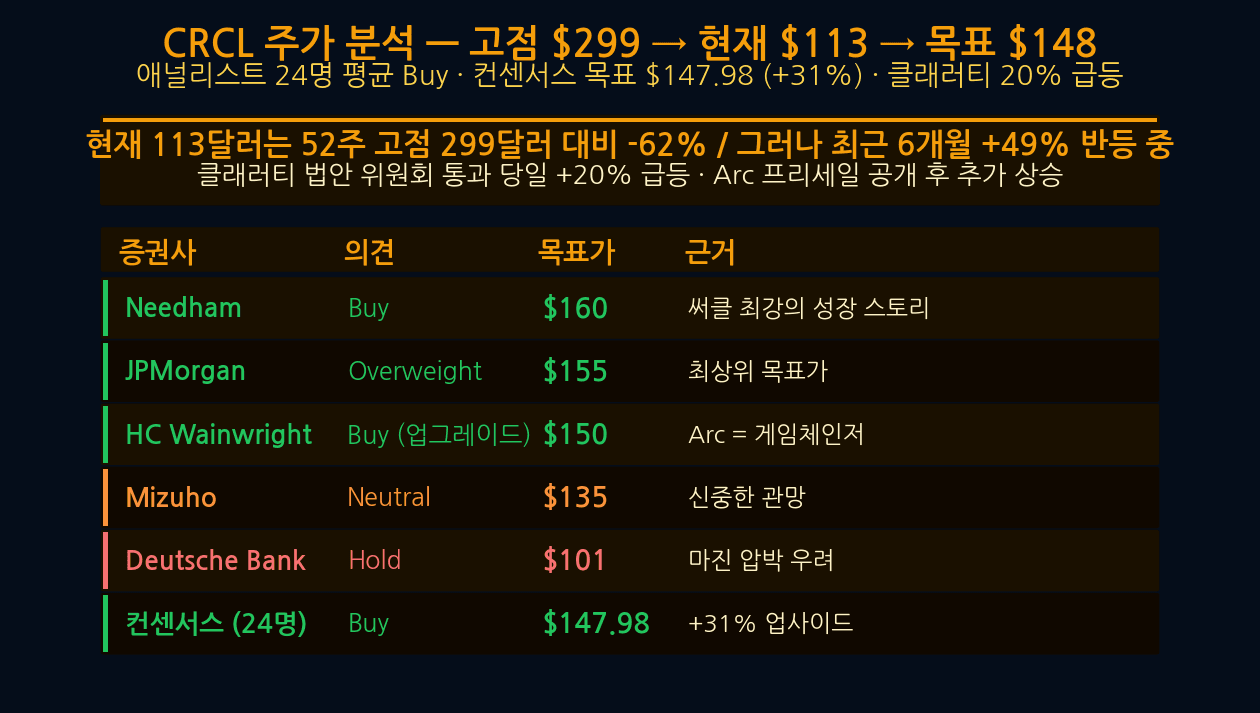
CRCL’s stock trajectory has followed a dramatic roller coaster since its IPO:
- IPO price: $31
- Post-listing high: $299 (institutional buying + stablecoin enthusiasm)
- Current price (as of May 22, 2026): $113
- 52-week range: $94 – $299
- Wall Street price target consensus: $180
At $113, the stock implies approximately 59% upside to the consensus target of $180. However, reaching that target requires: ① CLARITY Act passage on the Senate floor, ② successful Arc mainnet launch, and ③ visible growth in non-interest revenue. The prevailing view is that the current price already discounts a significant portion of regulatory uncertainty and interest-income risk.
6. CPN & Agent Stack: New Revenue Engines
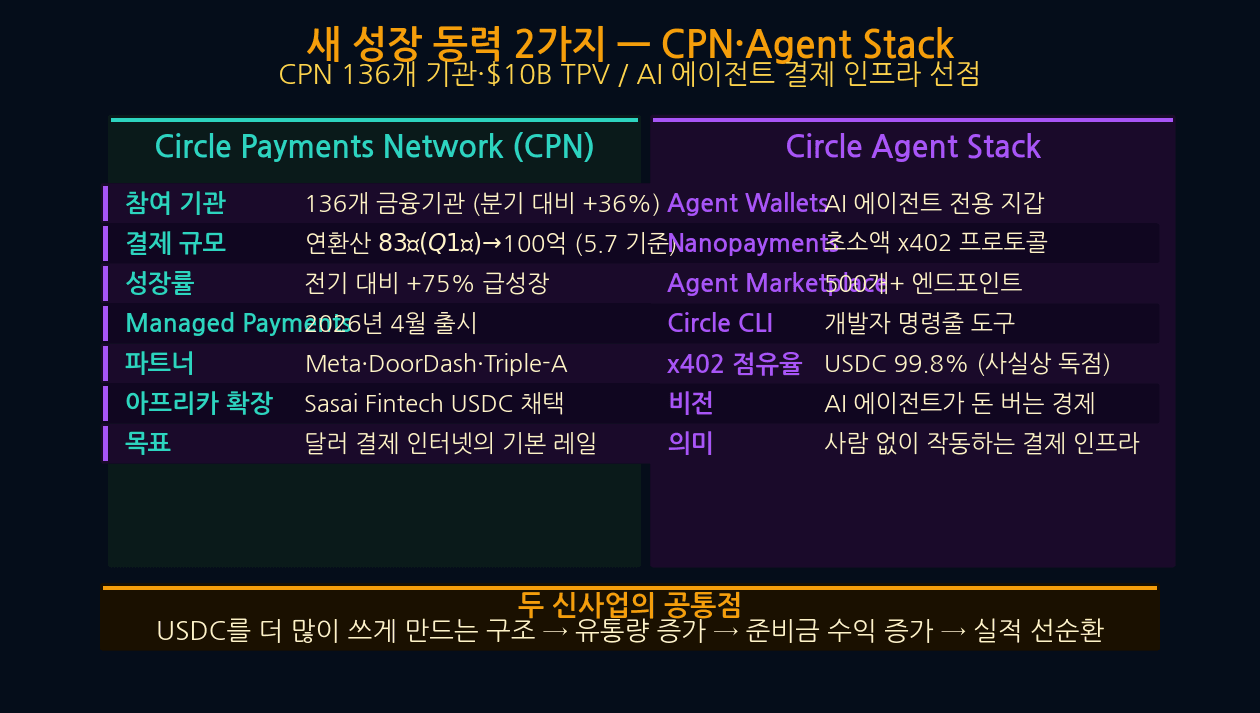
Circle Payment Network (CPN) is a B2B infrastructure for real-time dollar payments between enterprises settled in USDC. In 2026, the number of CPN-enrolled companies grew by more than 40% quarter-over-quarter, with monthly payment processing volumes expanding rapidly as well.
Even more noteworthy is the Agent Stack. As the era of AI agents executing payments autonomously arrives, Circle is proactively building stablecoin payment infrastructure specifically for AI agents. Key components include:
- Agent Wallet API — enables AI agents to independently send and receive USDC
- Programmable money features — conditional payments, automated settlement smart contract integrations
- Enterprise KYC layer — compliance automation in enterprise environments
- Integration with Arc Blockchain → cost-reduction synergies for CPN processing
CPN and Agent Stack are the core engines for building fee-based recurring revenue independent of interest income. As this revenue becomes visible, the case for valuation re-rating strengthens.
7. USDC vs USDT: Competitive Dynamics After Regulation
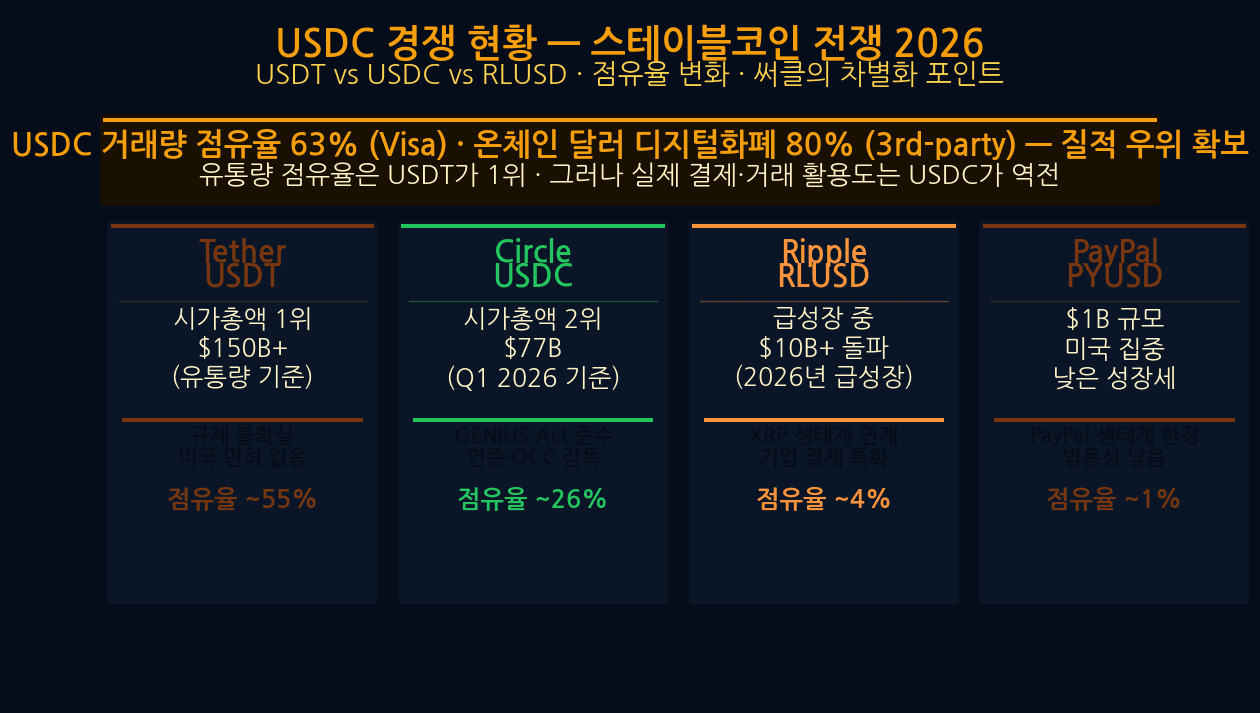
As of May 2026, stablecoin market share stands as follows:
- USDT (Tether) market cap: $143 billion — global #1, dominant in emerging markets and exchanges
- USDC (Circle) market cap: $62 billion — strong in U.S. and European institutional markets
- Market cap gap: approximately 2.3x
If the CLARITY Act passes the Senate floor, U.S. institutional investors and corporations will accelerate USDC adoption. Tether, operating outside the U.S. regulatory framework, may face restricted access to institutional clients. This regulatory asymmetry is the primary driver of potential USDC market share gains. That said, Tether’s dominance in emerging markets is unlikely to erode in the near term.
8. Three Key Catalysts for H2 2026
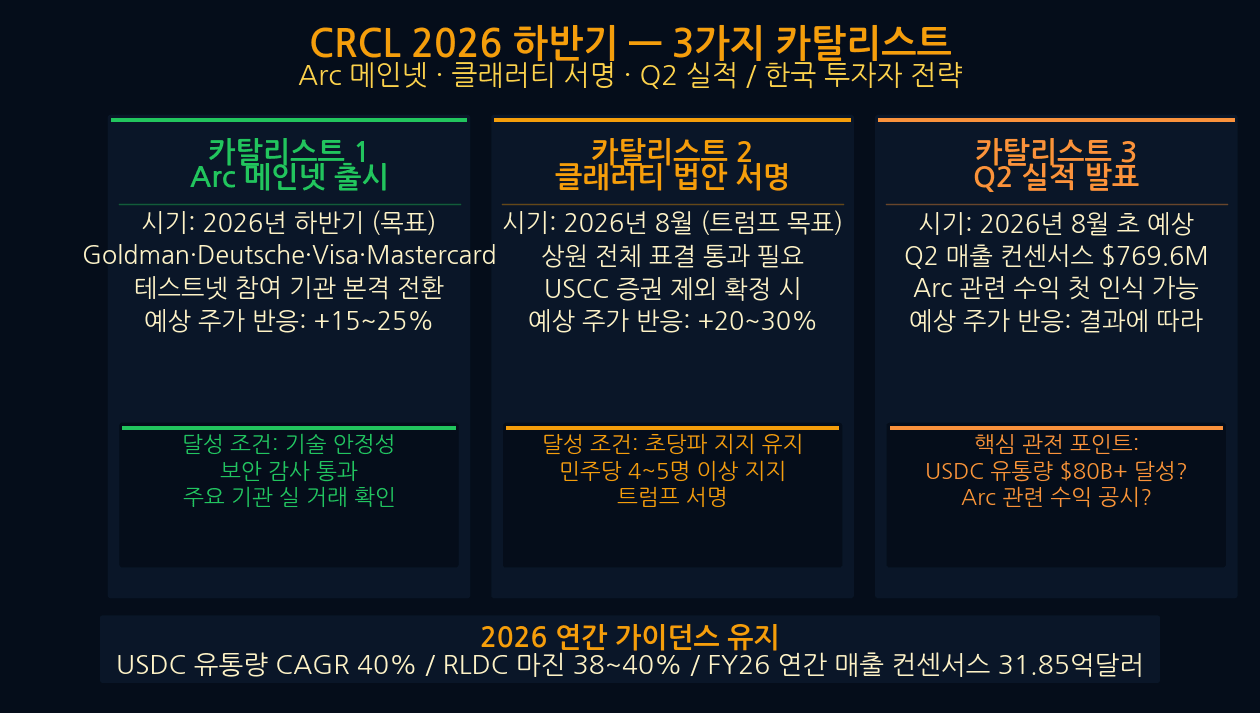
Below is a chronological summary of the major events that could materially impact CRCL’s stock in the second half of 2026:
- CLARITY Act Senate Floor Vote (expected: Q3 2026) — Passage would confirm USDC’s institutional status and accelerate adoption. Failure or significant amendments could trigger short-term price correction
- Arc Blockchain Mainnet Launch (expected: Q3–Q4 2026) — A successful launch is a valuation re-rating trigger. Number of ecosystem DApps and TVL (Total Value Locked) will be the key metrics
- Expanding Institutional Inclusion — Post-IPO lockup expiration complete; potential S&P 500 inclusion discussions underway. Passive fund inflows are a meaningful upside scenario
If all three catalysts materialize positively, the bull case goes well beyond the Wall Street consensus of $180. Conversely, a failed bill combined with an Arc launch delay would likely test the $94 support level.
9. CRCL Circle 2026 Analysis: Investor Strategy in Five Steps
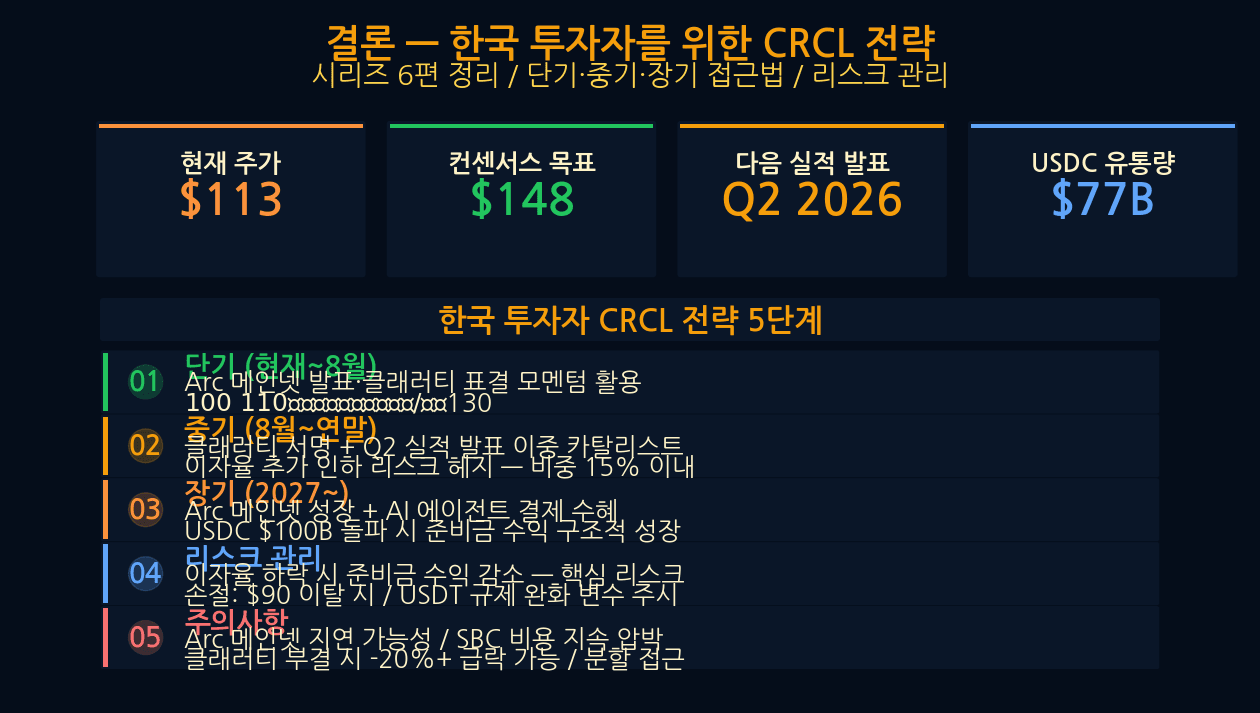
For investors interested in CRCL Circle 2026 analysis, here is a practical strategy framework. The following is provided for informational purposes only and does not constitute investment advice.
- Dollar-Cost Averaging Zone: $100 – $120 — At $113, the stock is approximately 20% above the 52-week low of $94. Rather than aggressive entry, a 2–3 tranche DCA approach is recommended to manage average cost basis
- Primary Price Target: $180 — Wall Street consensus target. CLARITY Act Senate passage is the near-term scenario for reaching this level
- Stop-Loss Level: $85 — A break below the 52-week low of $94 signals a trend reversal. A breach of $85 indicates structural risk expansion
- Re-evaluate Position if CLARITY Act Fails — Bill failure would delay the USDC institutional adoption timeline by at least 1–2 years, necessitating a full strategy reset
- Maintain Position Size Below 5% of Portfolio — Given the high-growth, high-volatility nature of this sector, excessive concentration is risky. Total crypto-related equity exposure should also be managed holistically
CRCL is not merely a stock — it is a bet on the core infrastructure of dollar digitization. Continuously monitoring both the regulatory environment and technological execution capability is the essence of long-term investing in this name.
📌 Disclaimer: This article is written for informational and analytical purposes only. It does not constitute investment advice or a financial recommendation. All investment decisions are made at your own discretion and risk.