
W6 — CRCL 2026 calendar: CLARITY May 14 markup and Q2 earnings
W Insights · W6 · May 12, 2026

CRCL 2026 calendar boils down to one Senate markup on May 14. The CLARITY Act vote, quarterly earnings, shareholder mix, lockups, and RSU vesting all converge inside a five-month window before August recess.
2026 is the year Circle Internet Group (NYSE: CRCL) effectively settles its identity. The U.S. digital-asset market-structure bill (CLARITY Act), the quarterly earnings cadence, and the first fully post-lockup shareholder base are all moving at the same time.
The five months to August 2026 are the inflection point in CRCL’s life
Regulation, earnings, and new business lines move in sync
The schedule is dense enough that without a single calendar view, even attentive investors will miss anchors. This piece pulls the CRCL 2026 calendar into eight pivots — the CLARITY Act path, quarterly earnings, shareholder mix, lockup status, employee RSU vesting, media tone, the CRCL-vs-BTC weekly chart, and a one-page year summary.
1. CLARITY Act — the May 14 markup is the hinge of the CRCL 2026 calendar
The single heaviest event in the CRCL 2026 calendar is the U.S. digital-asset market-structure bill known as the CLARITY Act.
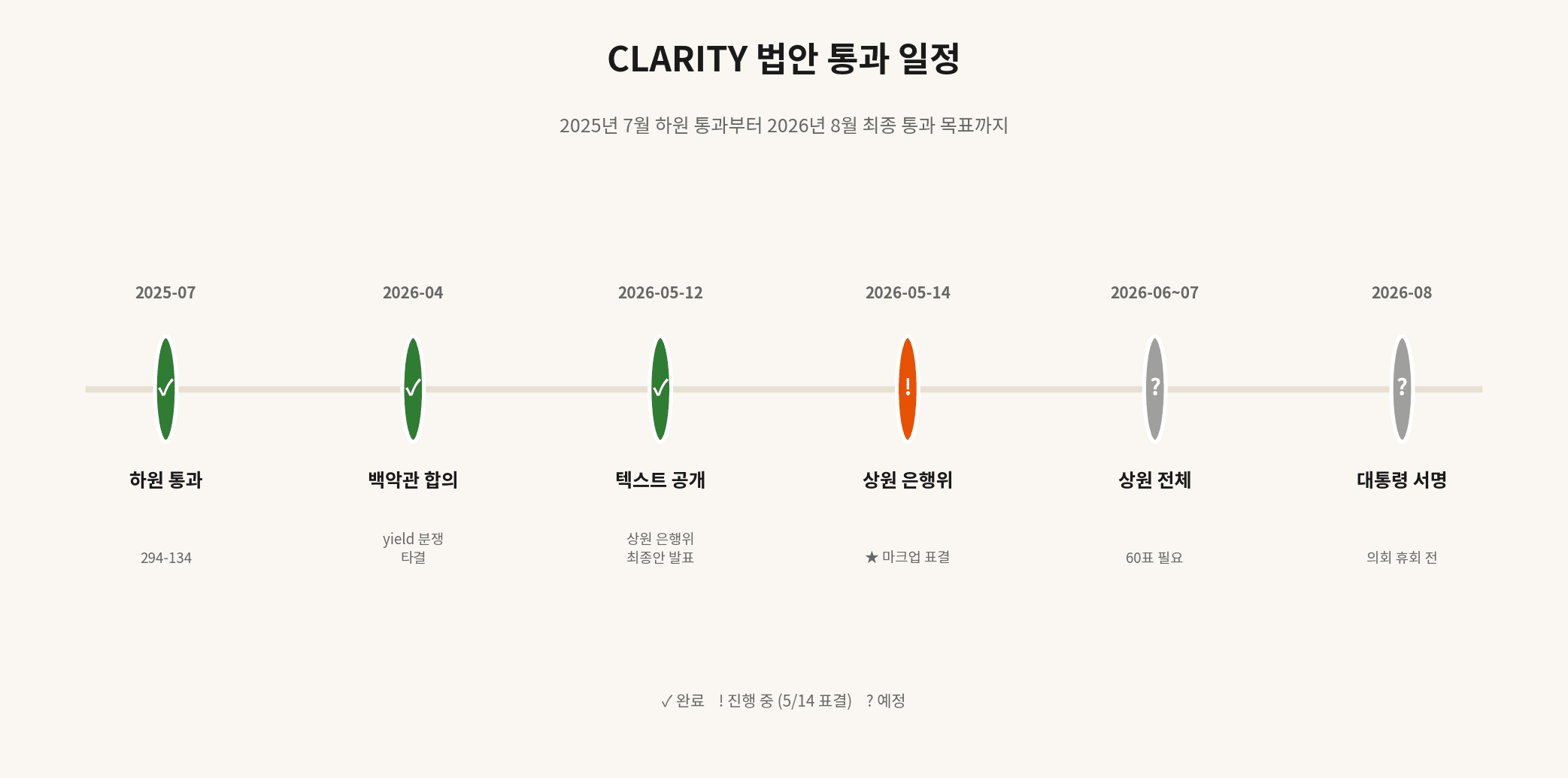
- July 17, 2025 — passed the House 294–134
- Mid-April 2026 — White House reaches a deal on stablecoin yields
- May 12, 2026 — Senate Banking releases final bill text
- May 14, 2026 — Senate Banking markup
- June–July (expected) — full Senate floor vote
- Before August recess — final passage target
Probability of passage — Polymarket 75%, Kalshi-style trackers 89%. Window closes at the October 5 midterm-campaign recess. Miss it and the bill could slip past 2030.
The reason CLARITY matters for CRCL is simple. Passage settles the SEC-vs-CFTC jurisdictional split and defines the legal perimeter for stablecoin issuers. The regulatory-uncertainty discount that has dogged Circle as a U.S.-domiciled USDC issuer would lift in one stroke. CoinDesk’s policy desk reads the same way.
2. Quarterly earnings — Q1 closed May 11, next print Aug 11
The earnings cadence is already locked in. Q1 2026 dropped yesterday (May 11). After that, August, November, and next February each carry a print the market will trade around.
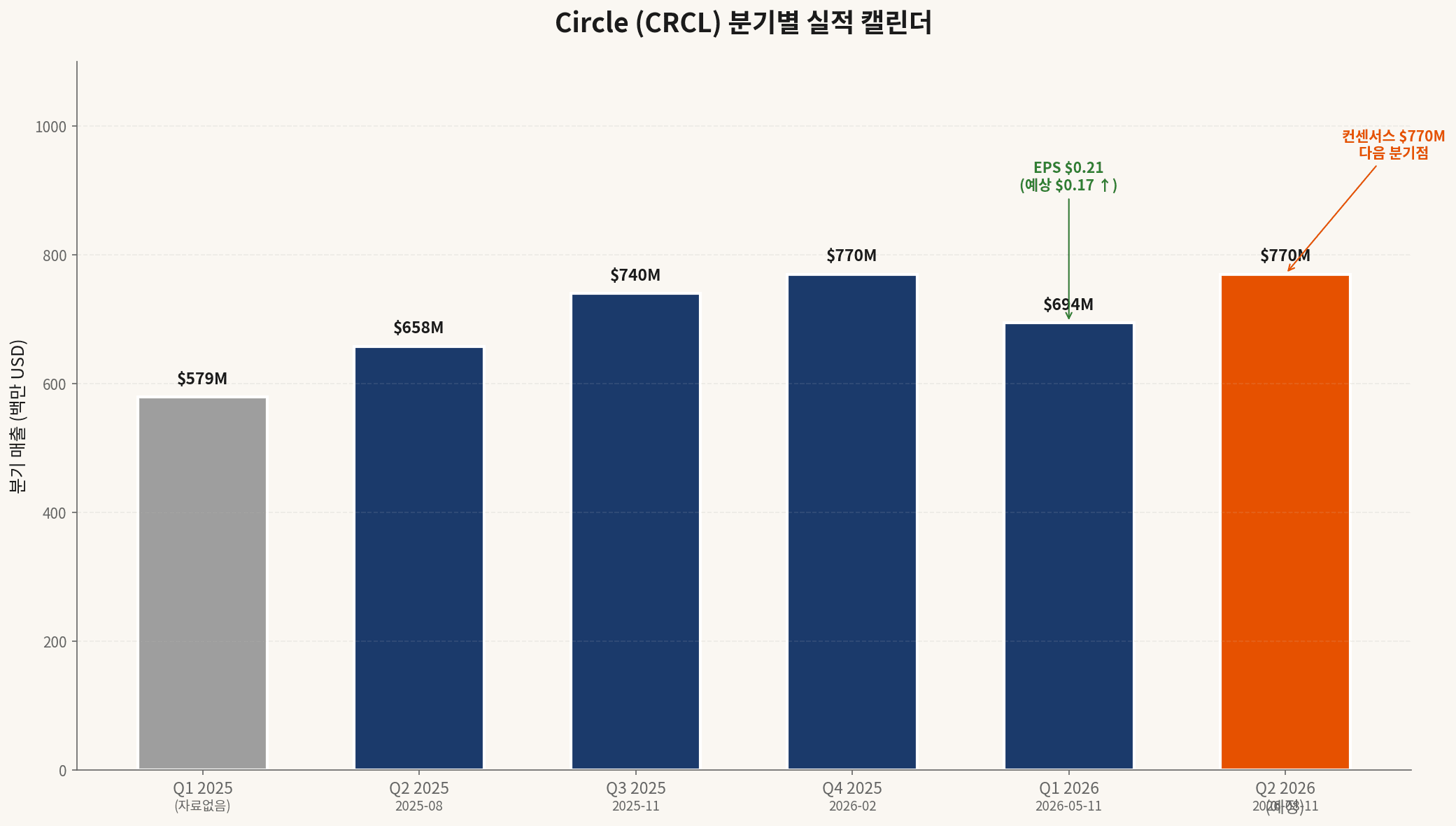
Q1 2026 — headline numbers (released May 11)
| Metric | Q1 2026 | YoY |
|---|---|---|
| Revenue and reserve income | $694M | +20% |
| Net income | $55M | -15% |
| Adjusted EBITDA | $151M | +24% |
| USDC market cap | $77B | +28% |
| On-chain volume | $21.5T | +263% |
| Adjusted EPS | $0.21 | beat $0.17 |
Revenue came in light of the $714.9M consensus, yet shares traded +5% in the post-print premarket. Markets clearly weighted the full-year guide and the ARC token presale above the headline miss.
Next print: August 11, 2026 (Q2)
2026 revenue consensus sits near $3.185B. Q1’s $694M run-rate implies the company has to average roughly $830M per quarter the rest of the way. A Fed cutting cycle compresses SOFR-linked reserve income; USDC supply growth has to lean against it for the math to work. That tug-of-war runs the full year.
3. Shareholder mix — 71% institutional, General Catalyst on top
CRCL’s current ownership map looks nothing like the day-after-IPO snapshot. As lockup supply cleared, mainstream institutional money quietly took the seats.
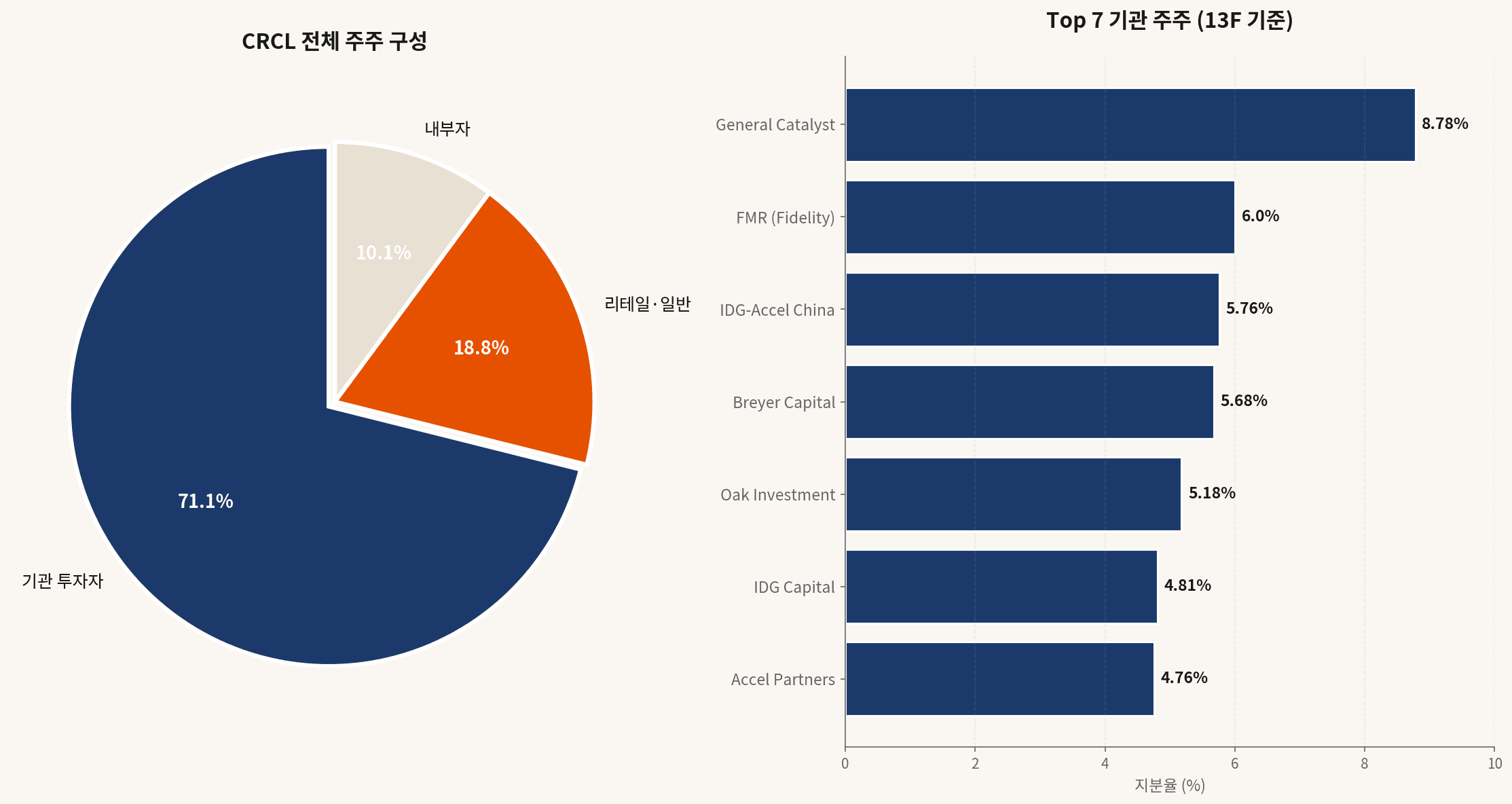
Per the latest 13Fs, General Catalyst (8.78%) is the single largest holder, followed by Fidelity (6.00%), IDG-Accel (5.76%), Breyer Capital (5.68%), and Oak Investment (5.18%). BlackRock, Vanguard, ARK Investment Management, Citadel, and Susquehanna all show in the filings. CRCL is already a fully main-stream U.S. equity holding.
On May 8, 2026, an a16z-crypto-led ARC token presale pulled $222M from BlackRock, Apollo, ICE, Standard Chartered Ventures, and ARK Invest. ARC was priced at a $3B FDV — an indirect read on how Wall Street is willing to mark the broader Circle stack.
4. Lockups — no additional 2026 events
All CRCL lockups cleared in 2025. No additional IPO-lockup events hit the CRCL 2026 calendar. Q4 2025 supply shock has been absorbed; the current $115 share price has fully recovered from that overhang.
CORE TAKEAWAY
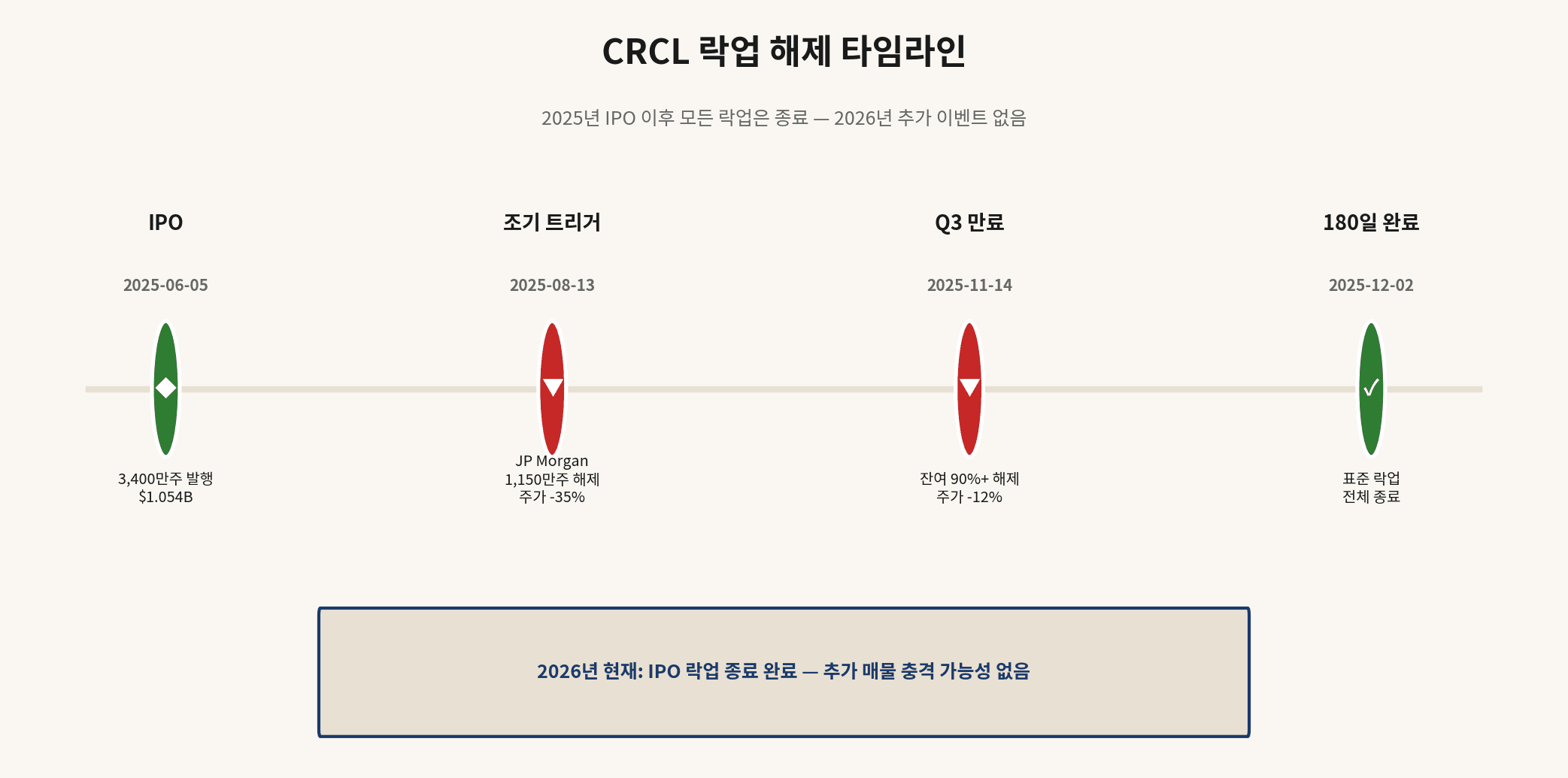
The sequence: on Aug 13, 2025, an early trigger released 11.5M shares held by JP Morgan, taking the stock down -35%. The Nov 12 Q3 print activated the early-expiry trigger; on Nov 14, more than 90% of remaining locked supply unlocked and shares fell another -12%. The standard 180-day lockup closed on Dec 2, ending the entire schedule.
★ Separate variable — ARC presale buyers face an additional 1–4 year lock from the moment ARC migrates to PoS/DPoS. If the chain isn’t live by May 8, 2028, refund rights activate.
5. Employee RSU vesting — recurring quarterly sell pressure
Post-IPO, Circle’s employee equity grants are vesting in earnest. Each quarter brings a routine of executives and staff receiving RSU tranches and either liquidating part for taxes or selling outright.
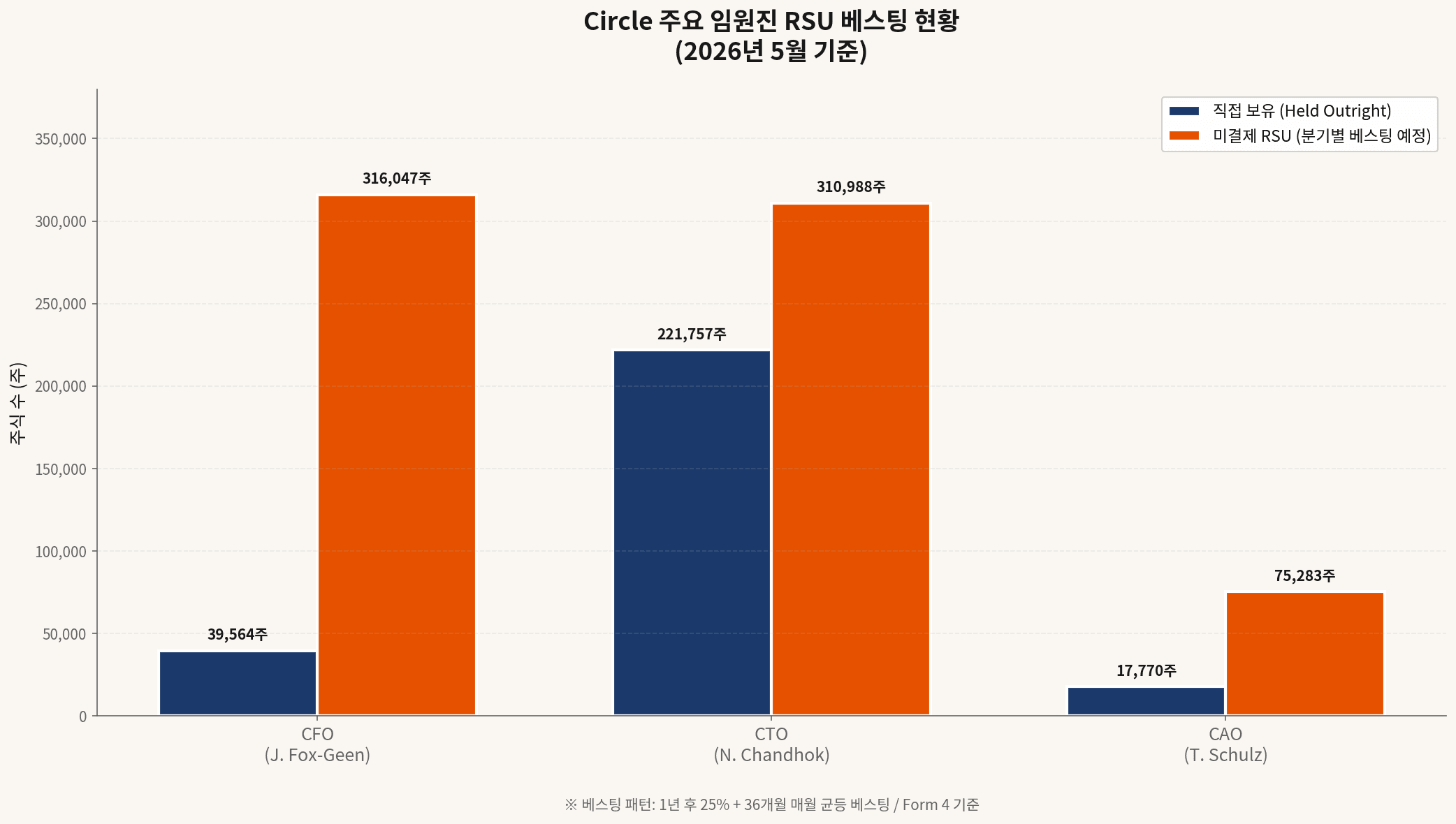
- 2026-05-01 — CTO Nikhil Chandhok, 3,816 shares withheld for taxes after vesting ($90.88), 310,988 RSUs outstanding
- 2026-05-01 — CFO Jeremy Fox-Geen exercised 7,200 options, sold at $92.64, 316,047 RSUs outstanding
- 2026-04-01 — CAO Tamara Schultz vested and sold a tranche, 75,283 RSUs outstanding
- 2026-02–04 — CFO Fox-Geen Rule 144 split sales (2/26, 3/2, 3/3, 4/1)
Standard vesting cadence drips on the 1st of each month. Option vesting follows the textbook “25% after a one-year cliff, then monthly over 36 months” grid. On top of that, a Circle Foundation donation moves 268,239 shares across four equal quarterly transfers during 2026 — about $32.6M at the May 6 close of $121.80.
⚠ Watch — Q1 2026 operating expenses jumped +76% mostly because post-IPO stock-based compensation roughly quadrupled. Management quietly reset the adjusted-EBITDA definition this quarter to exclude payroll taxes on stock comp — a signal they expect the line to stay elevated.
6. Media reading — 16 bullish vs 14 bearish signals
To stress-test the CRCL 2026 outlook, the right move is to see how the market is actually narrating it. Over the past month (April 12 to May 12), CNBC, CoinDesk, Yahoo Finance, Seeking Alpha, Newspim, PYMNTS, and Bernstein collectively produced a balanced split.
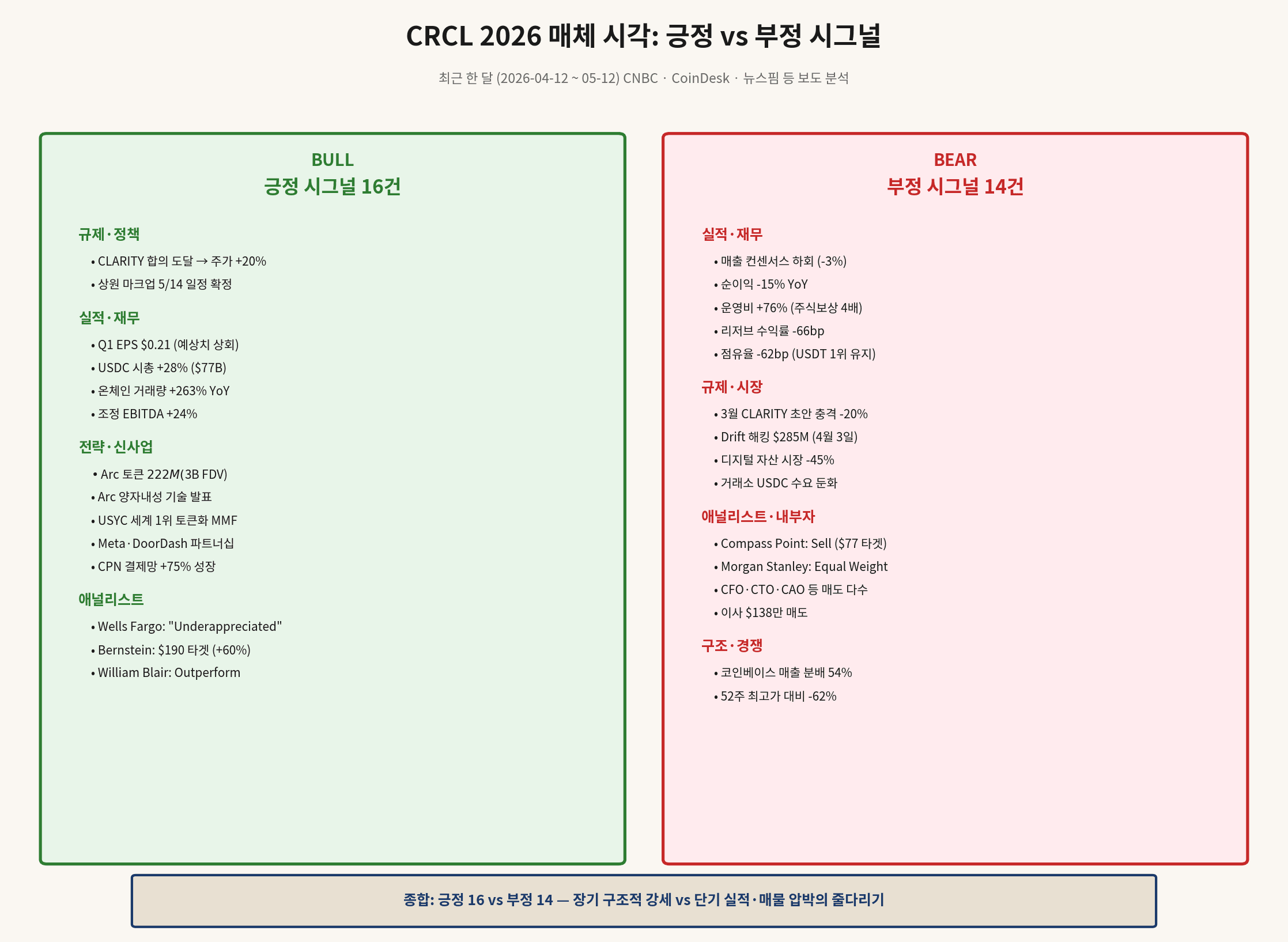
| ✓ Bullish (16) | ✗ Bearish (14) |
|---|---|
| [Policy] CLARITY deal → stock +20% / May 14 markup confirmed | [Earnings] Revenue miss -3% / Net income -15% YoY / Opex +76% / Reserve yield -66bp |
| [Earnings] EPS $0.21 (beat $0.17) / USDC +28% to $77B / EBITDA +24% | [Market] March CLARITY draft -20% / Drift hack $285M / Digital assets -45% |
| [New business] Arc $222M ($3B FDV) / USYC tokenized MMF #1 / Meta and DoorDash partnerships | [Analyst/insider] Compass Point Sell ($77) / Morgan Stanley Equal Weight / CFO, CTO, CAO selling |
| [Analyst] Bernstein $190 (+60%) / William Blair Outperform | [Structure] Coinbase revenue share 54% / -62% from 52-week high |
16 bullish, 14 bearish — split, but asymmetric. Bulls anchor on long-run structural drivers (regulation, institutions, AI). Bears anchor on near-term earnings and supply (revenue mix, insider selling, rates). Which side you sit on depends on your holding period.
Aggregate view
⚠ For Korea-based investors — U.S. after-hours prints land in the middle of the Korean night, and the first reaction is usually done by the time the regular session opens here. CLARITY-vote headlines behave the same way. Reacting after the fact is hard, so sizing the position ahead of the event is the safer playbook. The Yahoo Finance CRCL page shows pre-market action live.
7. CRCL vs BTC weekly — eleven months on one chart
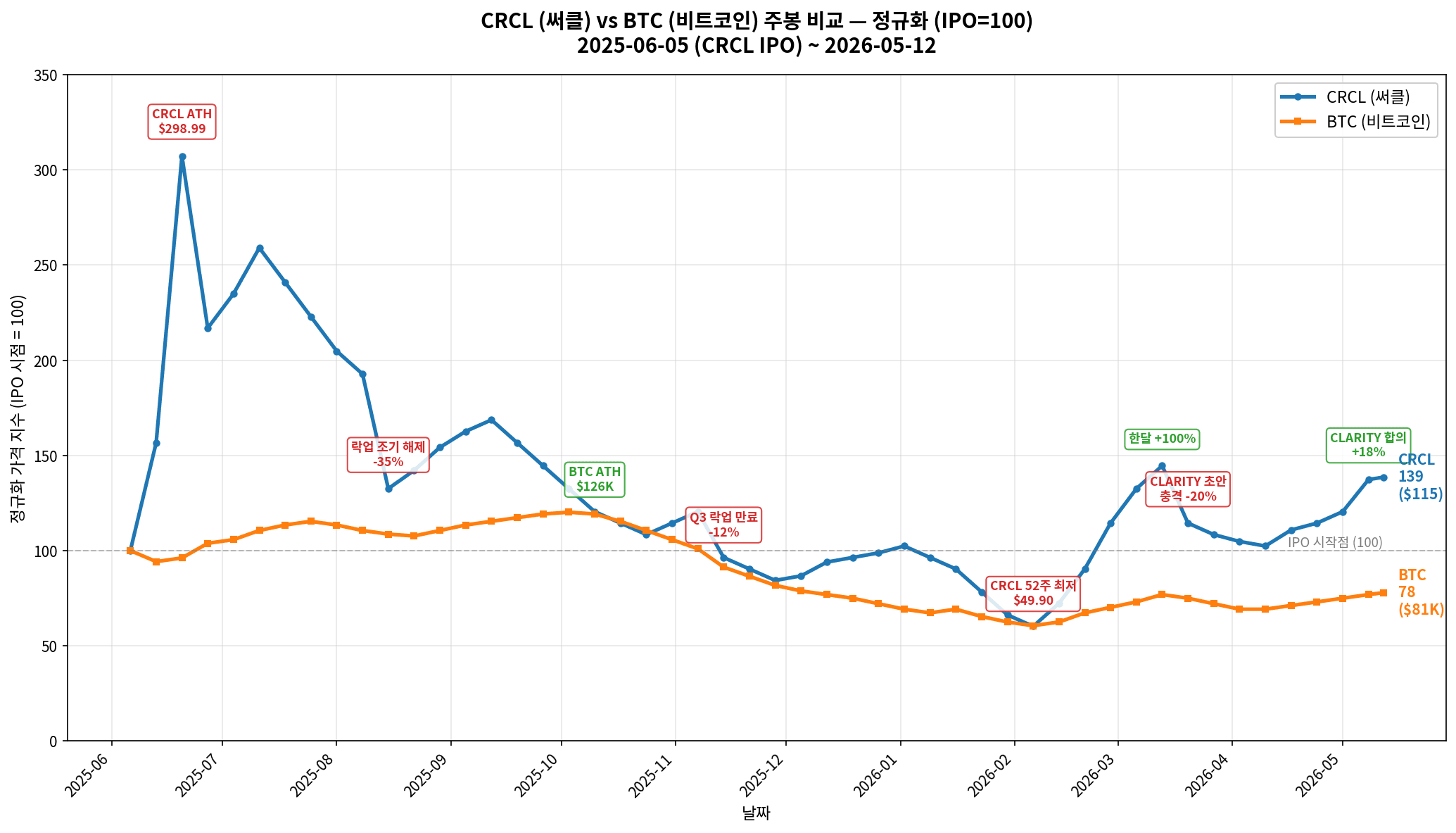
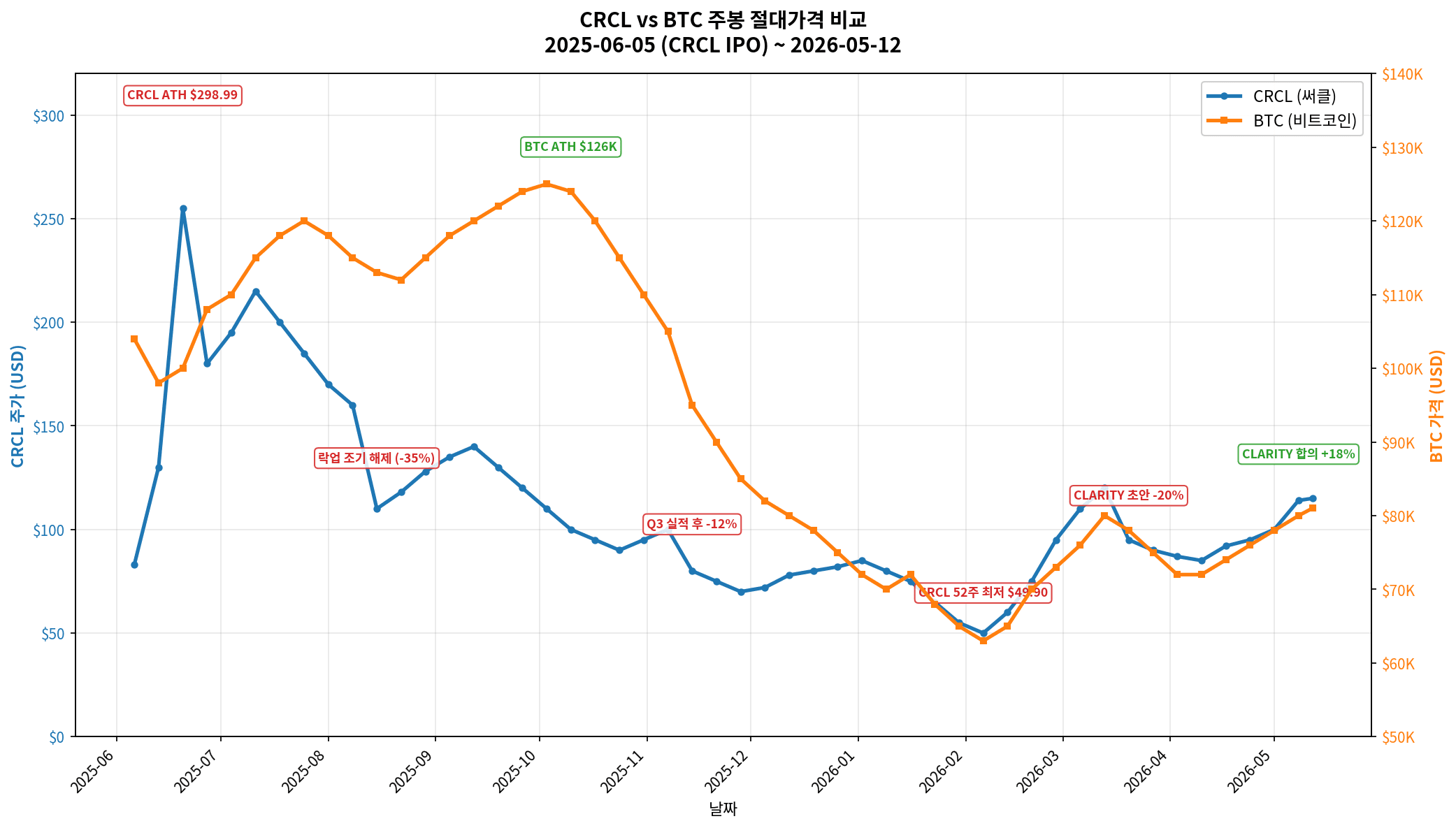
To judge the CRCL 2026 outlook you have to see how closely Circle has traded with Bitcoin. A stablecoin issuer can’t fully escape the crypto cycle. The weekly data from the June 5, 2025 IPO through May 12, 2026 — about 50 weeks — tells the story.
Normalized comparison (IPO = 100)
Absolute prices, dual axis
| Metric | CRCL | BTC |
|---|---|---|
| IPO-week close | $83 | $104,000 |
| Period high | $298.99 (6/23) | $126,272 (10/6) |
| Period low | $49.90 (2/5) | ~$63,000 (2/6) |
| Current (5/12) | $115 | ~$81,000 |
| Return since IPO | +38.6% | -22.1% |
| High/low spread | ~6x | ~2x |
| Correlation | 0.605 (moderate positive) | |
Four takeaways
1. CRCL is far more volatile than BTC. Across 11 months its high-to-low spread was 6x; BTC’s was ~2x. Owning CRCL effectively pays for the volatility profile of 3x-leveraged BTC.
2. The first four months tracked nothing. June through October 2025 was governed by Circle-specific events — IPO frenzy, lockup anxiety, insider selling. Even as BTC printed an all-time high near $126K, CRCL fell -35% on the JP Morgan lockup release.
3. From November 2025 the chart converged. Once lockups cleared, CRCL began moving with the macro crypto cycle. Both names bottomed together in early February 2026.
4. Since February 2026 CRCL has outrun BTC. Q4 results and CLARITY momentum produced a +100% bounce in two months; BTC was up about +20% over the same span. The stablecoin business is starting to decouple from the crypto price cycle and build its own momentum.
A 0.605 correlation reads as “moves together somewhat, but not the same trade.” Treating CRCL as a BTC substitute is wrong — it’s a separate asset with its own engine. Pairing BTC and CRCL in a portfolio can become double exposure rather than diversification; size accordingly.
8. Conclusion — the CRCL 2026 calendar on one page
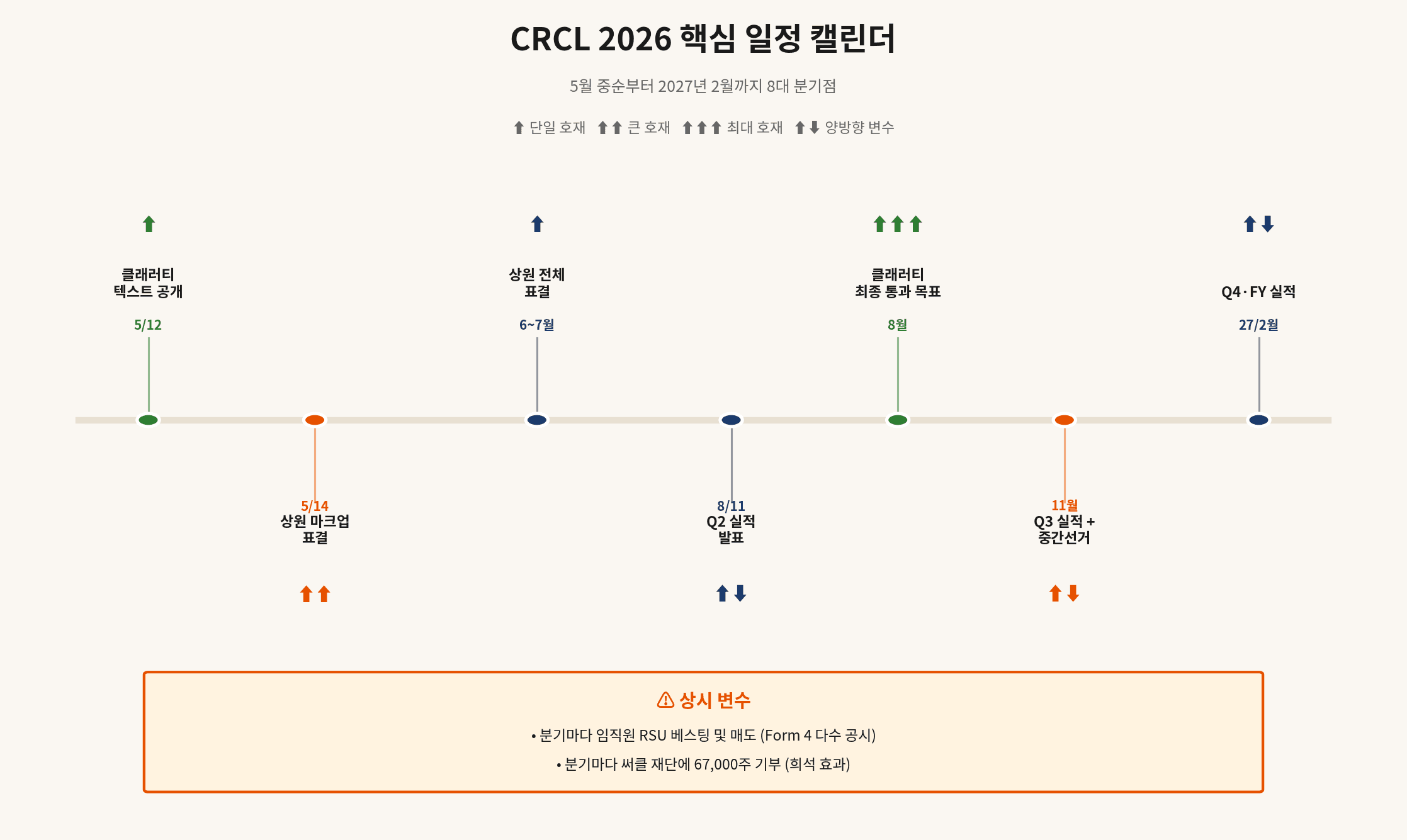
| Date | Event | Impact |
|---|---|---|
| 2026-05-12 | CLARITY Act text released | ⬆ Clarity |
| 2026-05-14 | Senate Banking markup | ⬆⬆ Core |
| 2026-08-11 | Q2 2026 earnings | ⬆⬇ Guidance |
| August 2026 | CLARITY final passage target | ⬆⬆⬆ Biggest catalyst |
| November 2026 | Q3 earnings + midterms | ⬆⬇ Politics |
| February 2027 | Q4/FY earnings | ⬆⬇ Annual |
| Every quarter | RSU vesting and sales | ⬇ Supply |
| Every quarter | Circle Foundation 67,000-share donation | ⬇ Dilution |
The regulatory discount lifting
— CRCL 2026 calendar in one line
versus RSU supply and rate cuts pulling the other way
The dominant variable remains the CLARITY Act. Passage by August opens USDC and EURC to U.S.-domestic expansion under clear law, and accelerates ARC and USYC’s path into regulated rails. Slip past the recess and the November midterm risk lands all at once.
For investors the workable plan is: read the May 14 markup outcome, track the floor vote through June and July, then size into August 11 Q2 earnings. The CRCL 2026 calendar is, in the end, the story of how those three nodes resolve.