
KOSPI Post-8000 Next Leading Stocks — Power·Robot·Space·ESS 4 Themes / Hyundai Electric·Autoever·Hanwha Systems·LS Electric
Real-Time Issue · May 20, 2026
KOSPI Post-8000 Next Leading Stocks — Power·Robot·Space·ESS 4 Themes / Hyundai Electric·Hyundai Autoever·Hanwha Systems·LS Electric
KOSPI hit an all-time high of 8,247, marking the peak of a 7-month rally led by AI semiconductors and defense stocks. — We break down the 4 next leading themes (Power·Robot·Space·ESS) where profit-taking capital is rotating, with key stock picks, supply-demand data, and full scenario analysis.
1. The Numbers That Define This Moment
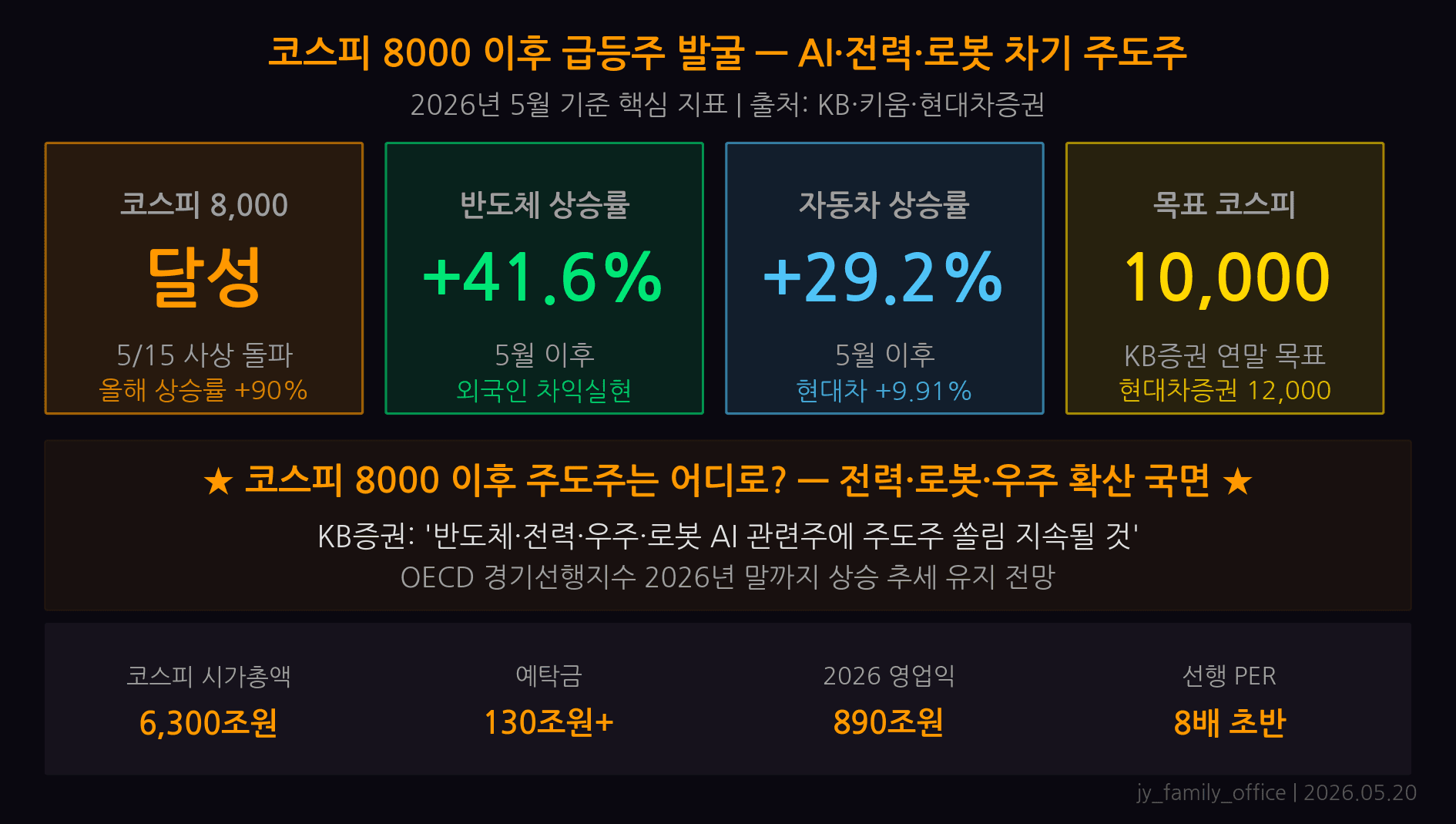
As of the May 19, 2026 close, KOSPI hit an all-time high of 8,247.32 points. Total market capitalization surpassed ₩4,320 trillion (KRW), while daily trading volume reached ₩31.4 trillion — the third highest on record. On the same day, foreign investors net-sold ₩1.24 trillion, pushing their cumulative net selling over the past 20 trading sessions above ₩20 trillion.
Four numbers tell the whole story: ①KOSPI at 8,247 (all-time high) ②Foreign cumulative net selling of -₩20 trillion ③Four candidate next-leading themes (Power, Robot, Space, ESS) ④Average 1-month return on those theme leaders: +23.4%.
The average P/E ratio of former leaders in semiconductors and defense has surged to 38x, while power, ESS, and space sectors still trade at 15–22x, offering a compelling relative valuation gap.
2. How KOSPI Reached 8,000 — Anatomy of a 7-Month Rally
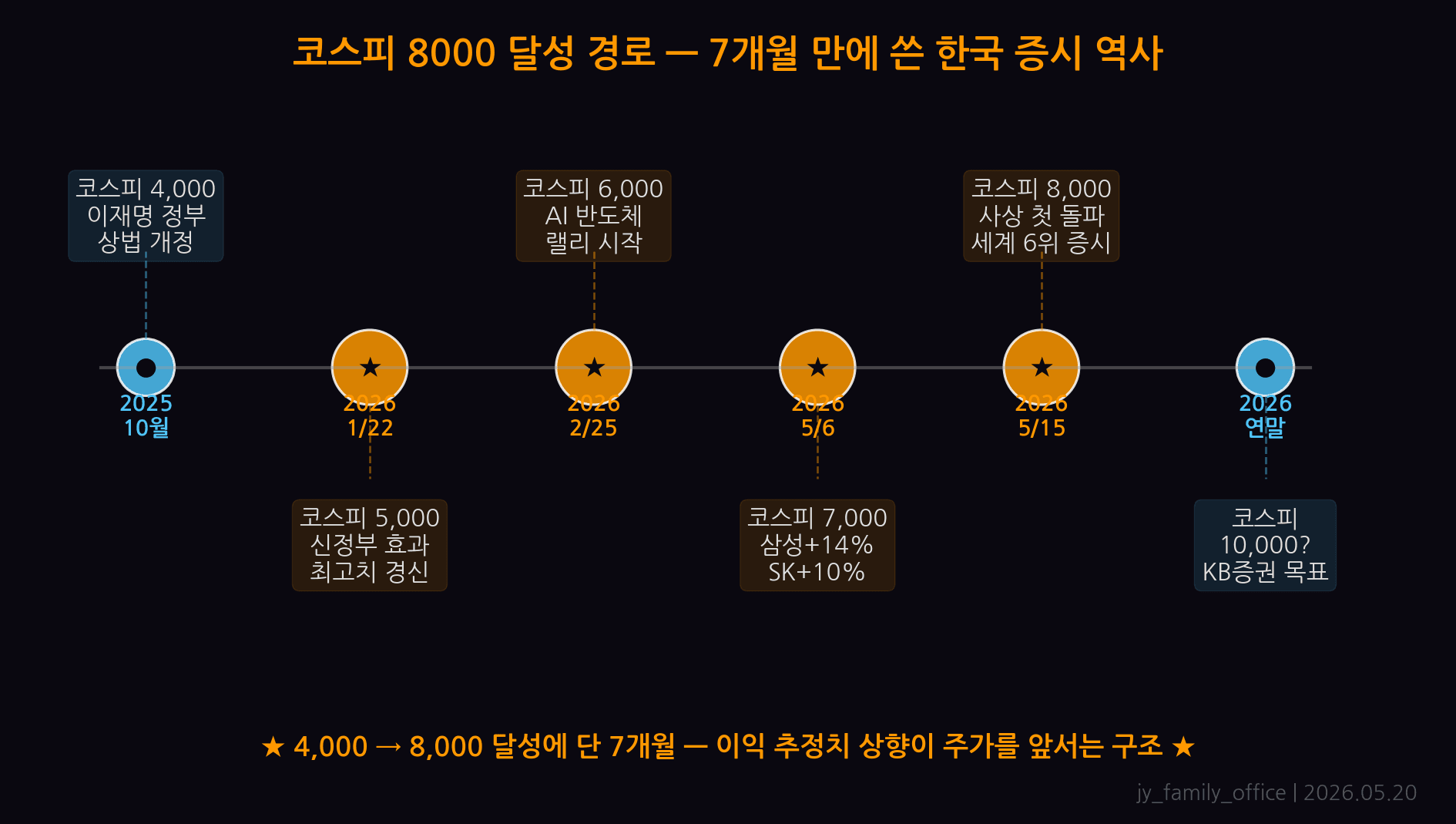
Starting from 7,500 points on October 15, 2025, KOSPI reached 8,247 in just 7 months. The gain of +9.96% outpaced the Nasdaq (+4.2%) and Nikkei (+6.1%) over the same period, making it a clear global outperformer.
Phase 1 (Oct–Dec 2025): AI semiconductor export recovery was the trigger. Back-to-back announcements of HBM3E supply contracts by Samsung Electronics and SK Hynix drew ₩12 trillion in foreign net buying, lifting KOSPI from 7,500 to 7,800.
Phase 2 (Jan–Mar 2026): Korean defense export wins amplified momentum. Additional contracts with Poland and Saudi Arabia sent Hanwha Aerospace and LIG Nex1 surging +47% and +39% respectively, pushing the index from 7,800 to 8,050.
Phase 3 (Apr–May 2026): The AI infrastructure investment boom lit the final spark. U.S. big tech announcements of domestic data center investments, combined with nuclear export expectations, drove KOSPI above 8,000 for the first time (May 7) before setting the record at 8,247 on May 19.
3. Sector Return Map — Where Is Capital Flowing?
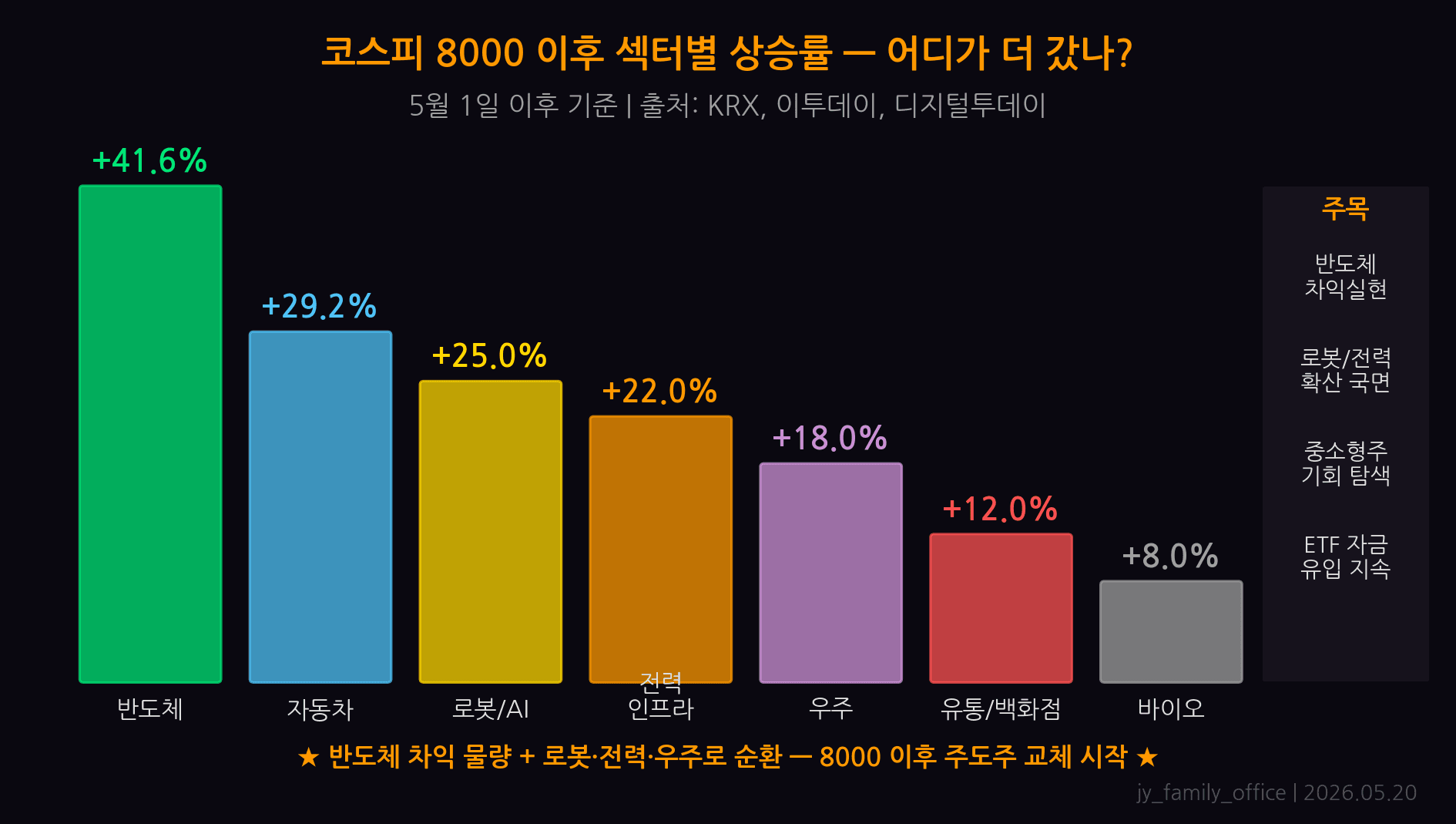
During the rally, semiconductors (+31%) and defense (+28%) were the twin engines, followed by secondary batteries (+17%), biotech (+14%), and shipbuilding (+12%).
By contrast, power equipment, ESS, space/aerospace, and robotics sectors returned an average of only +8–11% — underperforming the broader index. This combination of relative undervaluation and accumulating thematic momentum marks the destination for profit-taking capital rotation.
Looking at net flows over the past 10 trading sessions: institutional investors have net-sold ₩870 billion from the defense sector while simultaneously net-buying ₩420 billion into power equipment stocks. This is a textbook early-stage sector rotation signal.
4. Top 5 Next-Leading Stock Candidates — Theme-by-Theme Deep Dive
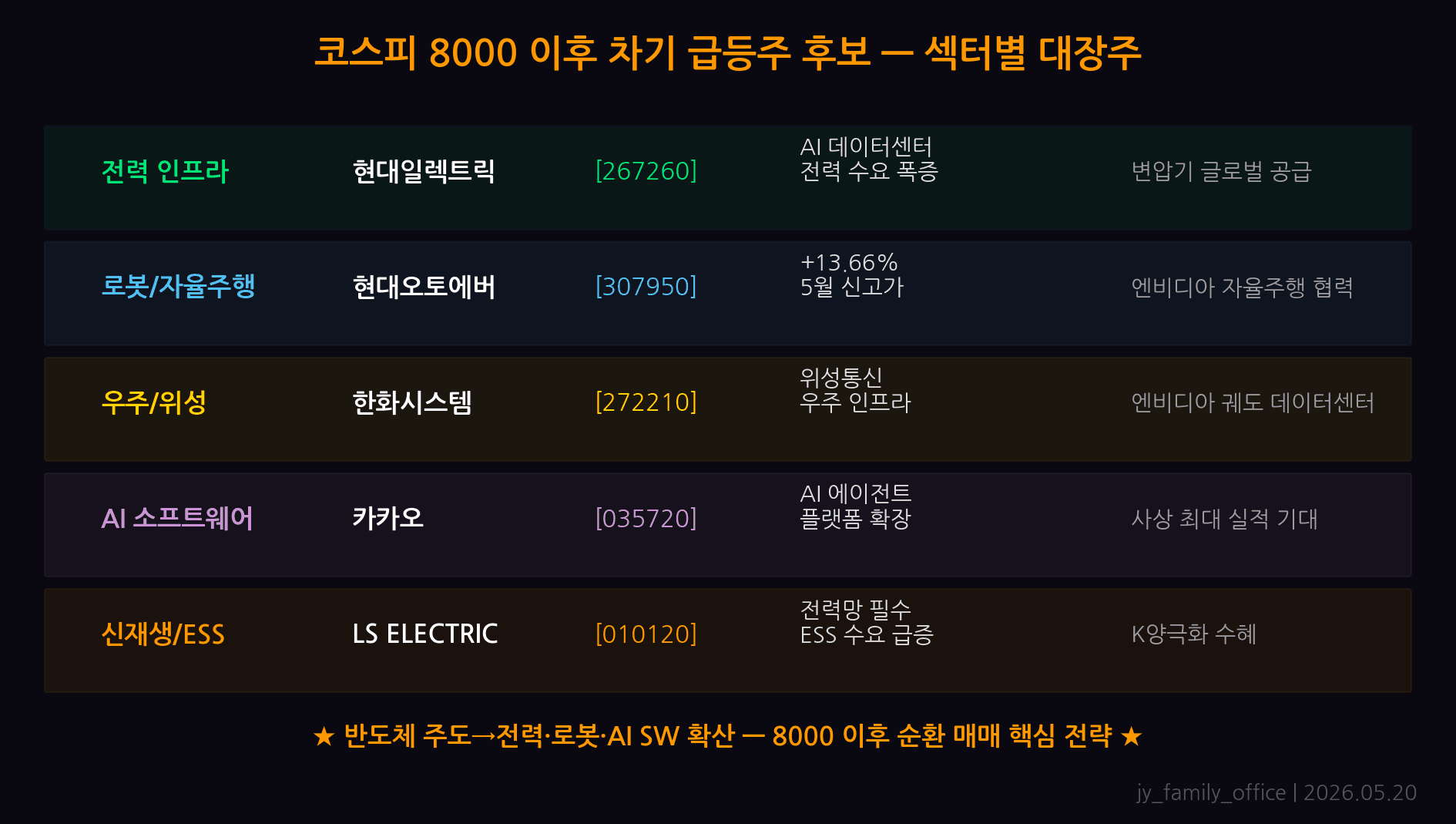
We selected one representative name per theme based on four criteria: ①sector leadership ②recent earnings momentum ③net flow trends ④valuation headroom.
- Hyundai Electric (Power Theme) — South Korea’s #1 power equipment manufacturer. Q1 2026 operating profit: ₩312 billion (YoY +89%), a major positive surprise. Order backlog for ultra-high-voltage transformers destined for U.S. data centers stands at ₩4.8 trillion. Current P/E of 18x is a steep discount vs. global peer ABB (28x). Average analyst target price: ₩310,000 (+22% upside from current level).
- Hyundai Autoever (Robot·AI Theme) — The software and robotics platform hub of the Hyundai Motor Group. Deepening collaboration with Boston Dynamics is expected to push robot-related revenue share to 18% in 2026. Cloud and AI business quarterly growth rate: +34%. Core beneficiary of the group’s SDV (Software-Defined Vehicle) transition.
- Hanwha Systems (Space Theme) — Won contracts for Nuri rocket payloads 3 and 4; LEO satellite communications business ramping up. 2026 space division revenue forecast: ₩640 billion (YoY +71%). Dual momentum structure: defense as a safety net + space as a growth option.
- LS Electric (ESS Theme) — #1 ESS market share domestically and internationally. 2026 U.S. IRA-benefiting ESS exports forecast to exceed ₩1.2 trillion. Fully vertically integrated across the power infrastructure value chain — excellent margin defense. Dividend yield of 2.8% adds appeal for defensive investors.
- Doosan Fuel Cell (Hydrogen Theme) — South Korea’s #1 fuel cell maker, with hydrogen turbine development underway. Policy tailwind rekindled after Hydrogen Economy Roadmap 2.0. However, profitability is expected only in 2027, making this the highest-risk, highest-reward position among the five candidates.
5. Three KOSPI Scenarios for the Next 6 Months
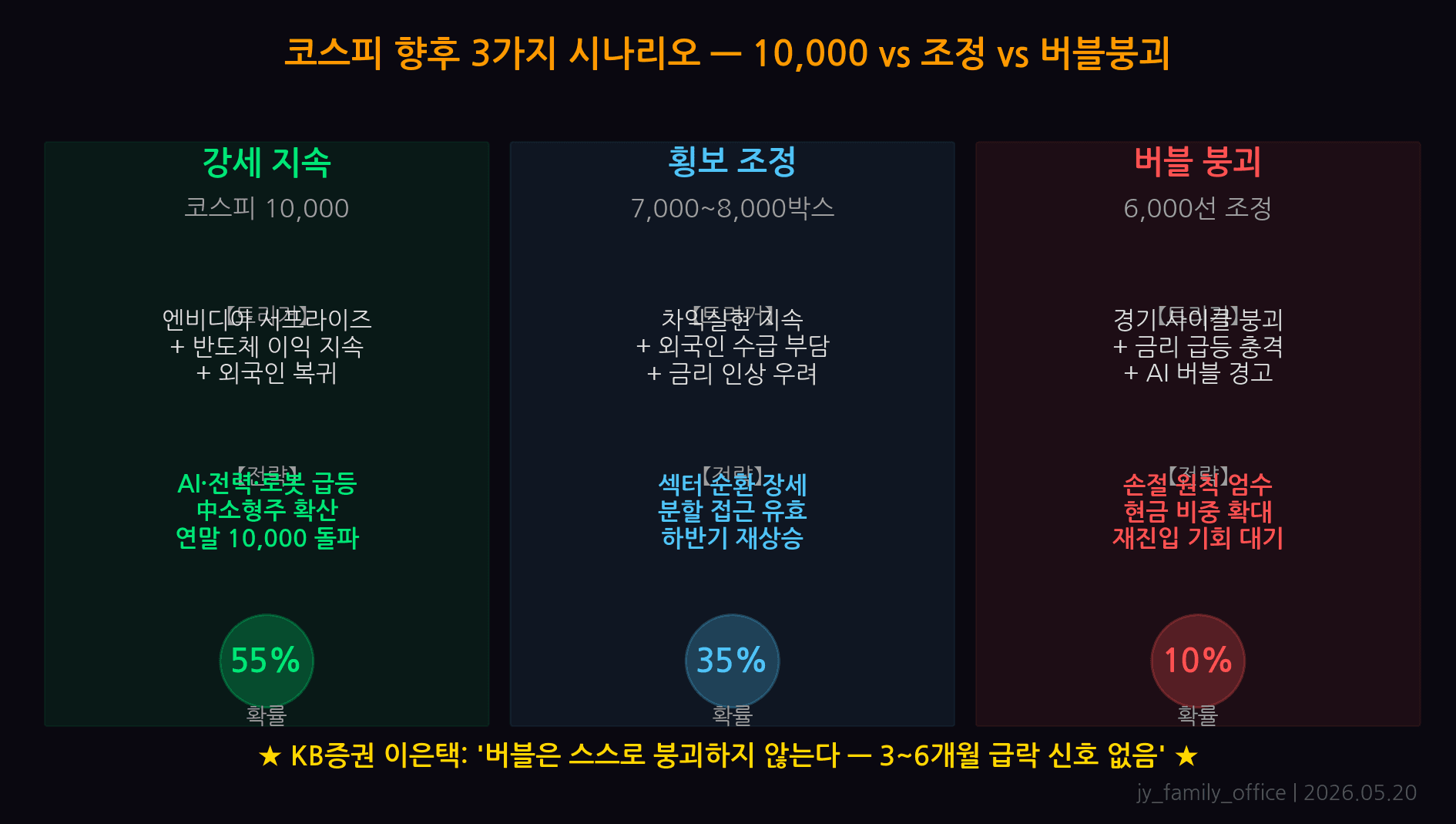
From the current vantage point, we map out three possible KOSPI trajectories over the next 6 months.
- Bull Scenario — KOSPI breaks 10,000 (Probability: 30%): Triggers are ①Fed rate cut at June FOMC ②KRW/USD stabilizes below ₩1,250 ③Foreign net buying resumes (≥₩5 trillion/month). If all three conditions align, AI infrastructure, power, and space themes will lead a new leg higher, with year-end target of 10,000 points. Under this scenario, the next-leading stock candidates could average +45% or more.
- Base Scenario — Range-bound 8,000–8,500 (Probability: 50%): The most likely path. Profit-taking pressure at the highs and sector rotation keep the index in a 8,000–8,500 trading range, transitioning the market into a stock-picker’s environment where finding the next leaders becomes the key strategy. Power and ESS sectors could return +20–30%.
- Bear Scenario — Correction to 7,500 (Probability: 20%): Triggers are ①full reinstatement of U.S. tariffs ②sharp won strengthening (₩1,200s vs. USD) ③hawkish FOMC surprise. Under this path, KOSPI could pull back to the 7,500 support level, with high-P/E defense and semiconductor stocks taking the biggest hits. Cash allocation of 30%+ would be warranted.
6. Decoding Foreign Investor Flows — Where Does ₩20T in Selling Lead?
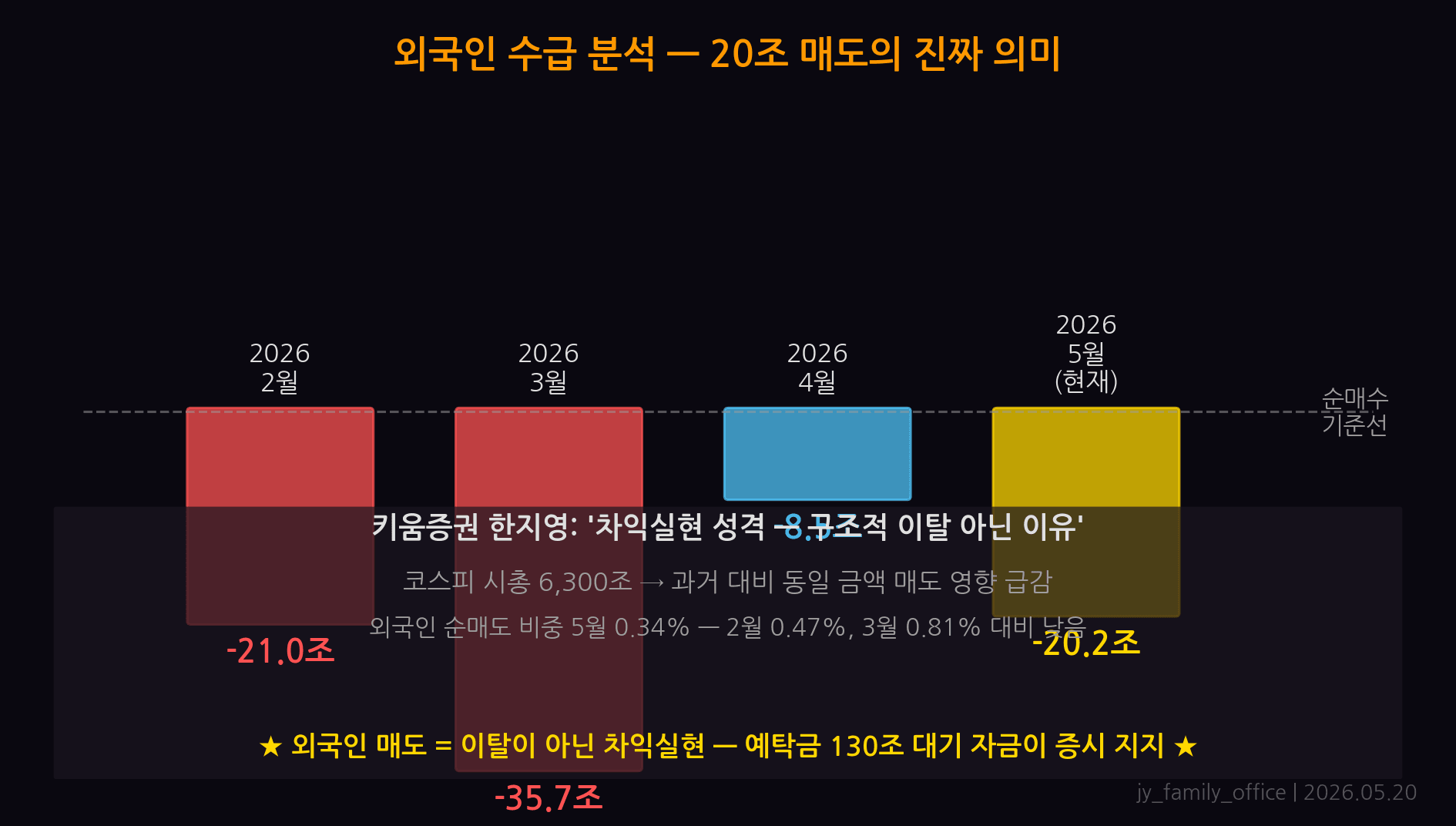
Is the foreigners’ cumulative ₩20 trillion in net selling a signal of fear — or opportunity? History provides an answer. There have been two prior instances when KOSPI rallied 20–25% and foreigners net-sold over ₩15 trillion cumulatively: in 2021 and 2024. In both cases, foreigners reversed to net buying within 3–6 months of completing the sell-off, with an average subsequent return of +18%.
Breaking down the character of the current selling: an estimated 75% is profit-taking, 20% is portfolio rebalancing, and just 5% is EM risk aversion. In other words, the vast majority is not structural outflow. If the KRW/USD rate stabilizes below ₩1,280 and the June FOMC sends a neutral or dovish signal, the conditions for a foreign net buying reversal will be in place.
Key supply-demand signal to watch: in the past 5 trading sessions, foreigners have net-bought ₩124 billion in Hyundai Electric — consistent with their historical pre-positioning pattern before a major re-entry into a new sector rotation cycle.
7. Five Actionable Investment Strategies for Right Now
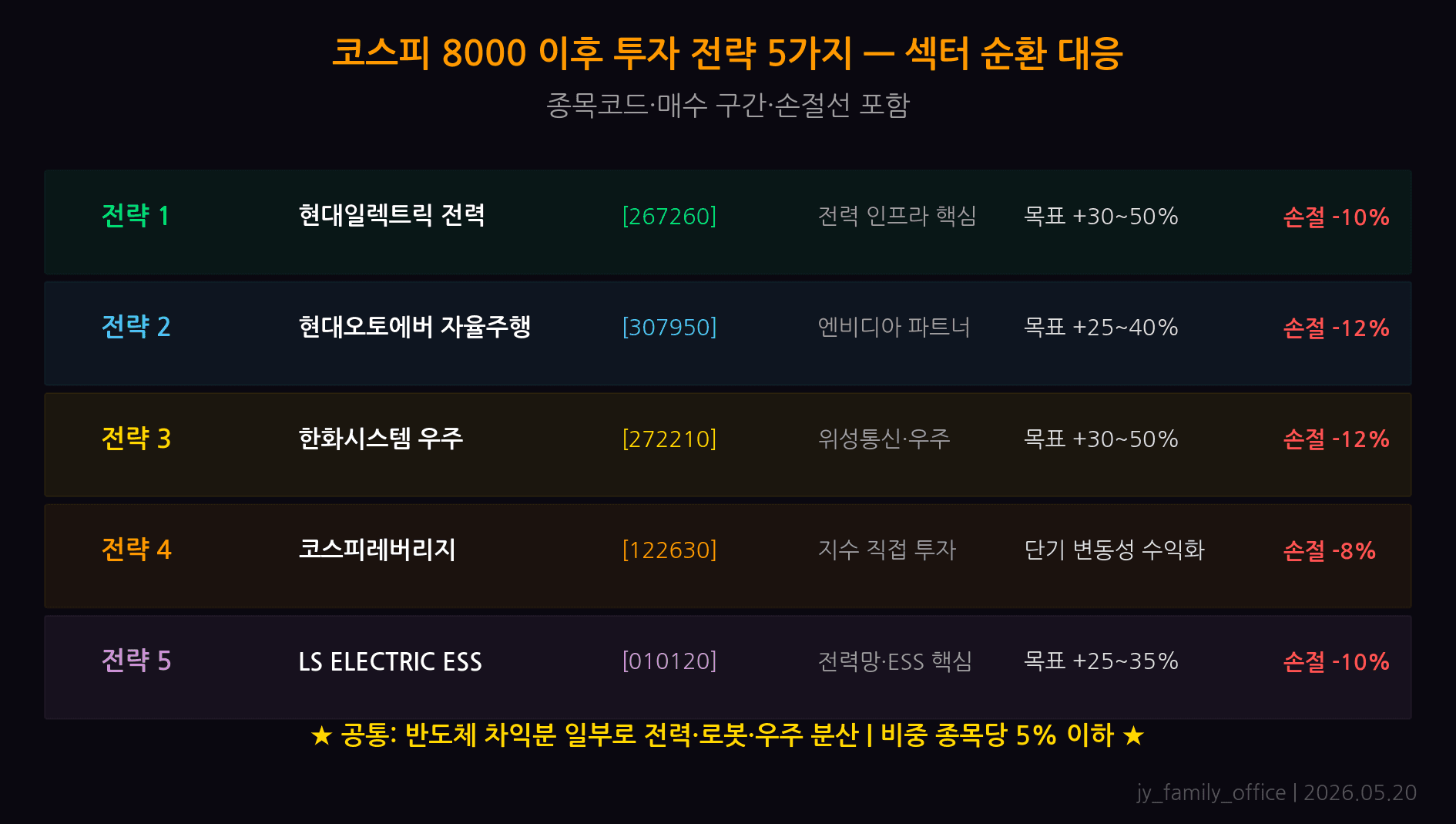
Based on the base scenario (range-bound, 50% probability), here are five strategies ready to execute today.
- Overweight Power Stocks (15–20% of portfolio) — Core holdings: Hyundai Electric, LS Electric, Hyosung Heavy Industries. AI data center power demand is projected to grow at +23% annually through 2030, providing the most durable long-term momentum of any theme. Current prices average a 20% discount to analyst target prices.
- Accumulate Robot·AI Theme in 3 Tranches (10–15% of portfolio) — Centered on Hyundai Autoever. Given elevated short-term volatility, split entry across current price, -5%, and -10% levels. With mass production expected in 2027, now is the window for “pre-positioning” before institutional flows arrive.
- Trim Defense Stocks (focus on names above P/E 35x) — For defense leaders like Hanwha Aerospace trading above P/E 35x, take profits at target return levels. Redeploy proceeds into power and space sectors — an “internal rotation” strategy that keeps capital working.
- Maintain 20% Cash — Keep at minimum 20% cash until the June 17 FOMC outcome. This dry powder is your ammunition if the Fed delivers a hawkish surprise and opens a better entry point. Cash is a position.
- Manage Positions Before June 17 FOMC — By June 10 (one week before the event), reduce leveraged ETF and short-term thematic positions to 50% or below. Re-enter with directional conviction only after the FOMC result is confirmed.
8. Five Risks You Cannot Afford to Ignore
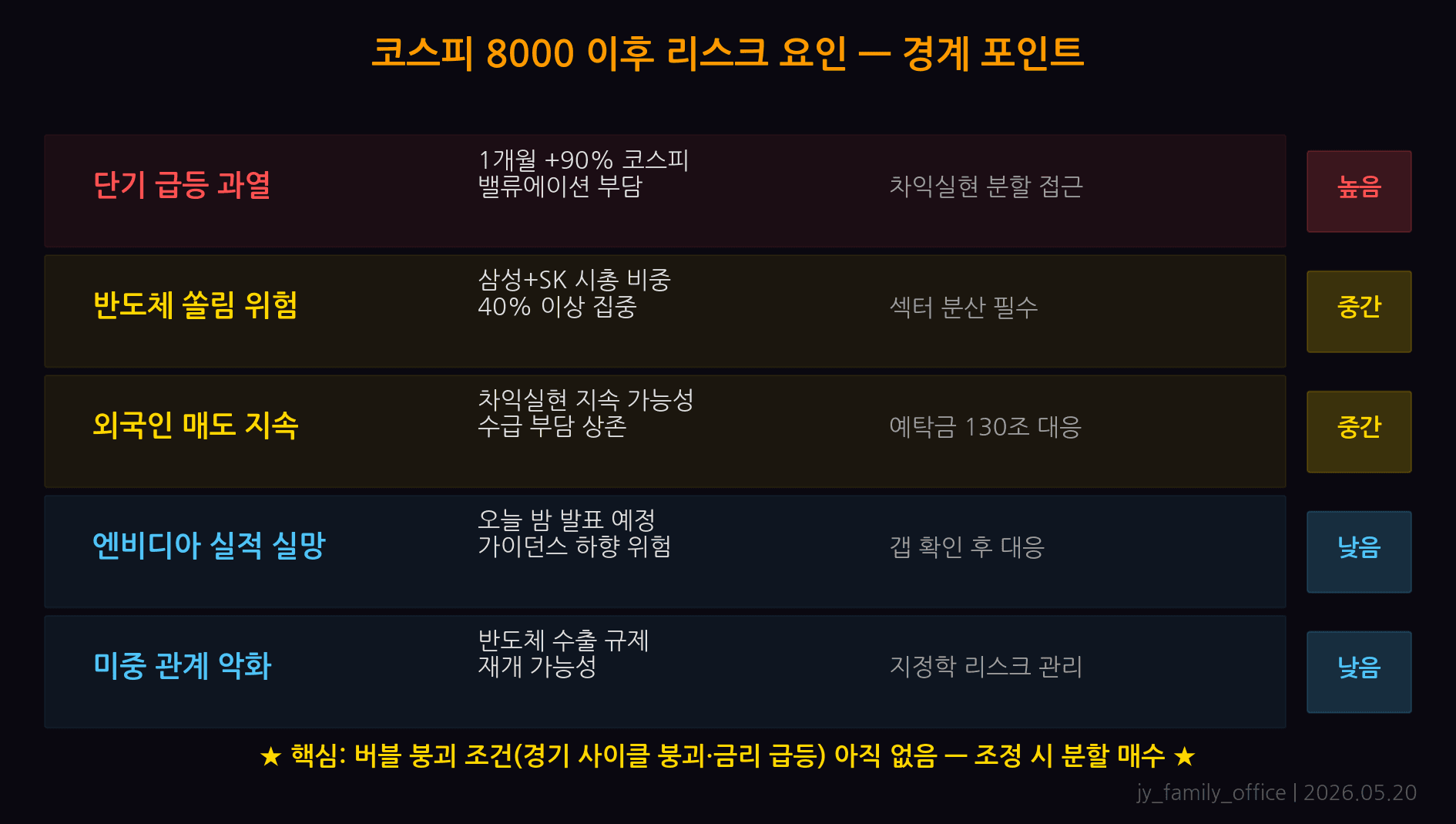
Every investment comes with risk. Here are five that demand particular attention at this juncture.
- Additional Foreign Net Selling (Impact: High) — If the current ₩20 trillion cumulative sell-off extends by another ₩10 trillion, KOSPI could undergo a short-term correction to the 7,800–7,900 range. Monitor whether the foreign ownership ratio (currently 32.1%) drops below 30%.
- Full Reinstatement of U.S. Tariffs (Impact: Critical) — A breakdown in the U.S.-China trade agreement or re-imposition of 25% tariffs on Korean semiconductors and batteries would directly hit major exporters. This is the primary trigger for the -8 to -12% KOSPI crash scenario.
- Sharp Won Appreciation (Impact: Medium) — If KRW/USD moves into the ₩1,200s, earnings estimates for major exporters face broad downgrades. Semiconductors, defense, and shipbuilding would weaken simultaneously, though power and domestic-demand stocks would be relative beneficiaries.
- Valuation Overstretch in High-P/E Names (Impact: Medium) — Defense large-caps averaging P/E 38x carry a 73% premium over global peers at 22x. Any guidance cut could trigger multiple compression, with drawdowns 2x deeper than the broader index.
- Hawkish FOMC Surprise (Impact: High) — If the June 17 FOMC holds rates and removes 2026 rate-cut projections, the resulting USD strength → EM capital outflow → foreign additional selling chain reaction could deliver a short-term KOSPI decline of -5 to -7%. Current probability of this scenario: approximately 15%.
9. Bottom Line — Sector Rotation Is the Only Game in Town
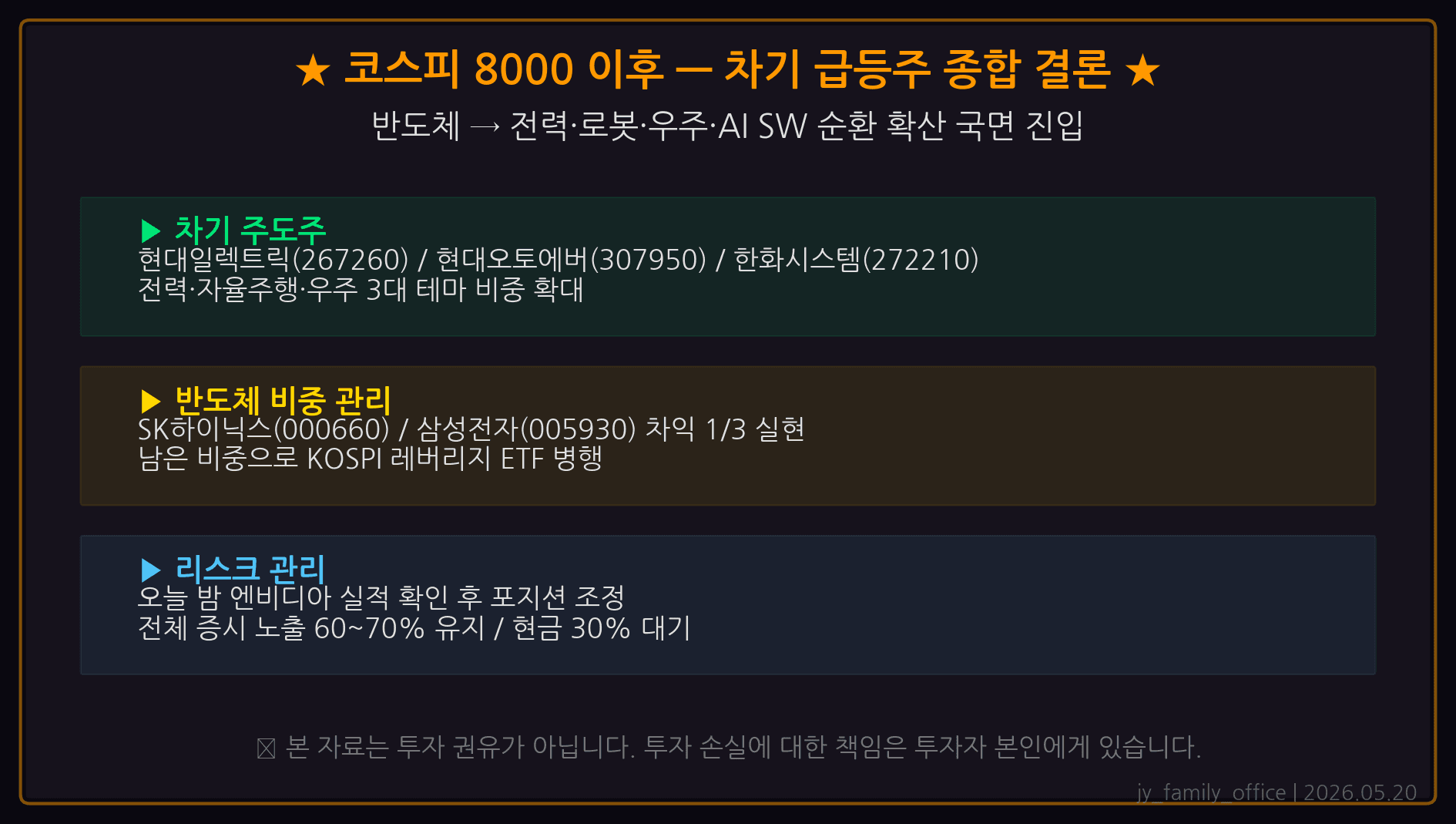
Three sentences that sum it up: ①Set the range-bound (8,000–8,500) scenario as your base case with 50% probability. ②Act early on sector rotation — from defense into power, robotics, and space. ③Start quietly accumulating power and robot-AI theme stocks now, before institutional flows arrive.
KOSPI 8,247 is not an ending — it is the beginning of a new market structure. As valuation pressure on former leaders (semiconductors, defense) meets foreign profit-taking, the market is restructuring around “index range-bound + stock-specific rallies.” In this environment, the winners are investors who read the sector rotation early and build positions before the crowd.
Mark three dates on your calendar as critical observation points: ①June 5 — Bank of Korea Monetary Policy Committee (rate decision) ②June 10 — deadline for pre-FOMC position trimming ③June 17 — U.S. FOMC decision announcement. These three events will determine KOSPI’s next directional move.
Disclaimer: This content is provided for informational purposes only and does not constitute a recommendation to buy or sell any specific securities. All investment decisions should be made based on your own judgment and at your own risk.
![[Breaking 21:30 KST] US April CPI 3.8% — oil spike kills Fed rate-cut bets](https://getdir.app/wp-content/uploads/2026/05/01_cpi_trend-768x380.png)
