Sam Altman ‘AI Jobs Apocalypse X’ — ‘I Was Wrong’ 5 Implications and Investment Strategies
Sam Altman ‘AI Jobs Apocalypse X’ — ‘I Was Wrong’ 5 Implications and Investment Strategies
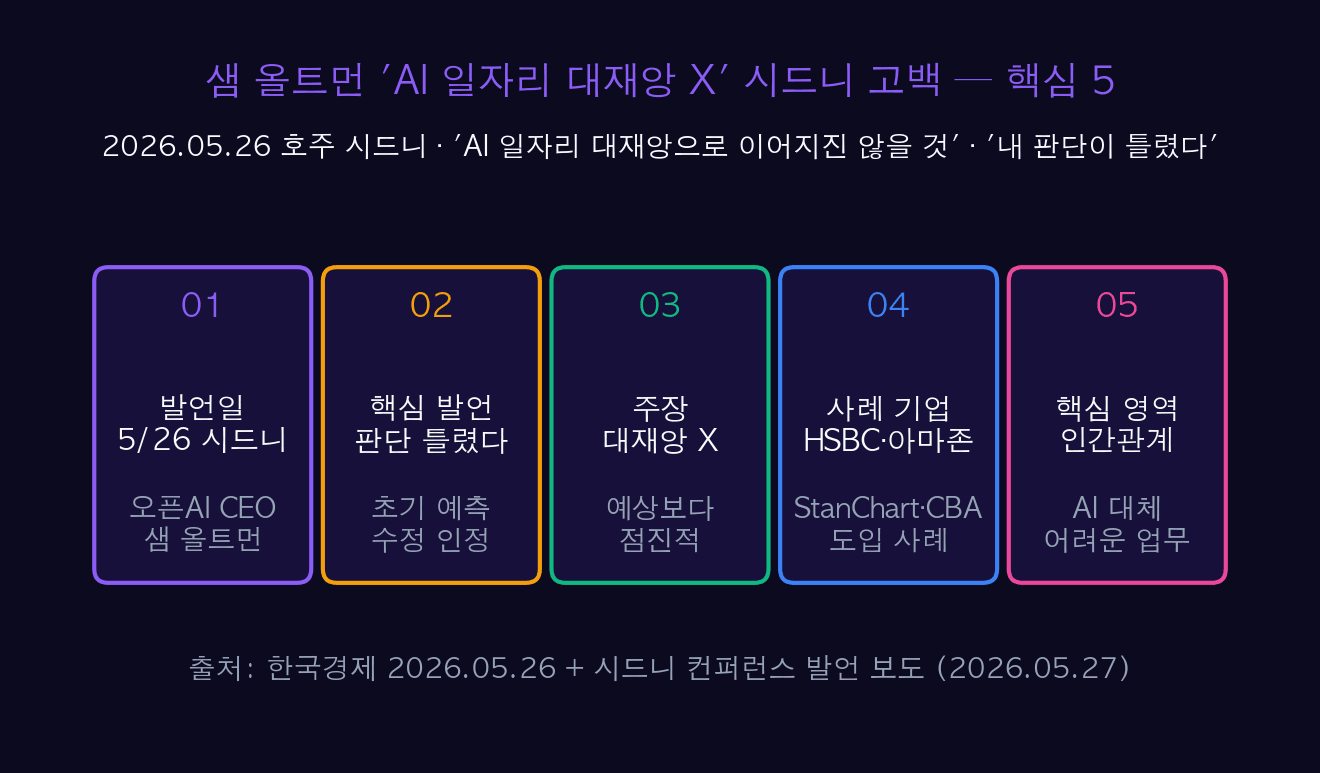
Sam Altman, CEO of OpenAI, said at a Sydney conference on May 26, 2026 that “AI will not lead to a so-called ‘jobs apocalypse’“, effectively revising his earlier prediction. He directly admitted, “I was wrong on this point“. It’s the first public self-correction by the creator of ChatGPT regarding AI’s job-market impact predictions.
This article synthesizes Hankyung’s 2026.05.26 Sydney coverage and analyses from McKinsey and MIT Tech Review to cover Sam Altman‘s Before/After prediction shift, 5 reasons AI unemployment lagged expectations, global enterprise adoption (HSBC·Amazon·StanChart·CBA), 5 human-relationship domains hard to replace, 5 actually-threatened roles, 5-year 3-scenario outlook, and 5 investment strategies. Original Hankyung article at Hankyung.
| Item | Value | Notes |
|---|---|---|
| Speaker | Sam Altman (OpenAI CEO) | ChatGPT’s creator |
| Date·Place | 2026.05.26 · Sydney, Australia | Public conference |
| Key Quote 1 | “AI will not lead to a jobs apocalypse” | Main headline |
| Key Quote 2 | “I was wrong on this point” | Public self-correction |
| Cited Examples | HSBC·Amazon·StanChart·CBA | Global adoption cases |
| AI Limit | Human-relationship work | Hard to replace short-term |
| Market Signal | Confirms gradual adoption | Infra + defensive both benefit |
01Sam Altman — Before vs After Prediction Shift
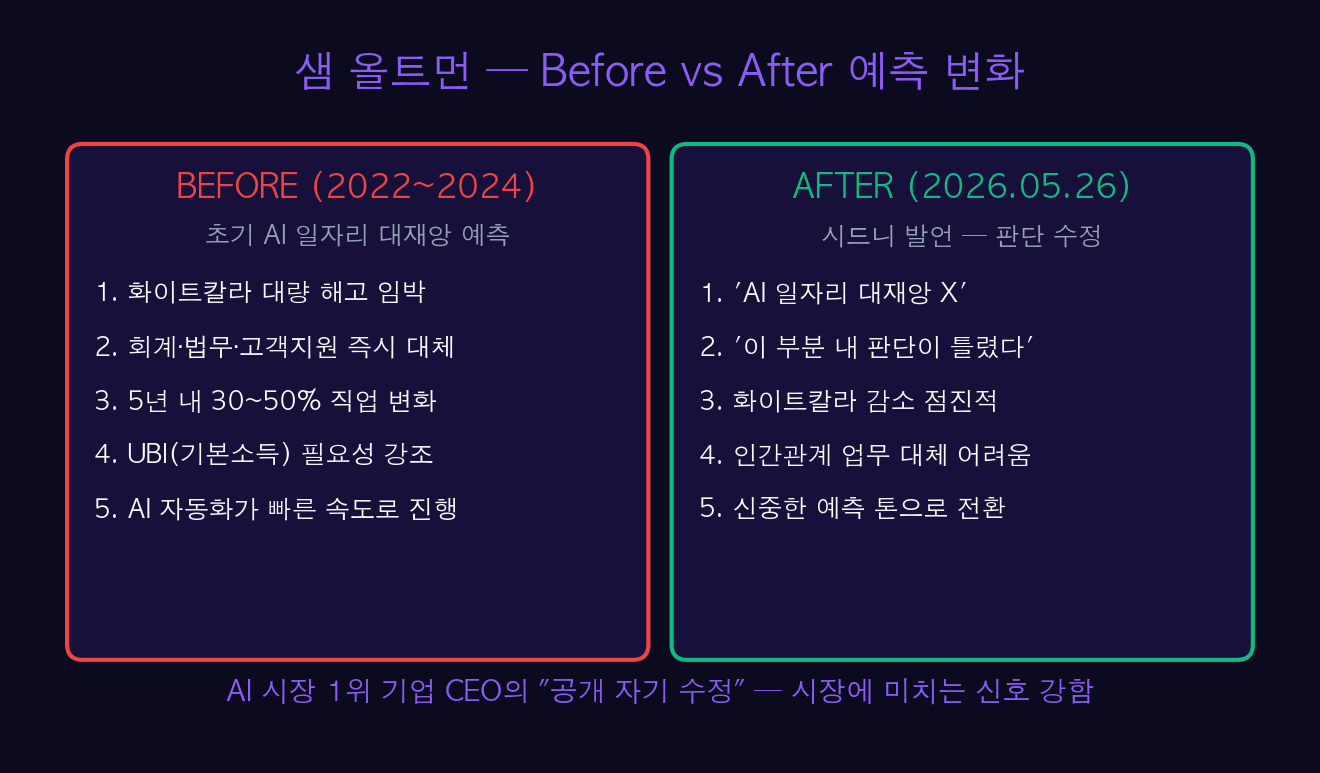
Sam Altman from 2022~2024 (right after ChatGPT launch) frequently spoke in a “AI will rapidly replace white-collar jobs” tone. He argued 30~50% of jobs would shift within 5 years and that social safety nets like UBI (universal basic income) might be necessary.
But in Sydney in May 2026, he publicly corrected: “I was wrong on this point”. A self-correction by the CEO of the AI industry’s #1 company on his core claim is rare and sends a strong signal to markets and policymakers that AI impact is gradual. This matters for both AI infrastructure firms and human-relationship industries.
| Period | Core Claim | Tone |
|---|---|---|
| 2022 (Before) | AI to massively replace white-collar | Apocalypse tone |
| 2023 (Before) | 30~50% jobs to shift within 5 years | Strong warning |
| 2024 (Before) | Social safety nets like UBI needed | Policy recommendation |
| 2025 | Tone moderated somewhat | Transition phase |
| 2026.05 (After) | “AI jobs apocalypse X” | Public correction |
| 2026.05 (After) | “I was wrong on this point” | Self-admission |
iINFO — Weight of Self-Correction
A self-correction by the CEO of the industry’s #1 firm sends a strong market signal. Altman, who created ChatGPT, is a core reference point for policymakers·companies·investors when evaluating AI impact. This statement effectively confirms AI adoption is on a “gradual” rather than “apocalyptic” path.
02Why AI Unemployment Lagged Expectations — 5 Factors
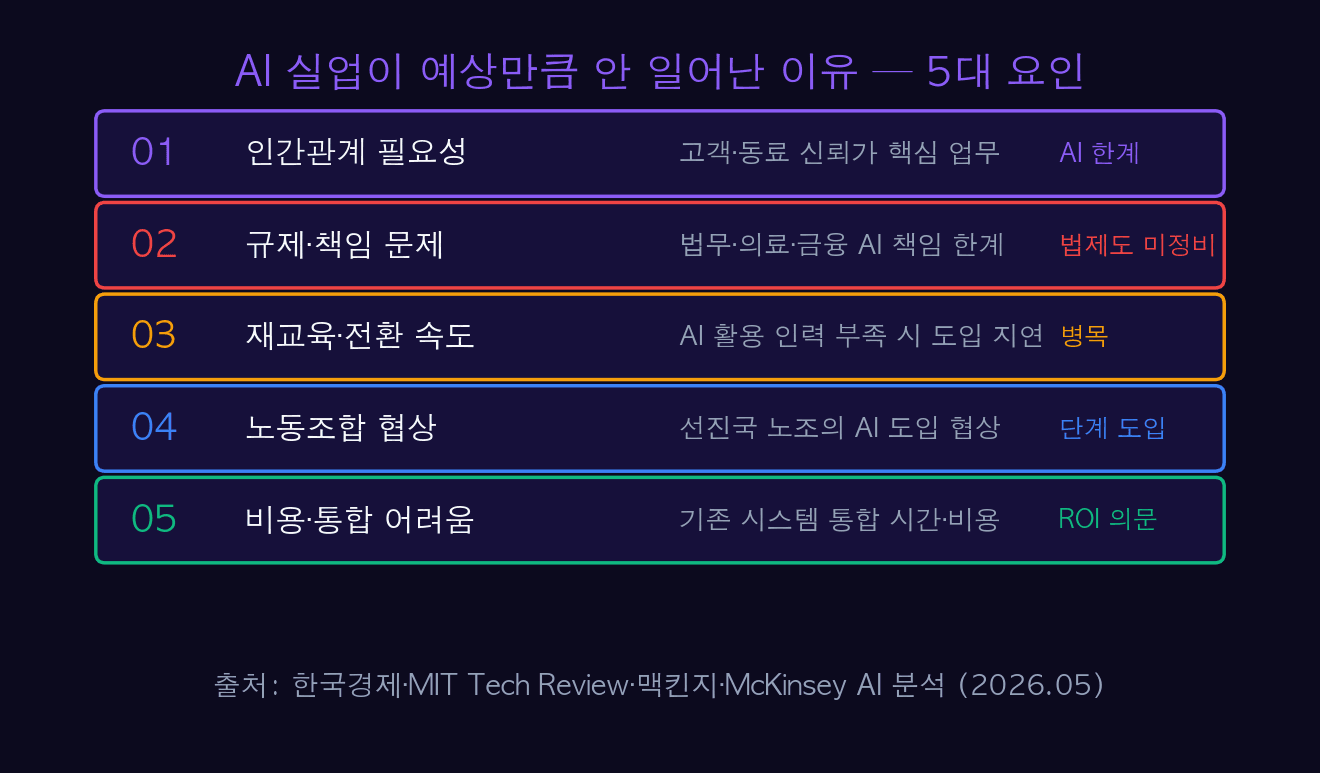
The slower-than-expected pace of AI unemployment isn’t due to a single factor. Need for human relationships, regulation/liability, retraining/transition pace, union negotiations, cost/integration difficulty compound.
The biggest is need for human relationships. Customer/colleague trust, subtle emotional handling, and ethical judgment cannot yet be fully replaced by AI. Second is regulation/liability in legal/medical/financial sectors. Lack of clear legal frameworks for who bears responsibility when AI makes wrong decisions slows adoption.
| Factor | Core Content | Strength |
|---|---|---|
| 1. Human Relations Needed | Customer/colleague trust as core | Very Strong |
| 2. Regulation/Liability | Legal/medical/finance AI accountability | Very Strong |
| 3. Retraining Pace | Lack of AI-literate workforce | Strong |
| 4. Union Negotiations | Negotiated AI adoption in unionized West | Strong |
| 5. Cost/Integration | Time/cost to integrate with legacy systems | Moderate |
| 6. Ethics/Trust | AI hallucination/bias concerns | Moderate |
03Global Enterprise AI Adoption — 6 Case Studies
Global cases cited in Hankyung’s report: HSBC, Amazon, Standard Chartered (StanChart), and CBA (Commonwealth Bank). Adding Goldman Sachs and JPMorgan to make 6 case studies, headcount reductions are 5~18% with simultaneous AI-related hiring, so “net reductions” are smaller than predicted.
Amazon is most aggressive (~-18%). Call-center and tier-1 customer support automation reduced headcount, but AI/cloud hiring is also active (+8%), so net change is about -10%. HSBC -12%/+4% nets -8%, StanChart and CBA are around -5% net — a “gradual restructuring” rather than “apocalypse” pattern.
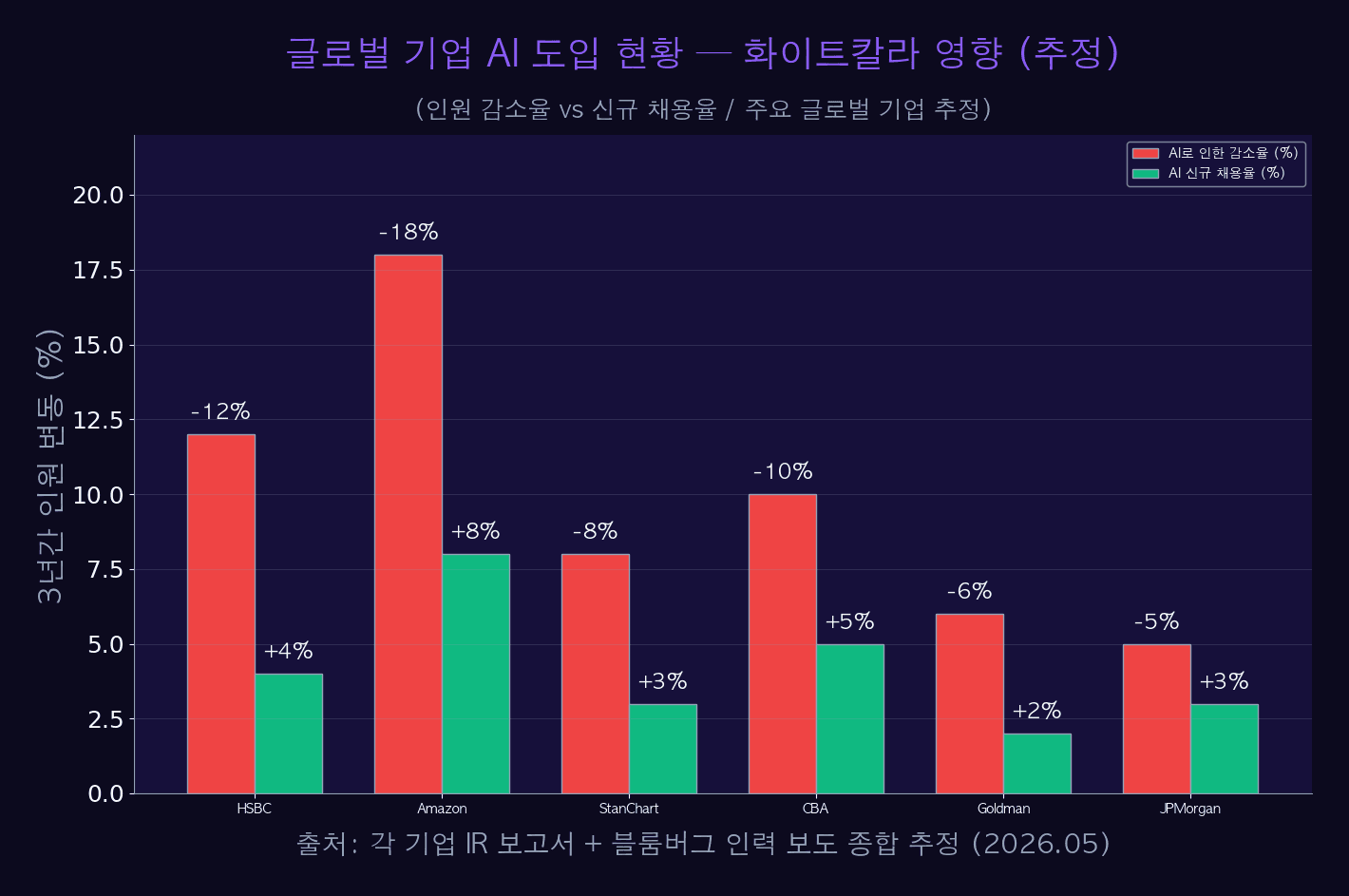
| Company | Reduction | AI Hiring | Net Change | Notes |
|---|---|---|---|---|
| HSBC | -12% | +4% | -8% | Cited in article |
| Amazon | -18% | +8% | -10% | Call center·logistics |
| StanChart | -8% | +3% | -5% | Cited in article |
| CBA | -10% | +5% | -5% | Cited in article |
| Goldman Sachs | -6% | +2% | -4% | Routine work automation |
| JPMorgan | -5% | +3% | -2% | Expanding AI investment |
!WARNING — Net Reductions Small, but “Role Transitions” Active
Net reductions per firm are -2~-10% — not “apocalypse”. But transitions from legacy roles to AI-augmented roles are very active. Reductions are partially absorbed by AI-domain hiring, so workers who stay in legacy roles unchanged must prepare for skill transitions.
04AI-Resistant Work — 5 Human-Relationship Domains
Altman’s direct quote that he “really value the relationship with people” signals domains AI cannot fully replace short-term clearly exist. Premium sales·B2B, healthcare·counseling·psychology, education·coaching, leadership·negotiation, and field service·care are the 5 core domains.
These share one trait — non-verbal elements like empathy, trust, contextual understanding, and physical contact are central. Text/voice AI interfaces cannot fill the “human value” decisive in decisions and customer satisfaction. These industries may be re-rated as defensive plays in the AI era.
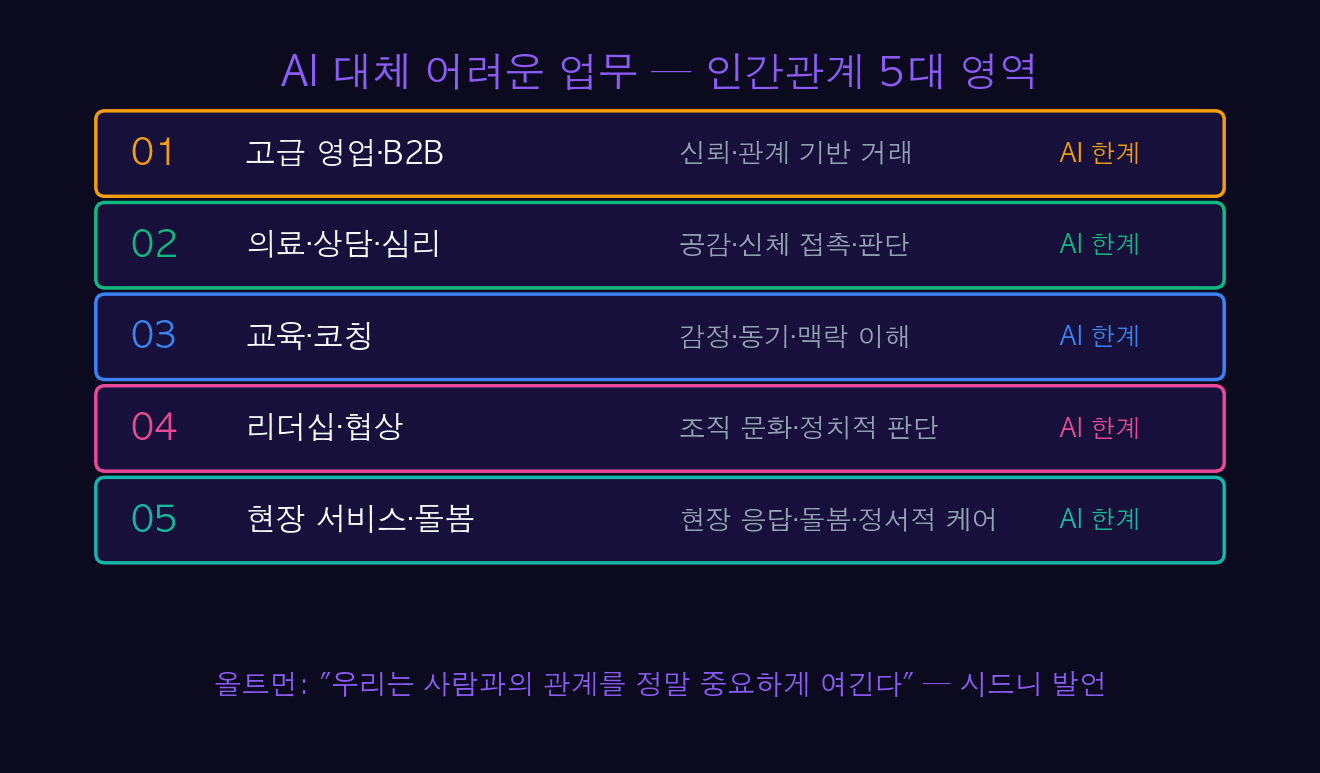
| Domain | Representative Roles | AI Limits | Beneficiary Sectors |
|---|---|---|---|
| 1. Premium Sales·B2B | Enterprise sales·M&A advisory | Trust/relationship-based deals | CRM·Accenture |
| 2. Health·Counseling·Psych | Doctors·counselors·nursing | Empathy·physical contact | UNH·JNJ |
| 3. Education·Coaching | Teachers·coaches·tutors | Emotion·motivation | EDU·Pearson |
| 4. Leadership·Negotiation | Executives·M&A·diplomacy | Org culture·political judgment | All industries |
| 5. Field Service·Care | Caregiving·elder care·premium services | Physical·emotional care | Healthcare·silver industry |
05Roles Actually Replaced by AI — 5 Threatened Domains
While Altman’s message is “not apocalypse”, roles actually under threat clearly exist. Call center/tier-1 support, code writing/debugging, routine accounting/reports, content/image/design, translation/summary/document processing see the most direct impact.
Call center and tier-1 customer support are automating fastest. Simple inquiries/FAQs are 90%+ handled by AI chatbots, with human agents specializing into complex/VIP cases. Code writing also shows multiple cases where developer productivity rose 2~3x using GitHub Copilot, Cursor, etc.
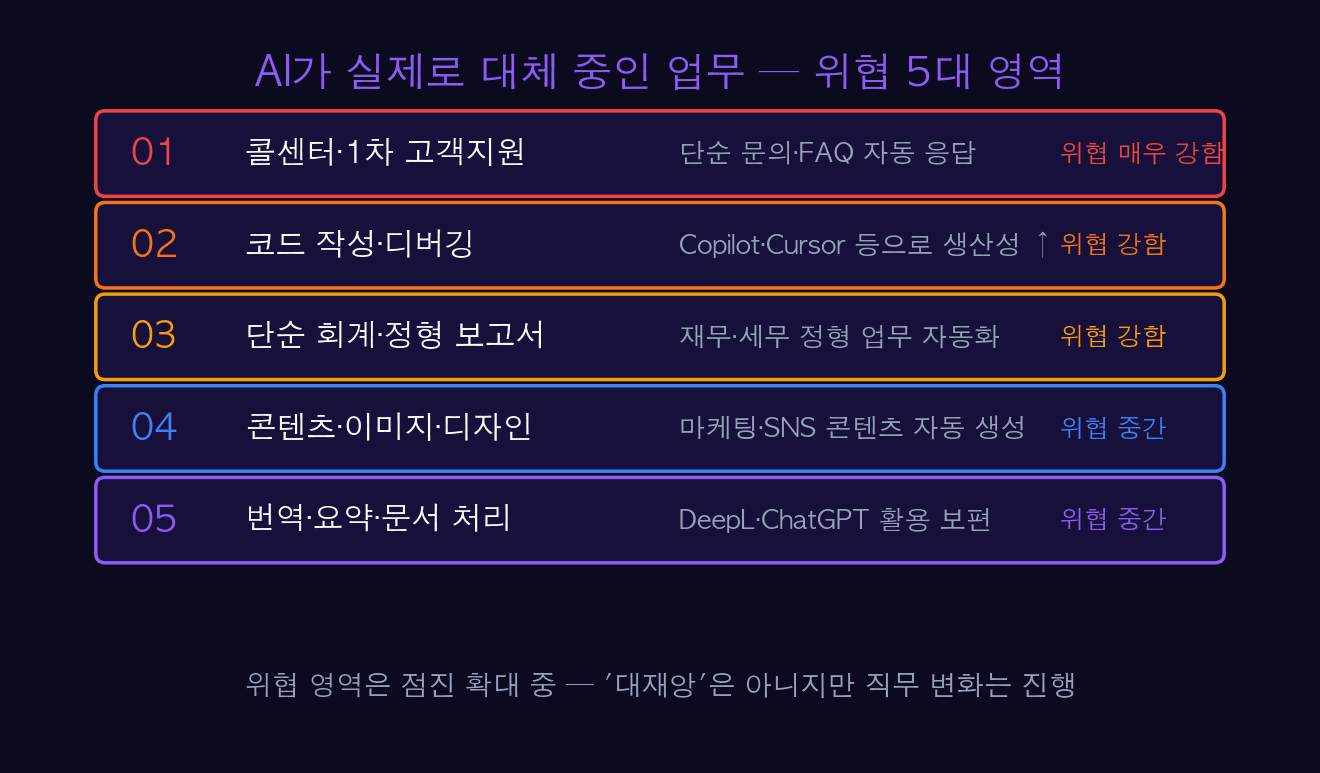
| Domain | Representative Roles | AI Tools | Threat Level |
|---|---|---|---|
| 1. Call Center·T1 Support | Agents·CS | ChatGPT·Claude chatbots | Very Strong |
| 2. Code Writing·Debug | Junior devs·QA | Copilot·Cursor·Devin | Strong |
| 3. Routine Accounting | Finance·tax assistants | AI analytics tools | Strong |
| 4. Content·Image·Design | Marketing SNS·design assistants | Midjourney·Sora·Veo | Moderate |
| 5. Translation·Summary | Translators·document assistants | DeepL·ChatGPT | Moderate |
| 6. Data Analysis Assist | Entry analysts | ChatGPT Code Interpreter | Moderate |
⚠ALERT — Threatened Roles Require “Specialization” Pivot
Threatened roles don’t “disappear entirely” but bifurcate into specialization polarization — “simple repetitive → AI, complex/premium → humans”. Workers stuck in pure repetitive tasks face natural displacement. Roles that can’t expand into complex/premium territory shrink. Retraining and role transitions are the next 5-year imperative.
06Next 5 Years AI Jobs Impact — 3 Scenarios
Combining McKinsey/MIT Tech Review analyses with Altman’s “gradual” tone, white-collar role change rates over 2026~2031 split into 3 scenarios. Bull 27% / Base 45% / Bear 70%. Bull aligns with Altman’s corrected view; Bear matches his earlier “apocalypse” prediction.
Markets and policymakers currently see the Base scenario (45%) as most likely. I.e., ~45% of white-collar workers will need to actively use AI by 2031, with major changes in role content and required skills. This creates retraining/transition pressure for workers, AI investment pressure for companies, and labor policy/retraining infrastructure pressure for governments.
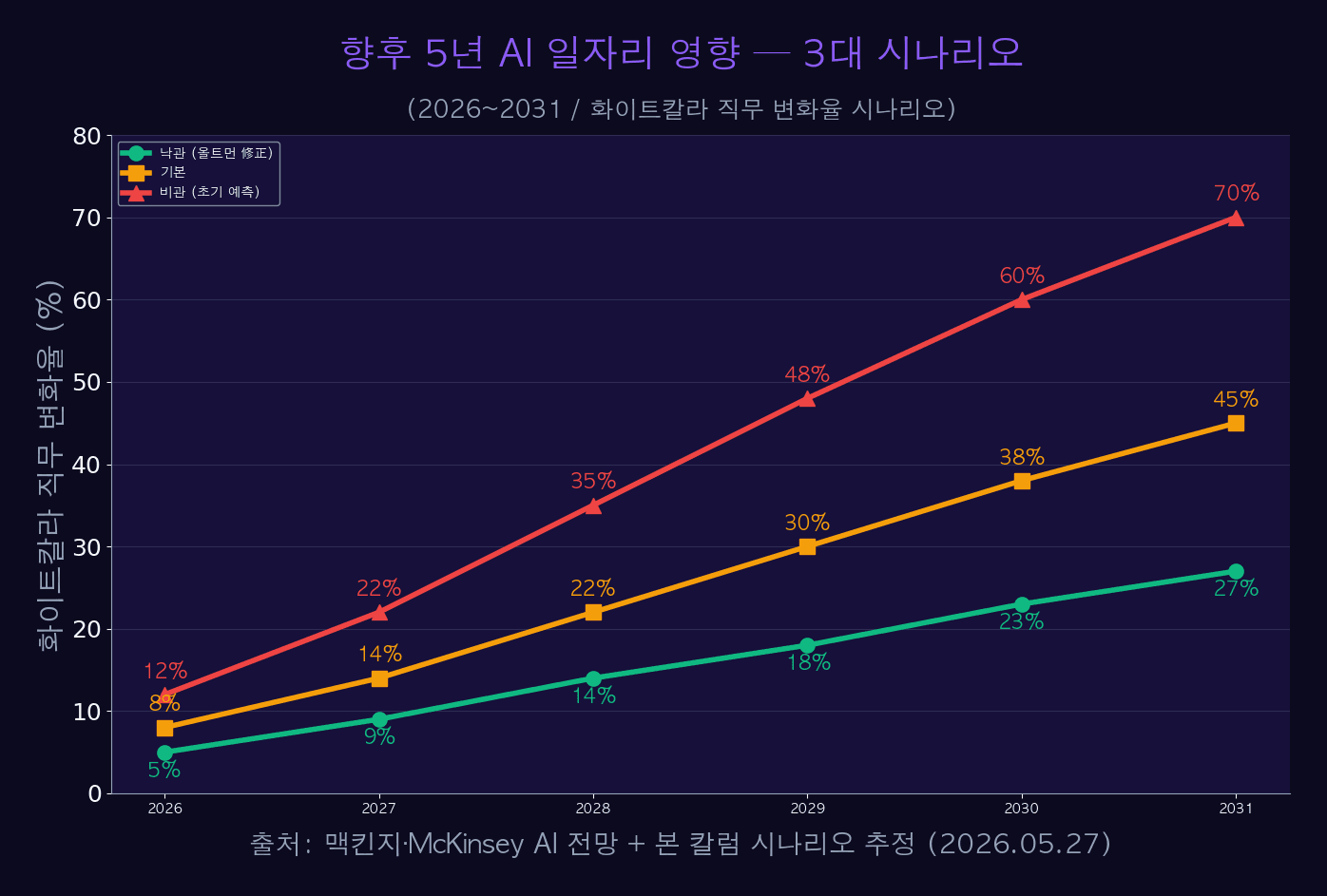
| Scenario | 2031 Role Change | Conditions | Probability |
|---|---|---|---|
| Bull (Altman revised) | 27% | Gradual AI + human-relations protected | 30% |
| Base (consensus) | 45% | AI ubiquitous + role transitions | 50% |
| Bear (initial forecast) | 70% | Rapid AI + mass unemployment | 20% |
✓TIP — 5 Personal Adaptation Strategies
If your role is closer to the AI-threat zone, you need: (1) AI tool proficiency (Copilot, ChatGPT, etc.), (2) Strengthen human-relationship/communication, (3) Deepen expertise (simple to AI, complex to you), (4) Multi-skill stack (2~3 domains vs 1), (5) Continuous AI learning (new tools quarterly).
07Investment Implications — “AI Gradual Adoption” Meaning
Altman’s “gradual” message sends two signals to investors. First, AI infrastructure firms (NVDA·MSFT·Palantir·Oracle etc.) see higher long-term demand stability. If AI rolls out over 5~10 years gradually rather than exploding, infra revenue follows a steady up-trend with lower short-term volatility.
Second, human-relationship industries (healthcare·education·premium services) get re-rated as defensives. UNH (UnitedHealth), JNJ (Johnson & Johnson), LVMH (luxury), Accenture (consulting) receive safety premium as “AI-resistant”. Balanced portfolios with “AI infra + human-relationship defensives” make sense.
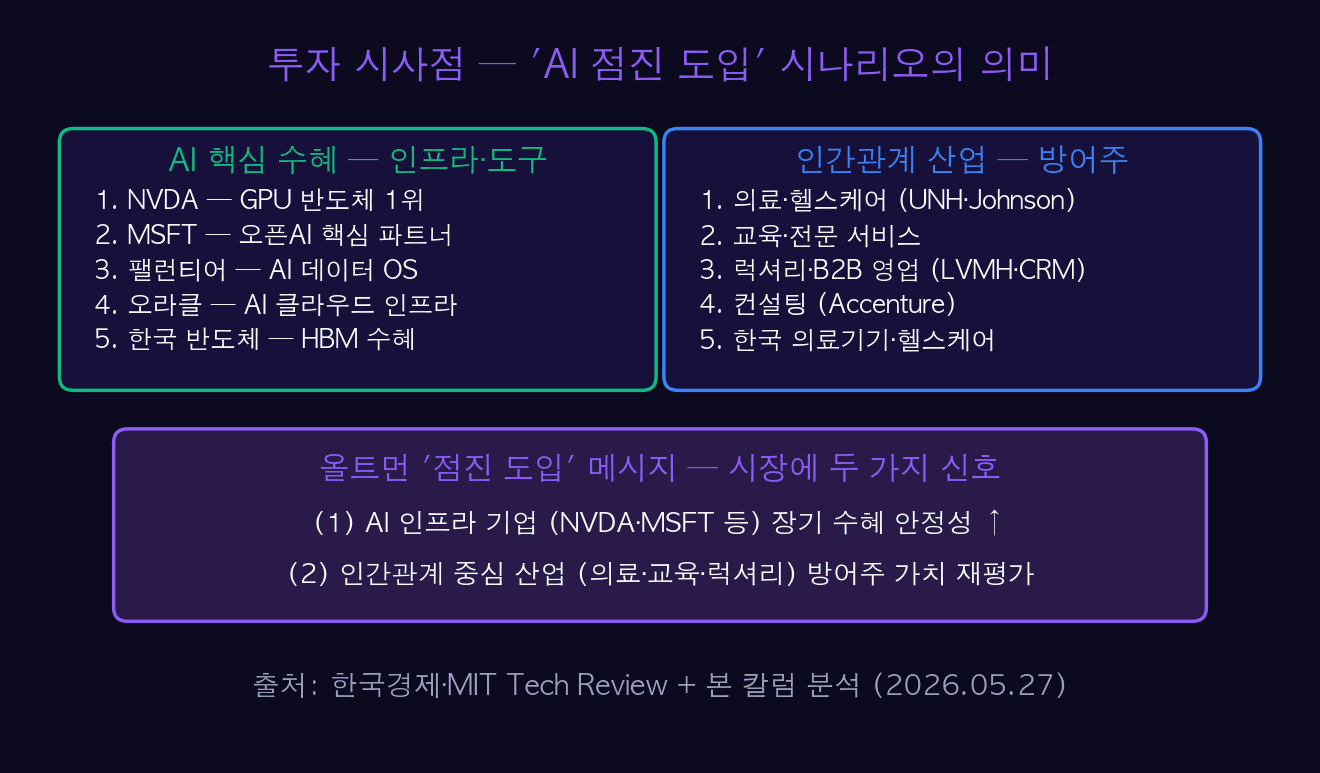
| Category | Representative | Investment Thesis |
|---|---|---|
| AI Infra (1) | NVDA (Nvidia) | #1 GPU semis — long-term stable demand |
| AI Infra (2) | MSFT (Microsoft) | Core OpenAI partner + Azure |
| AI Infra (3) | PLTR (Palantir) | AI data OS — government·enterprise |
| AI Infra (4) | ORCL (Oracle) | AI cloud infrastructure |
| Korea AI | Samsung·SK Hynix HBM | Gradual AI = stable demand |
| Human Defense (1) | UNH (UnitedHealth) | Healthcare — AI replacement limit |
| Human Defense (2) | JNJ (Johnson & Johnson) | Healthcare + trusted brand |
| Human Defense (3) | LVMH (Luxury) | Premium services — relationship core |
| Human Defense (4) | Accenture (Consulting) | AI advisory + relationships |
iINFO — “AI Infra + Human Defense” Balance Strategy
The most rational strategy to leverage Altman’s “gradual” signal is “AI infra + human-relationship defensives” two-axis balance. Avoid 100% on one side — about 50% AI infra (NVDA·MSFT·PLTR) and 50% human-relationship defensives (UNH·JNJ·LVMH). Whichever scenario unfolds, 50% benefits.
08Sam Altman Sydney Statement — 5 Investment Strategies
Five investment strategies based on Altman’s “AI jobs apocalypse X”: NVDA·MSFT phased buying + Palantir + healthcare defensives + Korean HBM + risk hedge. Balance AI infra and human-relationship defensives as two axes; cap combined exposure at 30~40%.
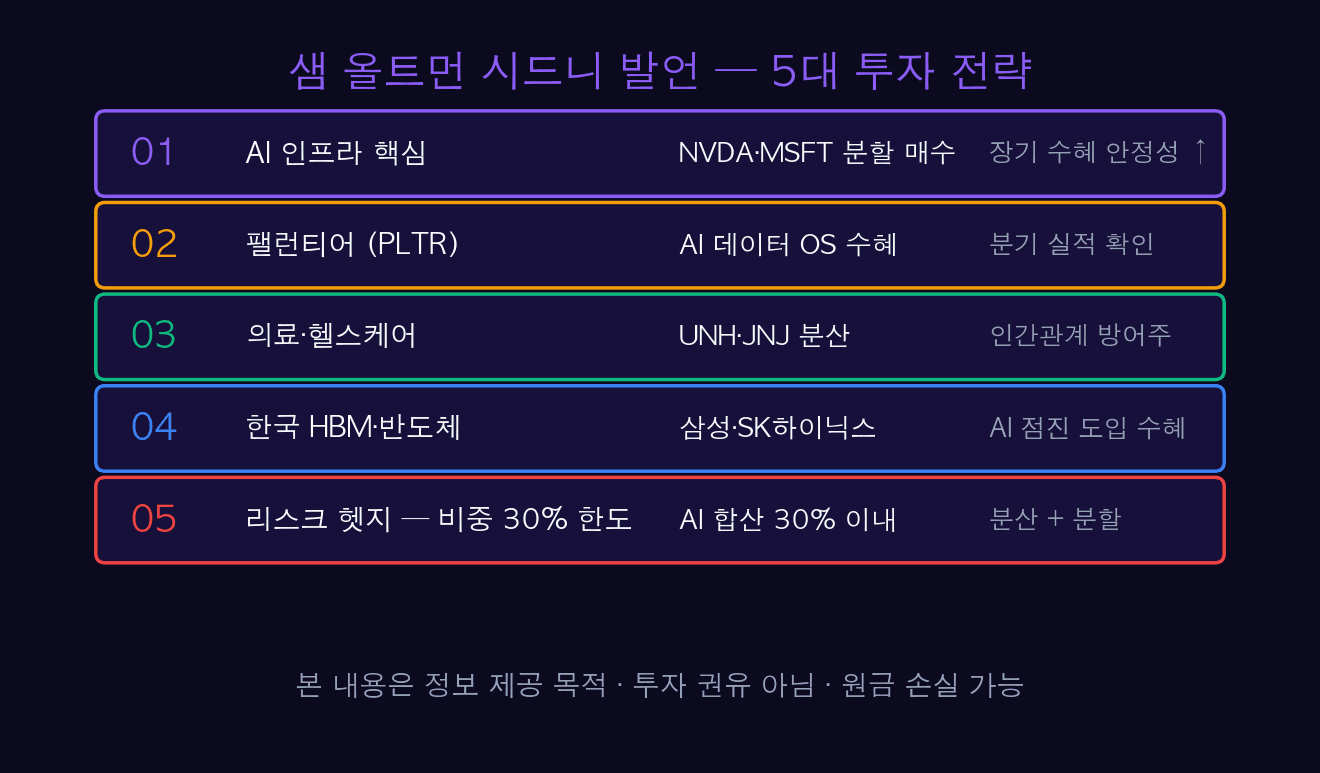
| Strategy | Ticker | Allocation | Rule |
|---|---|---|---|
| S1: AI Infra | NVDA·MSFT | 10~15% | -12% stop |
| S2: Palantir | PLTR | 5% | -15% stop |
| S3: Healthcare Def | UNH·JNJ | 5~10% | -10% stop |
| S4: Korean HBM | Samsung·SK Hynix | 5% | -12% stop |
| S5: Risk Hedge | Combined 30~40% cap | Cap | 20% cash |
- Statement: 2026.05.26 Sydney · OpenAI CEO Sam Altman
- Core: “AI will not lead to a jobs apocalypse” + “I was wrong on this point”
- Claim: White-collar reduction gradual · human-relationship work AI-resistant
- Cases: HSBC·Amazon·StanChart·CBA adoption (net -2~-10%)
- Defensive domains: Healthcare·education·premium sales·leadership·care
- Threatened: Call center·code·routine accounting·content·translation
- Scenarios: Bull 27% / Base 45% / Bear 70%
- Investing: AI infra + human-relationship defensives balance
- Allocation: Combined 30~40% / 20% cash
🔗 [This] Sam Altman ‘AI Jobs Apocalypse X’ — ‘I Was Wrong’ 5 Implications and Investment Strategies
🔗 [Related] Warren Buffett Value Investing Limits? Berkshire Worst S&P 500 Gap Since 2008
🔗 [Related] US Space Force SpaceX $2.29B Contract — Golden Dome SDN Backbone
🔗 [Related] Yen Depreciation Hits 1973 Low — 5 Causes Outlook
🔗 [Related] MakinaRocks 477850 Stock Outlook 5/27 — Korea’s Palantir
🔗 [Next] OpenAI Q3 Revenue·GPT-5 Launch D-Day Scenarios (Planned)
#SamAltman
#OpenAI
#ChatGPT
#AIJobs
#AIJobsApocalypse
#AIUnemployment
#WhiteCollar
#HumanRelationships
#AILimits
#Nvidia
#NVDA
#Microsoft
#MSFT
#Palantir
#PLTR
#HealthcareDefensives
#UNH
#JNJ
#LVMH
#Accenture
#SamsungHBM
#SKHynix
#AIInfrastructure
#GradualAdoption
#Retraining
#RoleTransition
#getdirEconomicInsights
#getdirAltman
#jyfamilyoffice
#2026AIInvesting