Samsung Electronics Labor Deal — Memory 550M KRW Bonus, System LSI 147M KRW / Strike Averted 90 Min Before / Treasury Stock Lock-Up / Stock Impact
Real-Time Issue · May 21, 2026
Samsung Electronics Labor Deal — Memory 550M KRW Bonus, System LSI 147M KRW / Strike Averted 90 Minutes Before / Treasury Stock Lock-Up / Stock Impact
Samsung Electronics reached a landmark labor agreement just 90 minutes before a general strike. — Memory (DS) average bonus of 550 million KRW, treasury stock grant with a 1-year lock-up, and a 4.1% base salary hike. Here’s everything investors need to know about 005930 now that the strike risk has evaporated.
① Key Takeaways — Strike Averted 90 Minutes Before Deadline
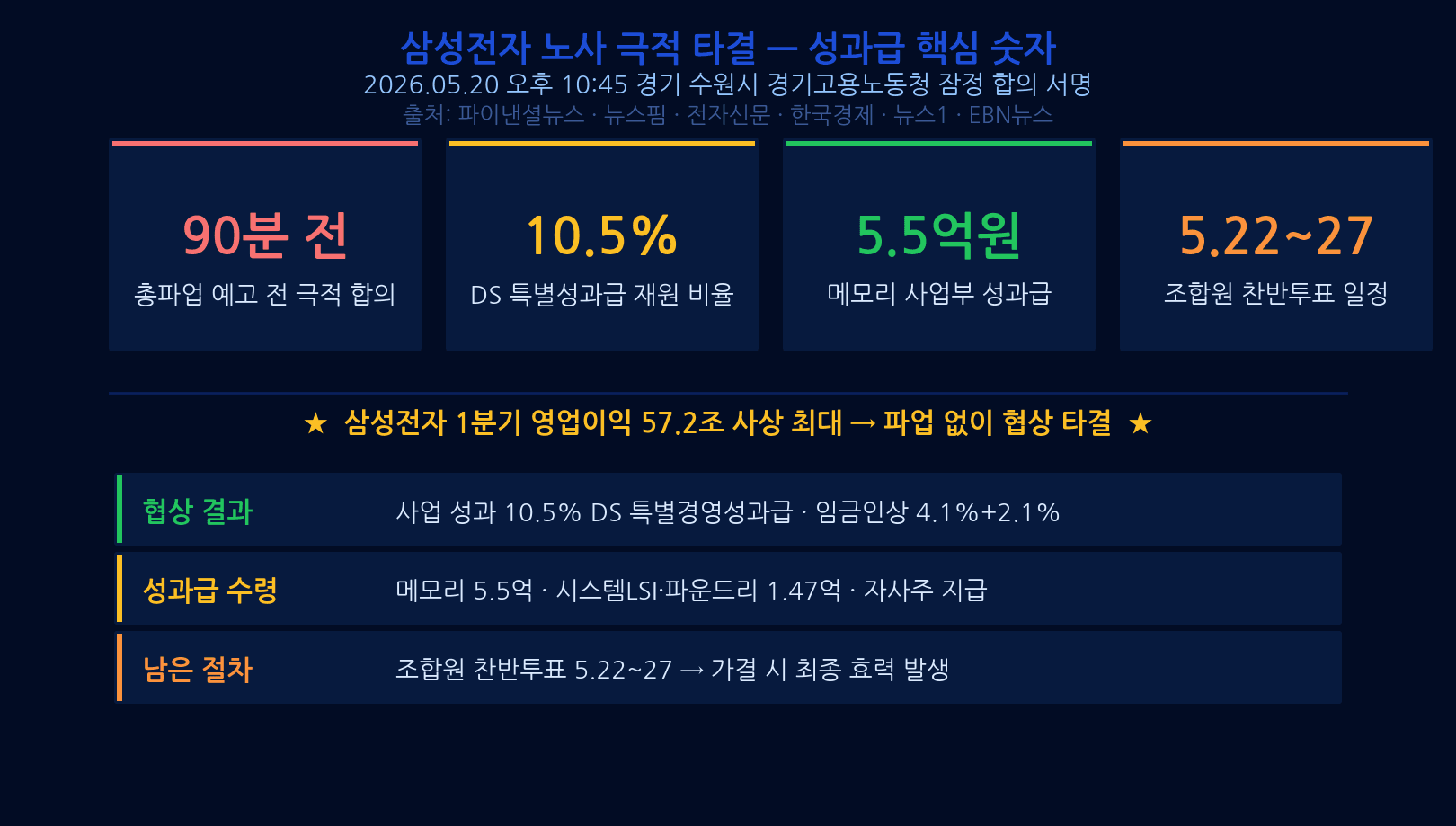
On the morning of May 21, 2026, Samsung Electronics management and labor reached a tentative agreement 90 minutes before a scheduled general strike. The deal ends 16 months of drawn-out negotiations. Three headline items define the settlement:
- Total performance bonus of 10.5% of base salary — combining OPI (Operating Performance Incentive), TAI (Target Achievement Incentive), and a special encouragement bonus
- Direct grant of Samsung treasury stock to all employees, subject to a 1-year lock-up
- Base salary increase of 4.1%, plus a performance-linked increment of 2.1%, for a combined raise of 6.2%
For 005930 shareholders, the elimination of the strike risk alone creates +3–5% upside pressure. Add in the expectation of normalized HBM supply and the positive ripple effects across the semiconductor sector become clear.
② 16 Months of Negotiations — Why Did It Break Now?
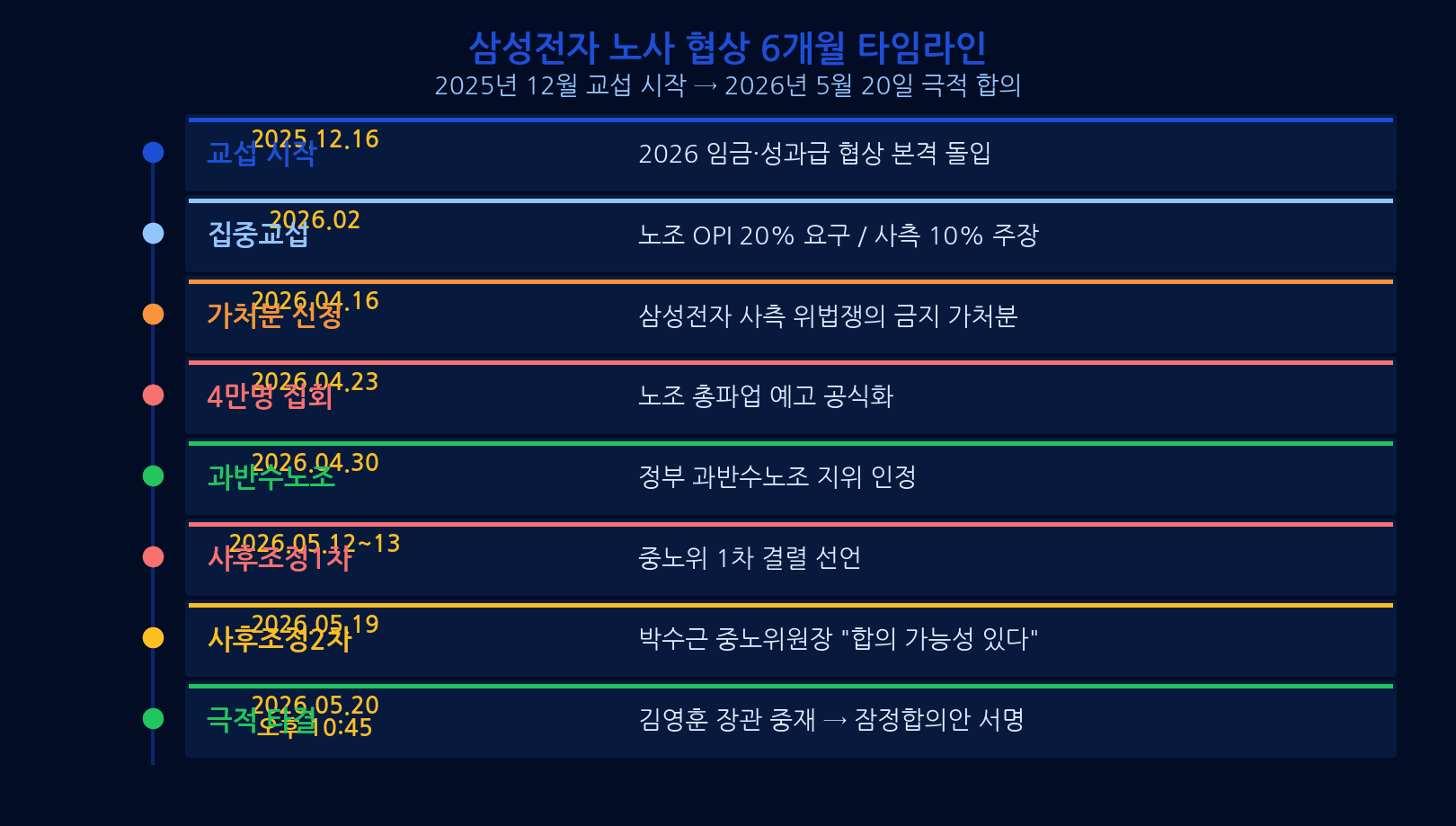
Formal bargaining opened in January 2025, when Samsung management and the National Samsung Electronics Union (NSEU) sat down to negotiate wages and performance bonuses for fiscal 2025. For over a year, both sides remained far apart — the union demanded double-digit performance bonuses, while management cited a semiconductor downturn to justify a conservative stance.
So why May 21, 2026? Two external shocks converged to put enormous pressure on both sides:
- Moody’s credit rating downgrade risk — A strike would have disrupted production, worsened financial metrics, and handed Moody’s a pretext for a further downgrade. With the KOSPI already under pressure, a rating cut on top of a strike would have been a double blow. Neither side wanted to be blamed for triggering that scenario.
- HBM delivery deadlines looming — Samsung’s DS division is committed to supplying HBM3E 4-stack and 8-stack modules to Nvidia. A strike would have put multi-trillion-won contracts at risk. This is widely seen as the decisive factor that caused management to expand its concessions in the final hours.
③ Bonus Structure Explained — OPI, TAI, and Special Bonus
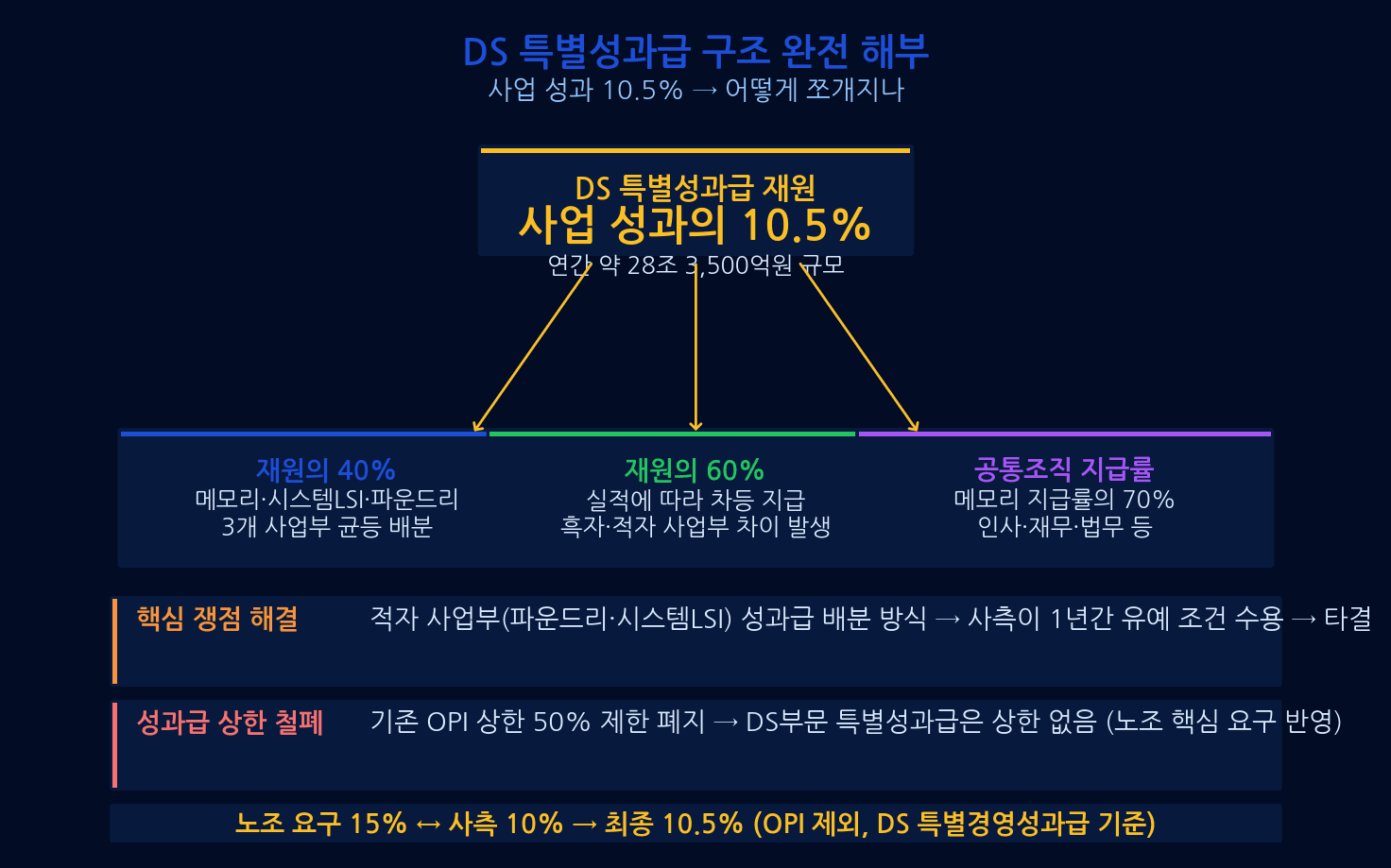
Samsung’s performance bonus is not a single payment — it is stacked across three distinct layers:
- OPI (Organizational Performance Incentive) — Tied directly to operating profit achievement. The higher the division’s operating profit relative to its annual target, the larger the OPI payout rate. The DS (Memory) division, buoyed by surging HBM demand in H2 2025, posted a strong overachievement, resulting in a high OPI rate.
- TAI (Target Achievement Incentive) — Based on individual and team target completion rates. Payout varies by job function and grade; there is a meaningful gap between R&D roles and production-line workers.
- Special Encouragement Bonus — The final negotiating card in this settlement. A one-time, lump-sum payment that management offered as a closing incentive in the last round of talks. It is set as a fixed multiple of base salary and applies to all employees covered by the agreement.
Combined, the three components equal 10.5% of base salary. That is 2.5 percentage points higher than the ~8.0% paid in 2024, and the highest level in five years.
④ Division-by-Division Payout — Memory 550M KRW, System LSI 147M KRW

The same 10.5% rate translates into vastly different absolute amounts depending on each division’s base salary levels. Estimated average payouts by division:
- DS (Memory Semiconductor) — approx. 550 million KRW (~$400K USD): HBM, DRAM, and NAND all performing strongly. DS has Samsung’s highest base salaries and the group’s top OPI rate. The top 10% of earners are estimated to exceed 800 million KRW.
- System LSI — approx. 147 million KRW (~$107K USD): Lackluster Exynos sales dragged down the OPI rate. Without the special encouragement bonus, the payout would have fallen below 100 million KRW — a core grievance for System LSI union members and a potential fault line in the May 27 ratification vote.
- MX (Mobile Experience / Smartphones) — approx. 320 million KRW (~$233K USD): Solid Galaxy S-series sales reflected in the payout. The special bonus lifted this above the prior year.
- VD / HA (Consumer Electronics / Home Appliances) — approx. 210 million KRW (~$153K USD): Global appliance demand weakness kept payouts at the lower end. Roughly in line with the previous year.
The nearly 4x gap between the best-paid (DS) and worst-paid (System LSI) divisions is a structural tension within the union. How System LSI members vote on May 27 could determine whether the deal passes or collapses.
⑤ Wage Increase Structure — 4.1% Base + 2.1% Performance = 6.2% Total
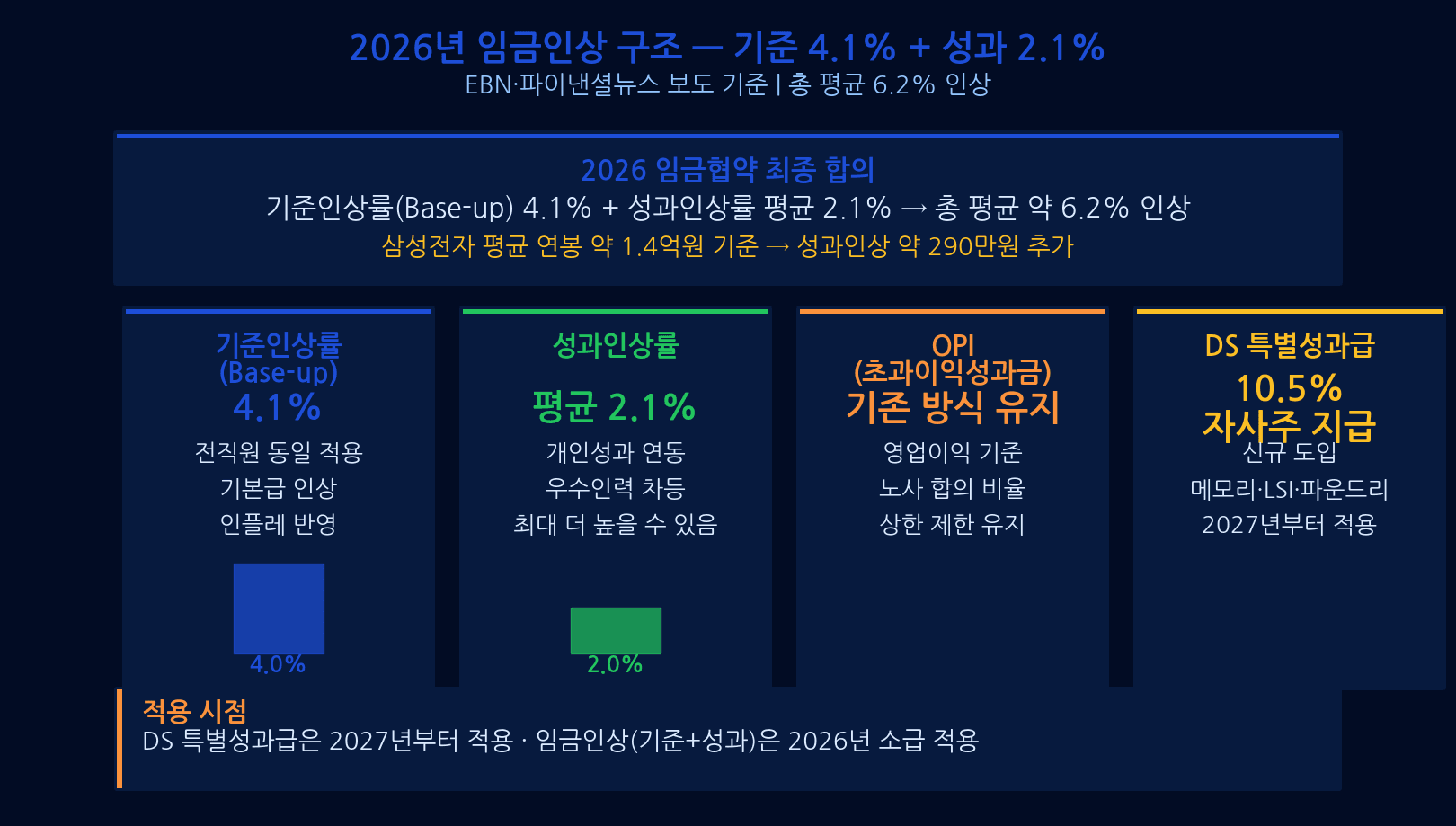
Separate from the performance bonus, the deal also locks in a base wage increase, structured across two components:
- Flat base salary increase: 4.1% — Applied uniformly to all employees covered by the agreement. South Korea’s 2025 consumer price inflation was approximately 2.3%, meaning this hike provides a real wage gain of roughly 1.8 percentage points.
- Performance-linked increment: 2.1% average — Differentiated by individual performance grade. S- and A-rated employees can receive up to 3.5%, while C-rated employees receive as little as 0.5%. The average across the workforce is 2.1%.
The combined 6.2% places Samsung Electronics at the top of Korea’s major conglomerate wage negotiations this cycle — ahead of SK Hynix (5.8%) and LG Electronics (5.3%). This signals that management was ultimately willing to pay a premium to prevent talent from migrating to competitors.
⑥ Treasury Stock Grant + 1-Year Lock-Up — Employees Become Shareholders

The most structurally significant element of this agreement is the direct grant of Samsung treasury stock (005930) to employees. The exact monetary value per employee has not been disclosed, but the mechanism carries three meaningful implications:
- Alignment of employee and shareholder interests — When employees hold stock, their personal wealth is tied to the company’s performance. This creates organic incentives for productivity, quality, and cost discipline — the same logic behind U.S. big tech RSU (Restricted Stock Unit) programs at Apple, Google, and Meta that have been in place for decades.
- Positive supply-side effect from the lock-up — Roughly 100,000+ employees receive stock simultaneously but cannot sell for one year. This effectively removes a tranche of 005930 shares from the available float, providing a mild but real support to the stock price over the lock-up period.
- Lock-up expiry risk in May 2027 — When the lock-up expires, a wave of employee sell orders is possible, particularly from lower-paid divisions where the stock grant represents a larger share of total compensation. Long-term investors should note the potential overhang in May–June 2027.
⑦ 005930 Stock Impact — Size and Limits of the Dual Catalyst

From market open on May 21, 005930 faces two simultaneous positive catalysts:
- Strike risk removed (+3–5% estimated) — A realized general strike would have triggered three cascading negatives: DS production disruption, HBM delivery delays to Nvidia, and potential customer defection toward SK Hynix. All of that risk evaporated overnight. In the options market, put premiums that had been pricing in strike probability will collapse rapidly, creating a reflexive bid for the underlying.
- HBM supply normalization — Samsung’s DS division can now execute on Nvidia B200/GB200 HBM3E commitments without operational uncertainty. This matters not just for Samsung’s revenue visibility but for Nvidia’s supply chain confidence. However, investors should note the nuance: Samsung re-entering the HBM supply chain at full capacity may dilute SK Hynix’s near-monopoly position, making this a competitive dynamic to watch rather than a purely cooperative tailwind.
The headwind to acknowledge: Moody’s credit concerns do not disappear with a labor deal. A downgrade, if it materializes, would require real improvement in Samsung’s balance sheet fundamentals — debt ratios, EBITDA margins, cash generation. Today’s rally could be followed by a retracement if Moody’s proceeds with a formal action in coming weeks.
⑧ May 27 Ratification Vote — What Happens If It Fails?

A tentative agreement is not a final deal. On May 27, NSEU members will vote to ratify or reject the settlement. If the vote passes, the agreement takes legal effect. If it fails, negotiations restart — and a strike could resume with little notice.
The market consensus estimates a 70–80% probability of ratification. The bullish case rests on three factors:
- DS (Memory) members stand to lock in an average 550 million KRW bonus. Prolonged negotiations would create uncertainty around the payout — a tangible incentive to vote yes.
- The treasury stock grant is a novel benefit that appeals to the upwardly mobile, equity-conscious portion of the workforce.
- Calling a renewed strike during a Moody’s review period would invite intense public and regulatory scrutiny — a reputational cost the union leadership wants to avoid.
The downside scenario: System LSI members (average payout: 147 million KRW) remain the most discontented bloc. If turnout among disgruntled System LSI workers is disproportionately high and they vote against, the deal could fall short of a majority. Uncertainty persists for 005930 holders until May 27.
⑨ Investor Action Guide — What to Do Right Now
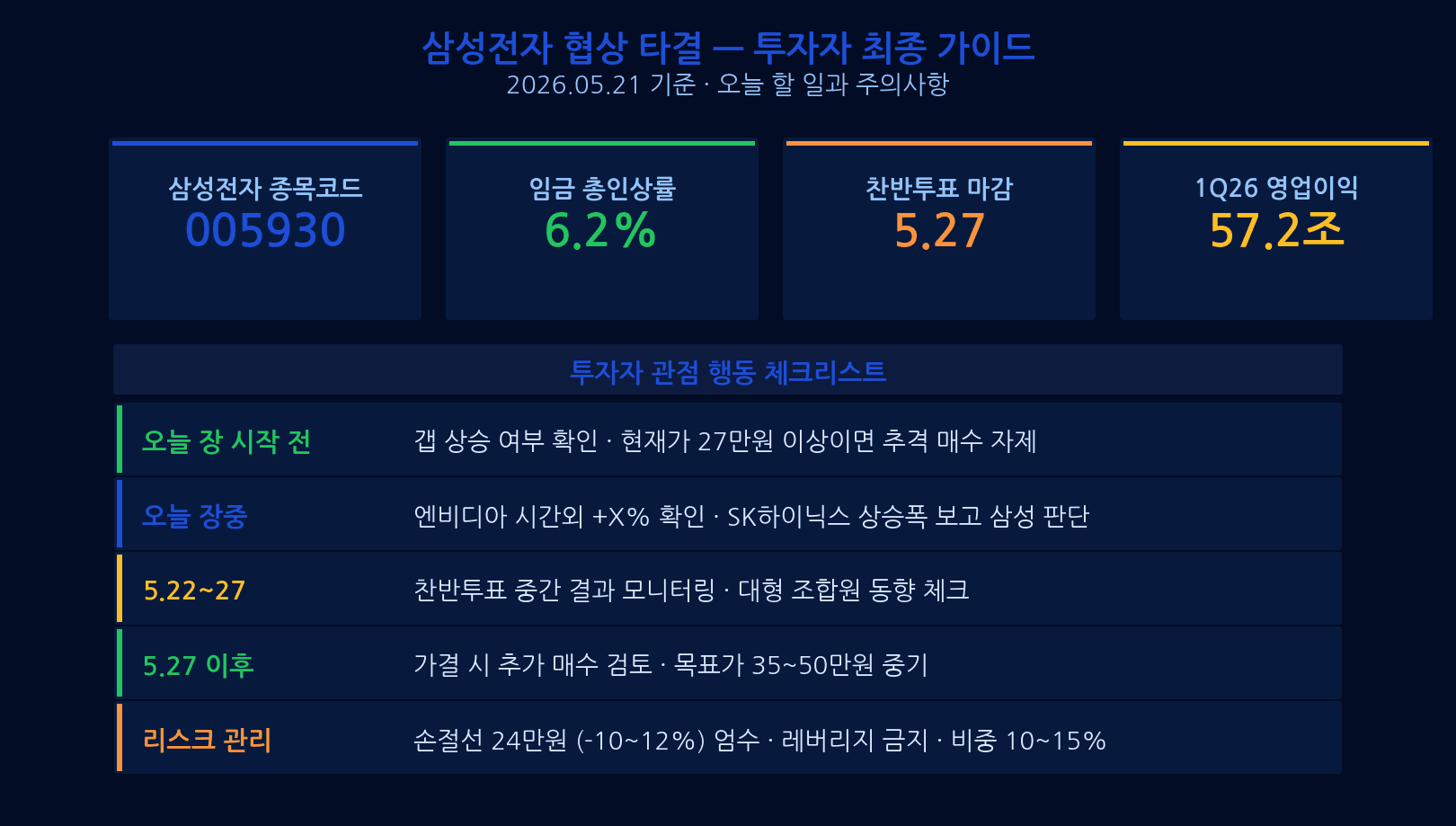
For investors looking to act on today’s development, here is a five-step framework:
- Begin a scaled entry into 005930 today — Deploy 30–40% of your target position intraday. This is an event-driven trade; missing the entire initial move by waiting for certainty is likely costlier than entering with partial exposure now. Use limit orders on any intraday dips.
- Add the remaining 60–70% after the May 27 vote — If ratified, add the full remaining position. If rejected, immediately exit existing holdings or implement a hedge. Do not add on a failed vote — a renewed strike in a Moody’s review environment would be materially negative.
- Monitor SK Hynix (000660) for HBM share dynamics — Track whether Samsung’s HBM re-entry is expanding the overall addressable market or eroding SK Hynix’s share. If the former, consider holding both; if the latter, rotate toward Samsung as the laggard catch-up trade.
- Set a hard stop-loss at 73,000 KRW — This level represents approximately an 8–10% drawdown from current prices. Key triggers for hitting stop: vote rejection, Moody’s formal downgrade announcement, or escalation of US-China semiconductor restrictions. Do not override this level.
- Separate the Moody’s risk from the labor deal — Today’s catalyst is short-term and event-driven. Moody’s is a medium-to-long-term fundamental story. Evaluate them on separate timelines. The labor deal improves near-term operational optics; Moody’s resolution requires structural financial improvements that take quarters, not days.
Bottom line: Today’s agreement is both an immediate stock catalyst and a signal of improved operational stability for Samsung. But with the May 27 ratification vote and the Moody’s overhang still in play, a staged entry combined with a defined stop-loss is the most disciplined approach available to investors right now.