Samsung Electronics Bonus Vote May 22~27 Complete Guide — Memory 550M·LSI 147M KRW / 75~80% Approval / Strike Restart & Stock Impact if Rejected
Real-Time Issue · May 21, 2026
Samsung Electronics Bonus Vote May 22~27 Complete Guide — Memory 550M·LSI 147M KRW / 75~80% Approval Expected / Strike Restart & Stock Impact if Rejected
The Samsung Electronics Workers’ Union (SEWU) is holding an online ratification vote on the 2026 wage and performance bonus agreement from May 22 (Thu) through May 27 (Tue). Approximately 30,000 union members will decide on a deal that includes up to 550 million KRW for Memory (DS) and 147 million KRW for System LSI & Foundry workers. A “yes” vote ends the strike threat; a “no” vote triggers a full walkout on May 28 — with direct implications for Samsung’s stock price.

1. Vote Schedule — May 22~27, Online Ballot

SEWU will conduct a fully online ratification vote from May 22 (Thu) 9:00 AM through May 27 (Tue) 6:00 PM KST. Members can vote via PC or smartphone after completing personal authentication. The result is expected to be announced on the evening of May 27 or the morning of May 28.
- Voting period: May 22 (Thu) 09:00 ~ May 27 (Tue) 18:00 KST
- Format: Online electronic ballot (PC & mobile supported)
- Eligible voters: Approximately 30,000 SEWU members
- Passage threshold: Simple majority (50% + 1 vote) of valid ballots cast
- Result announcement: Evening of May 27 or morning of May 28
Voter turnout is expected to be high. In the 2024 strike vote, turnout reached 82%. A low-turnout scenario could shift the outcome, as abstentions effectively count against passage in some interpretation frameworks used by the union.
2. Key Provisions of the Tentative Agreement — 10.5% Bonus + 6.2% Pay Rise

Samsung management and SEWU reached a tentative agreement in early May 2026. The package centers on a total performance bonus of 10.5% of base salary and a pay increase of 6.2% (4.1% base + 2.1% performance-linked).
- Performance bonus (OPI + TAI): Total 10.5% of annual base salary
- Base pay increase: 4.1% applied uniformly across all job grades
- Performance-linked increase: 2.1% tied to divisional results
- Company stock grant: 15 shares of Samsung Electronics per employee (lock-up; first release 2027 H1)
- Welfare points: Additional 200,000 KRW in welfare mileage
The stock lock-up structure releases 50% in H1 2027 and the remaining 50% in H1 2028. At the current price of 76,800 KRW, 15 shares carry a market value of approximately 1.15 million KRW (~$870 USD).
3. Bonus Breakdown by Division — Memory 550M vs. LSI 147M KRW
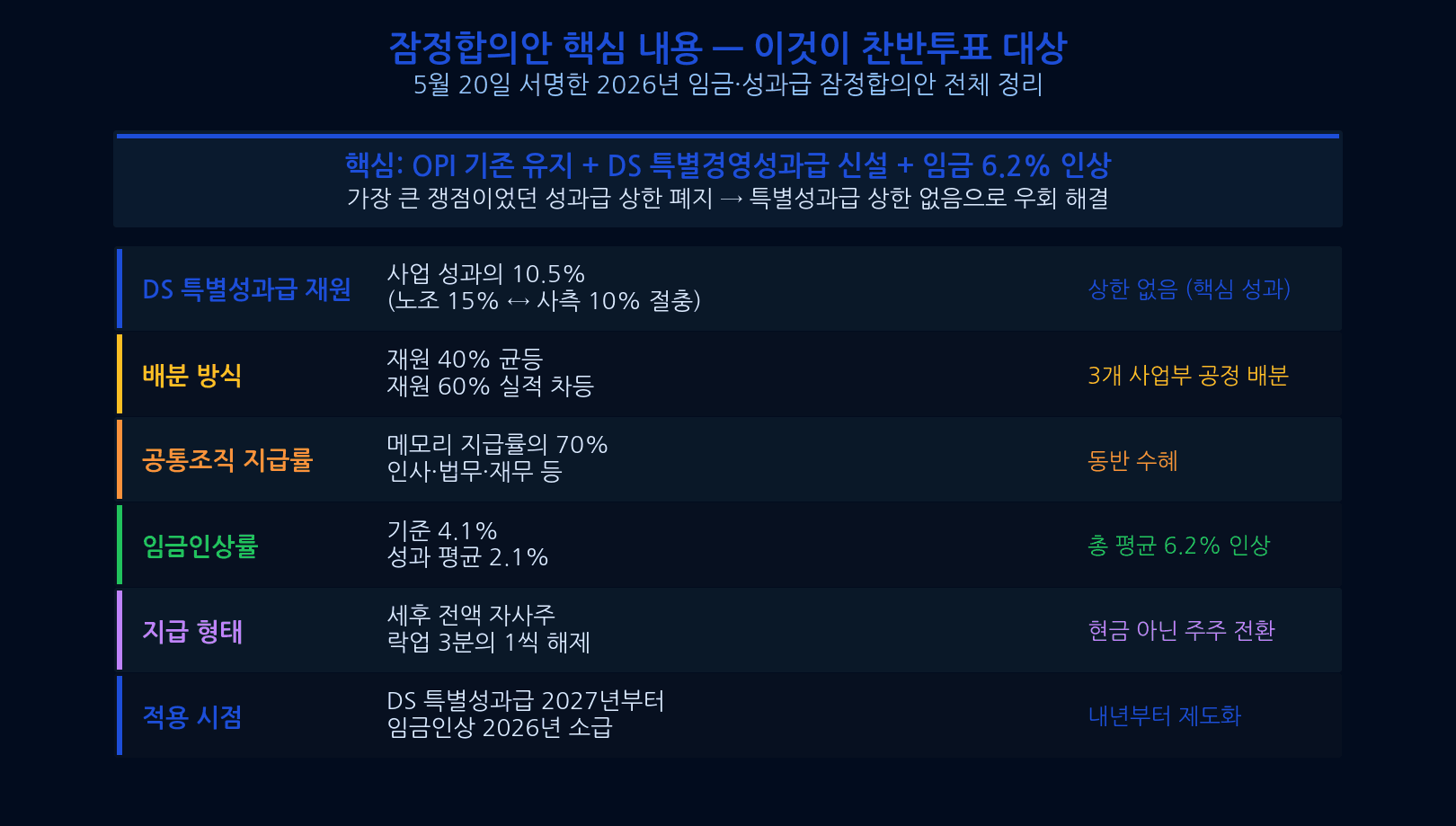
Performance bonus amounts vary dramatically by division, reflecting each unit’s 2025 profitability. The gap between Memory (DS), which rode the semiconductor supercycle, and the loss-making System LSI & Foundry is the central point of contention.
- Memory / DS Division: Up to 550 million KRW (OPI basis; adjusted for grade and individual performance rating)
- System LSI & Foundry: Up to 147 million KRW (calculated separately due to divisional losses)
- MX (Mobile & Network): Up to 320 million KRW
- VD/DA (TV & Appliances): Up to 210 million KRW
- Harman: Separate formula, approximately 180 million KRW
When the 15-share stock grant (~1.15M KRW) and 200,000 KRW welfare points are added to the cash bonus, Memory division employees’ total compensation value rises further. LSI employees, however, argue that a 3.7× bonus gap within the same company constitutes unjust differentiation.
4. Yes vs. No — The Core Arguments
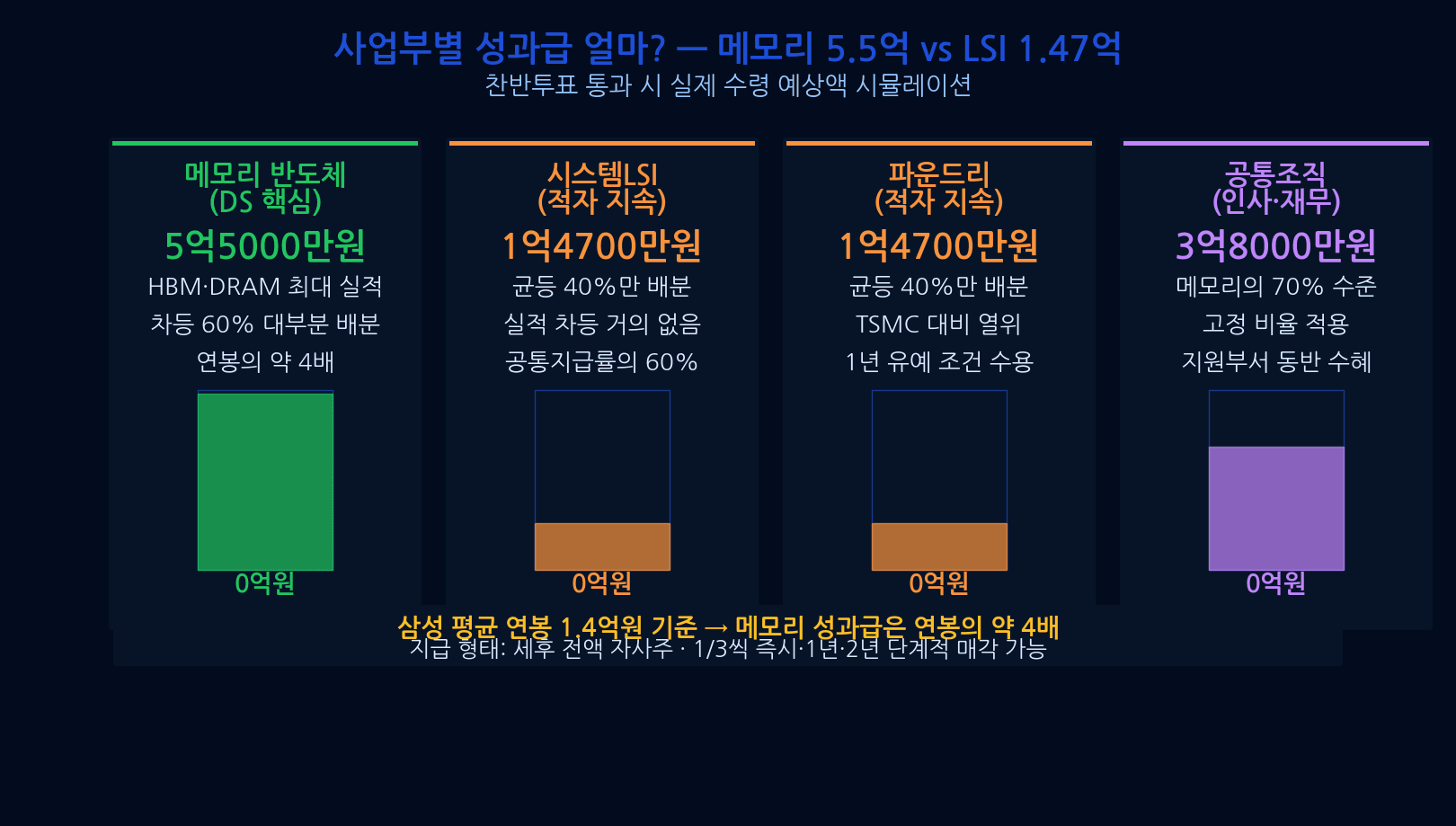
The fundamental fault line runs between divisions. Memory workers lean toward approval; LSI and Foundry workers are the primary source of “no” sentiment. Here is how each camp frames its position.
Arguments in Favor (Yes Vote)
- A prolonged strike could reduce production output and shrink the very bonus pool being contested
- The 6.2% pay rise is among the highest in Samsung’s recent history and sets a long-term compensation floor
- The 15-share stock grant provides a meaningful long-term upside tied to company performance
- Extended walkouts risk losing orders to TSMC and SK Hynix, weakening Samsung’s competitive position
- Samsung’s total compensation already compares favorably to domestic and regional peers
Arguments Against (No Vote)
- A 3.7× gap (550M vs. 147M KRW) between DS and LSI is discriminatory treatment within one company
- The bonus formula is opaque; heavy individual performance weighting gives management excessive discretion
- The 2-year stock lock-up transfers share-price risk onto workers, not shareholders
- LSI/Foundry losses stem from management’s failed strategy — why should employees bear the cost?
- Rejecting the deal and forcing re-negotiation would yield a better outcome, argue the hardliner faction
5. Approval vs. Rejection Scenarios — Stock and Strike Impact

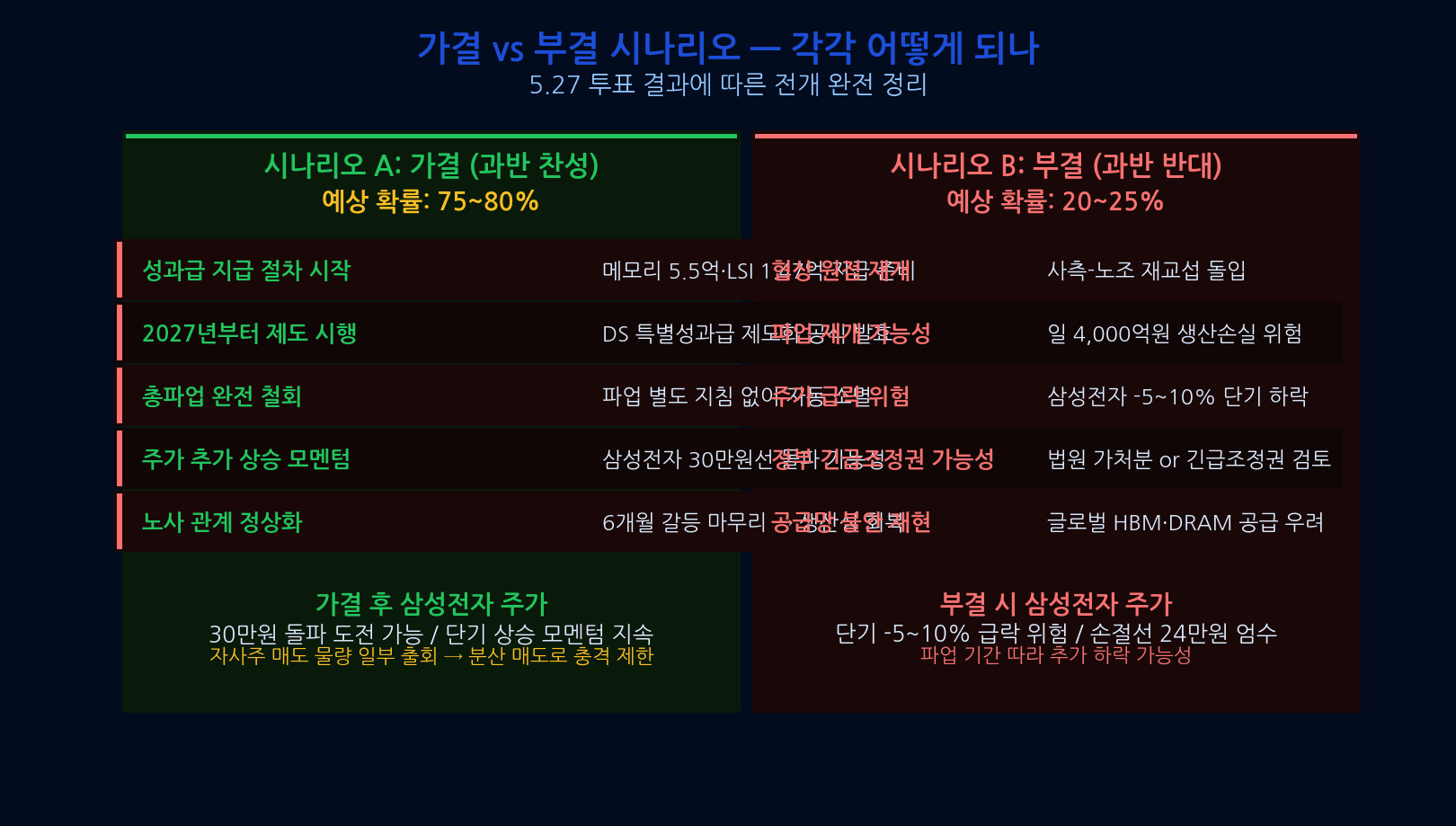
Market consensus currently prices in a 75~80% probability of approval. However, given that LSI and Foundry workers account for roughly 30% of the union membership, rejection cannot be ruled out entirely.
Scenario A — Approval (Probability: 75~80%)
- Strike officially ends; normal production operations confirmed
- Samsung Electronics share price expected to rise +3~5% (target: 78,000~80,000 KRW)
- Short-term foreign investor net buying inflow anticipated
- HBM and DRAM shipment plans normalize → H2 2026 earnings guidance upgrade possible
Scenario B — Rejection (Probability: 20~25%)
- Full strike resumes immediately on May 28 (Wed)
- Share price expected to fall -3~5% (downside: 69,000~71,000 KRW)
- Foundry urgent-order delivery delays become a credible risk
- Re-negotiation enters motion — resolution expected to take 2~4 additional weeks
6. Bonus Payment Timeline — Cash in June if Approved
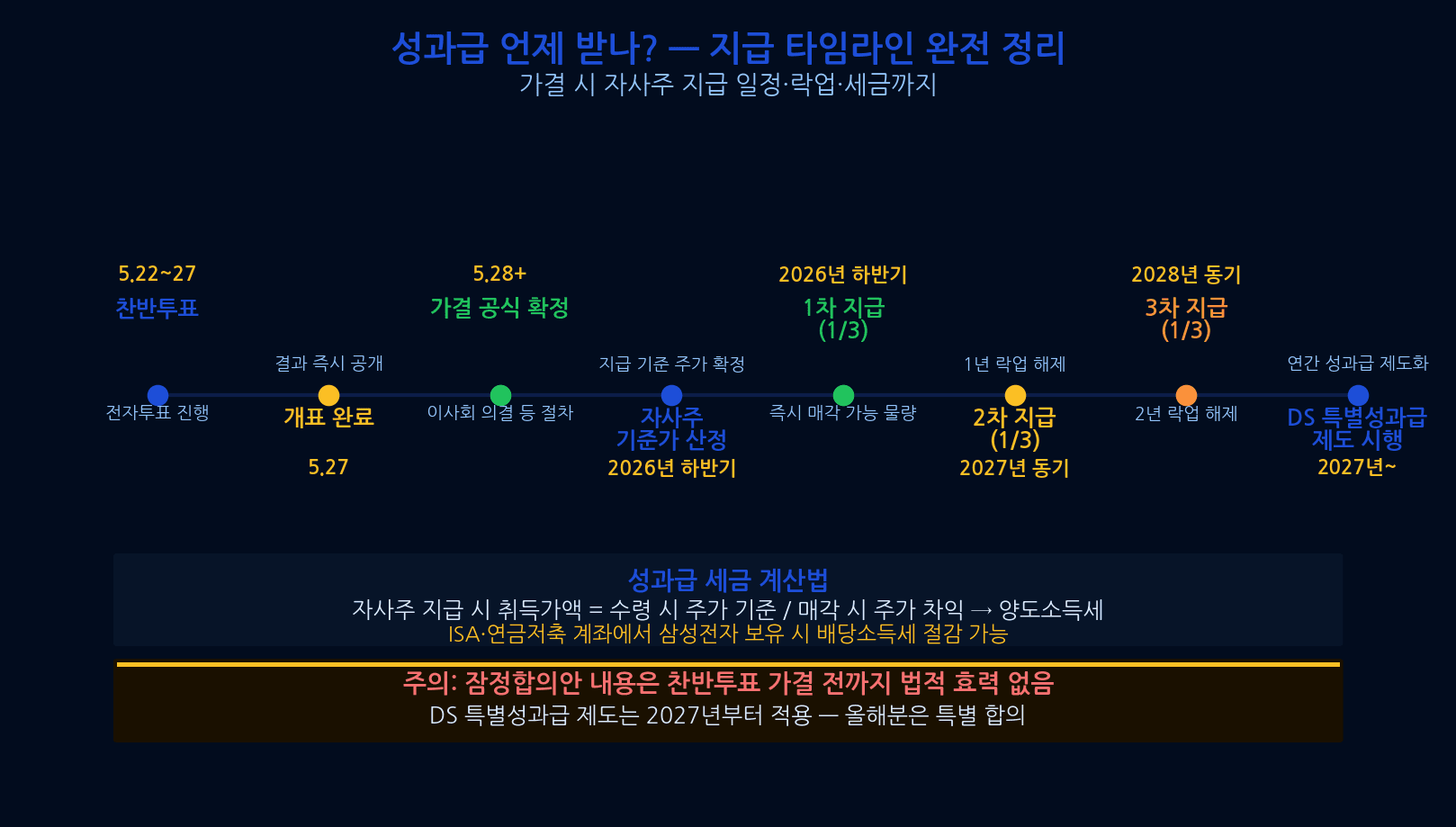
If the vote passes, cash bonuses and stock grants will be disbursed on the following schedule:
- May 27~28: Vote result announced; formal approval confirmed
- May 29 ~ early June: Samsung board of directors final ratification
- Mid-June: OPI and TAI cash bonuses paid in a lump sum (aligned with regular pay cycle)
- Late June: 200,000 KRW welfare mileage points credited
- H1 2027: First lock-up release — approximately 7~8 of the 15 shares become freely tradable
- H1 2028: Second (final) lock-up release — remaining shares fully unlocked
The 6.2% wage increase is retroactive to March 2026, meaning three months of back-pay will be included in the June paycheck — meaningfully boosting actual take-home amounts.
7. Samsung Stock Price Scenarios — Based on Current 76,800 KRW
Samsung Electronics closed at 76,800 KRW on May 21, 2026. The vote outcome is a clear binary catalyst for near-term price direction.
- Approval target price: 78,000~80,000 KRW (+1.6% to +4.2%)
- Rejection downside price: 69,000~71,000 KRW (-7.6% to -10.2%)
- 52-week high: 82,400 KRW / 52-week low: 62,200 KRW
- Foreign ownership: ~53.4% — foreign investor flow is the key short-term price driver
- Analyst consensus 12-month target: 88,000 KRW
Even in the approval scenario, sustained upside beyond the initial pop depends on Q2 earnings (July release) and HBM4 supply contract announcements. Profit-taking after the event is likely, making aggressive post-result chasing risky.
8. Conclusion + Investor Action Guide — Wait Until May 27

This vote is not merely a labor relations outcome — it directly determines Samsung’s H2 2026 production stability and near-term stock momentum. Below is a practical action framework for investors at each stage.
- Current holders: Hold through May 27; set a stop-loss at 73,000 KRW in case of rejection
- Buyers on the sideline: Wait for confirmed approval before entering; avoid chasing the first-day spike
- Short-term traders: Prepare for volatility around the May 27 close and May 28 open — hedge both directions
- Long-term investors: Event-agnostic; 12-month target 88,000 KRW intact; accumulate on weakness via dollar-cost averaging
- Risk management: If rejection triggers a strike, monitor whether 73,000 KRW support holds as the key stop-loss level
With consensus strongly favoring approval, the market has partially priced in a “yes” outcome. This means the upside surprise on approval is limited, while a rejection shock would likely be more severe than currently discounted. Asymmetric risk skews toward protecting the downside.
9. Strategy Summary + Key Calendar

Here is the full timeline of events and the corresponding investor playbook at each milestone.
- May 22 (Thu): Online ballot opens at 09:00 KST
- May 27 (Tue): Ballot closes at 18:00 KST — results expected same evening
- May 28 (Wed): Approval → strike officially ends / Rejection → full strike resumes
- Early June: Samsung board ratification; bonus disbursement process begins
- Mid-June: OPI and TAI cash bonuses paid out to ~30,000 union members
- Early July: Samsung Q2 2026 preliminary earnings release (next major stock catalyst)
- H1 2027: First lock-up release of 15-share stock grant
Bottom line: Stay patient until May 27. If the vote passes, buy on the dip after any initial surge subsides — do not chase. If rejected, respect the 73,000 KRW stop-loss and wait for a re-negotiation timeline to form. For the long haul, HBM4 volume ramp and H2 2026 earnings recovery remain the primary bull thesis regardless of this week’s outcome.