Iran ceasefire oil scenario — how far Brent falls, three paths, and a five-step playbook for Korean investors
Trending · May 25, 2026 · DIR
Iran oil scenario — President Trump said on May 23 that the U.S.-Iran peace deal is “largely negotiated,” putting an end to $105 Brent in sight. If the deal closes, Brent could fall to $70-80 and Korean pump prices could drop by up to 400 won per liter. We break down each oil scenario with five concrete investment moves.
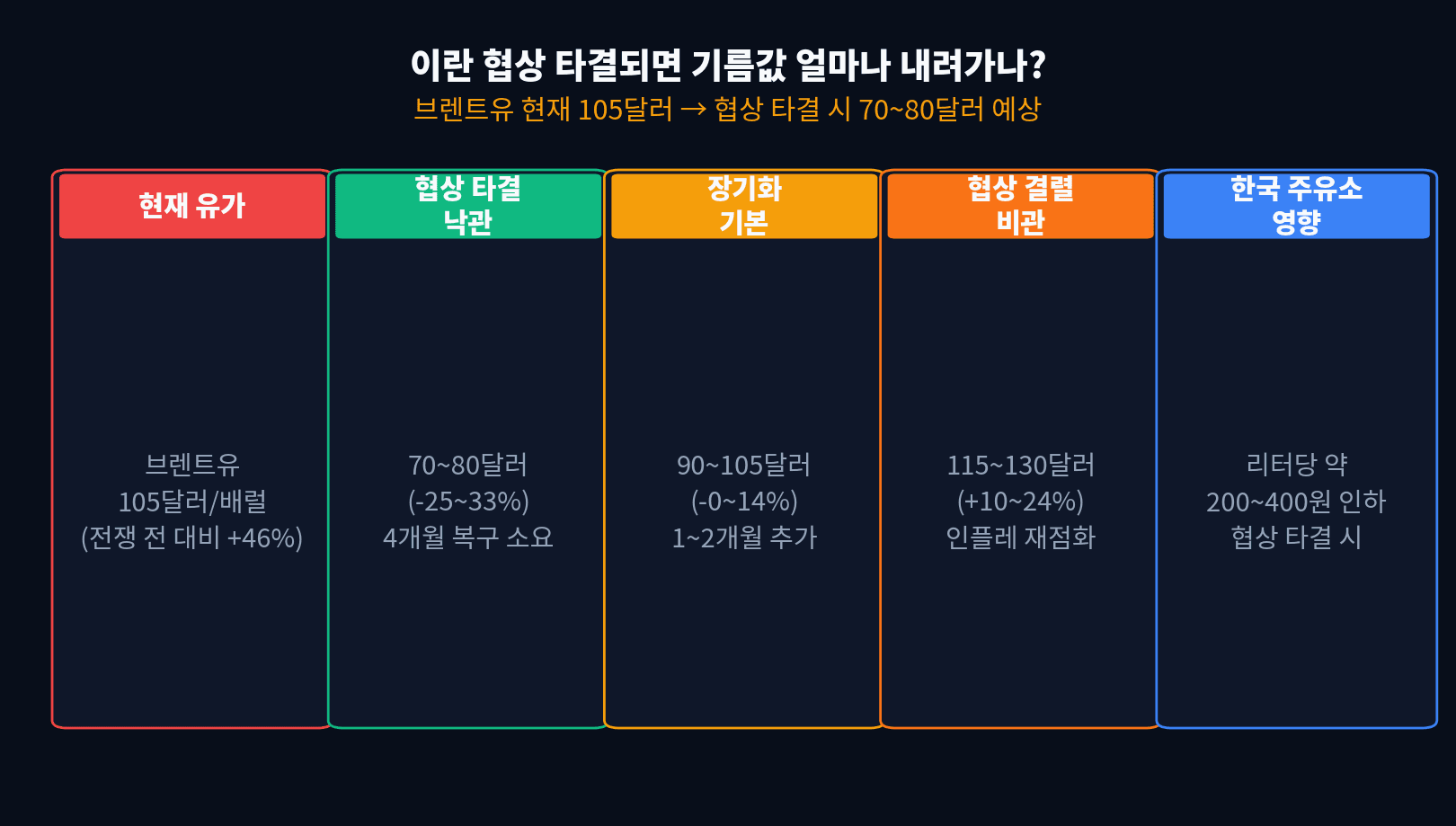
On May 23, President Trump posted on Truth Social that a U.S.-Iran peace agreement is “largely negotiated.” Since the February 28 outbreak of conflict, Iran’s closure of the Strait of Hormuz has driven Brent crude to $105 per barrel and Korean gasoline above 2,200 won per liter. A deal could cut Korean pump prices by up to 400 won per liter. Background coverage is updated live on Reuters Middle East.
| Scenario | Brent crude | Probability | Korea pump price |
|---|---|---|---|
| Deal reached (bullish) | $70-80 | 45% | ~1,780-1,900 KRW/L |
| Prolonged talks (base) | $88-105 | 35% | 2,100-2,200 KRW/L hold |
| Talks collapse (bearish) | $115-130 | 20% | 2,500-2,600+ KRW/L |
01 | U.S.-Iran negotiation timeline — where do we stand?
Since the February 28 outbreak, Pakistan has been mediating talks. Trump posted on May 22 that “an agreement is largely negotiated and will be announced shortly,” but Iran continues to push back on uranium-enrichment export demands and on dropping its Hormuz transit-fee proposal.
“An Agreement has been largely negotiated, subject to finalization between the United States of America, the Islamic Republic of Iran, and the various other Countries.”
— Donald Trump, Truth Social (May 23, 2026)
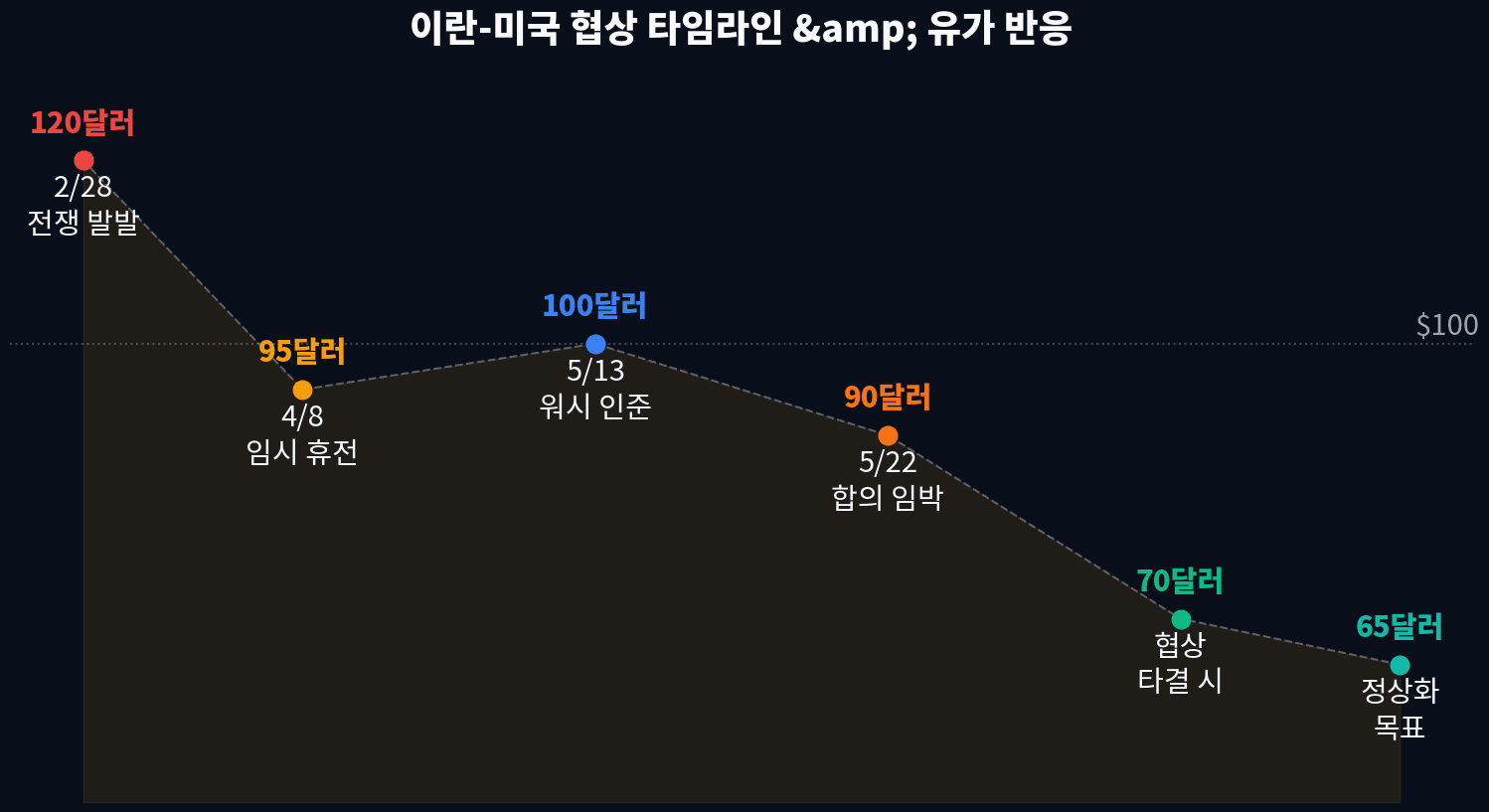
| Date | Event | Oil reaction | Negotiation status |
|---|---|---|---|
| 2/28 | U.S.-Israel strike Iran | $105 → $120 spike | War begins |
| 3/2 | Iran closes Hormuz | $120 sustained | Blockade intensifies |
| 4/8 | 2-week tactical truce | $120 → $95 drop | Pakistan mediates |
| 4/13 | U.S. naval blockade | $95 → $105 rebound | Blockade resumes |
| 5/22 | Trump signals imminent deal | $105 → $100 easing | Final-stage talks |
1) Iran refuses to ship enriched uranium abroad
2) Iran’s demand for Hormuz transit fees (a U.S. red line)
3) Security guarantees from Israel
If even one of these remains unresolved, a deal will be hard to close.
02 | Three oil scenario paths — the numbers behind each outcome
Each oil scenario splits H2 2026 prices into a distinct trajectory. Barclays warns Brent could top $130 if talks collapse. Even if a deal is struck, rebuilding inventories will take at least four months — so prices won’t normalize overnight.
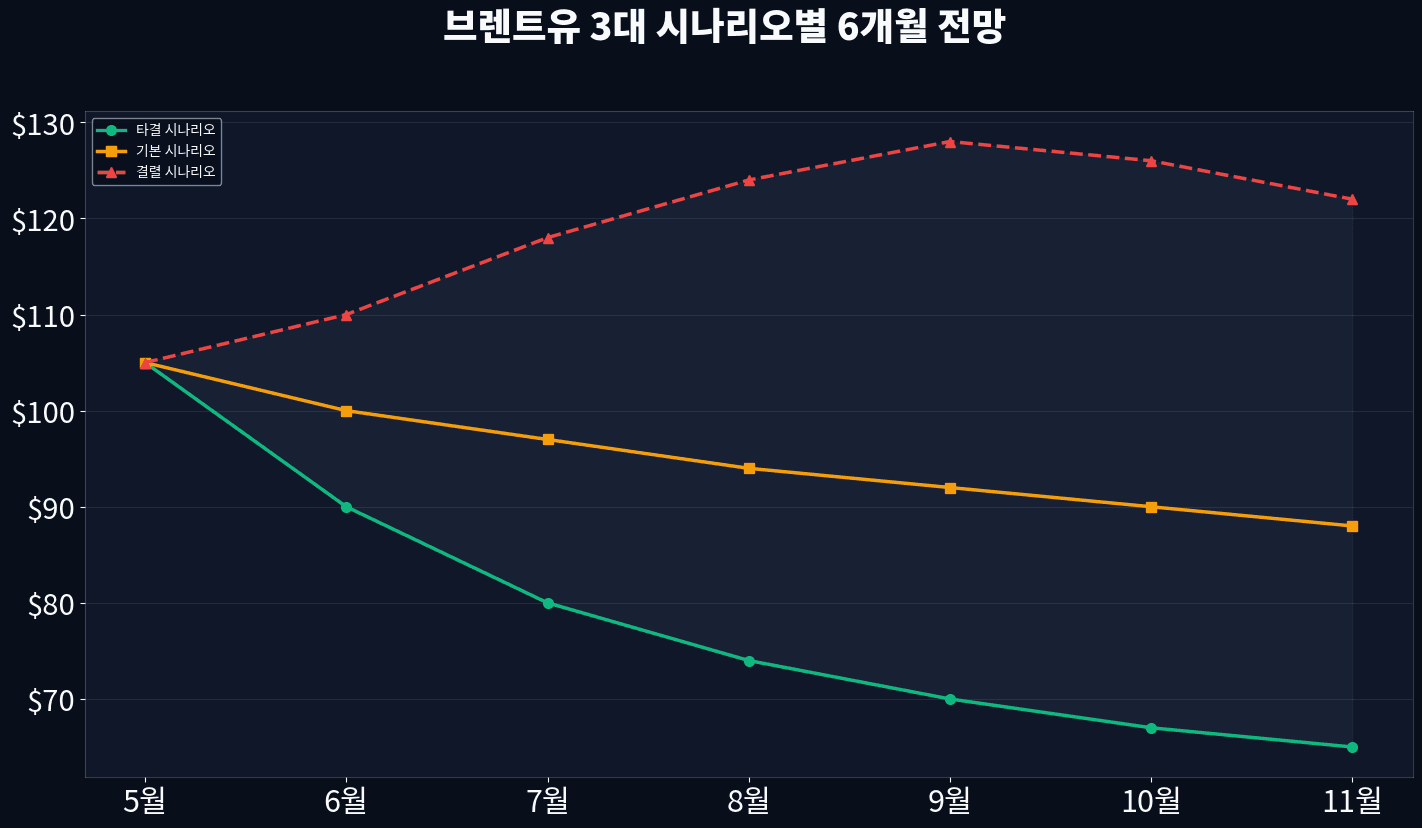
→ oil declines gradually, not instantly
| Period | Deal reached | Base case | Talks collapse |
|---|---|---|---|
| Now (May) | $105 | $105 | $105 |
| June | $80-90 | $97-100 | $110-115 |
| Jul-Aug | $70-80 | $92-95 | $118-125 |
| Sep-Oct | $67-72 | $88-92 | $124-128 |
| Nov-Dec | $65-68 | $86-90 | $120-125 |
U.S. crude inventories are near their lowest level since 2020, with a daily supply gap of 6-8 million barrels. Even with a deal, global inventory rebuild will take meaningful time.
03 | Korean economy impact — oil and your wallet
Every $10 drop in Dubai crude improves Korea’s trade balance by roughly $6-7 billion per year. Dubai crude is currently $106/bbl, up 47% from $72 before the war. A return to the $70-80 range would deliver substantial relief to the Korean economy.
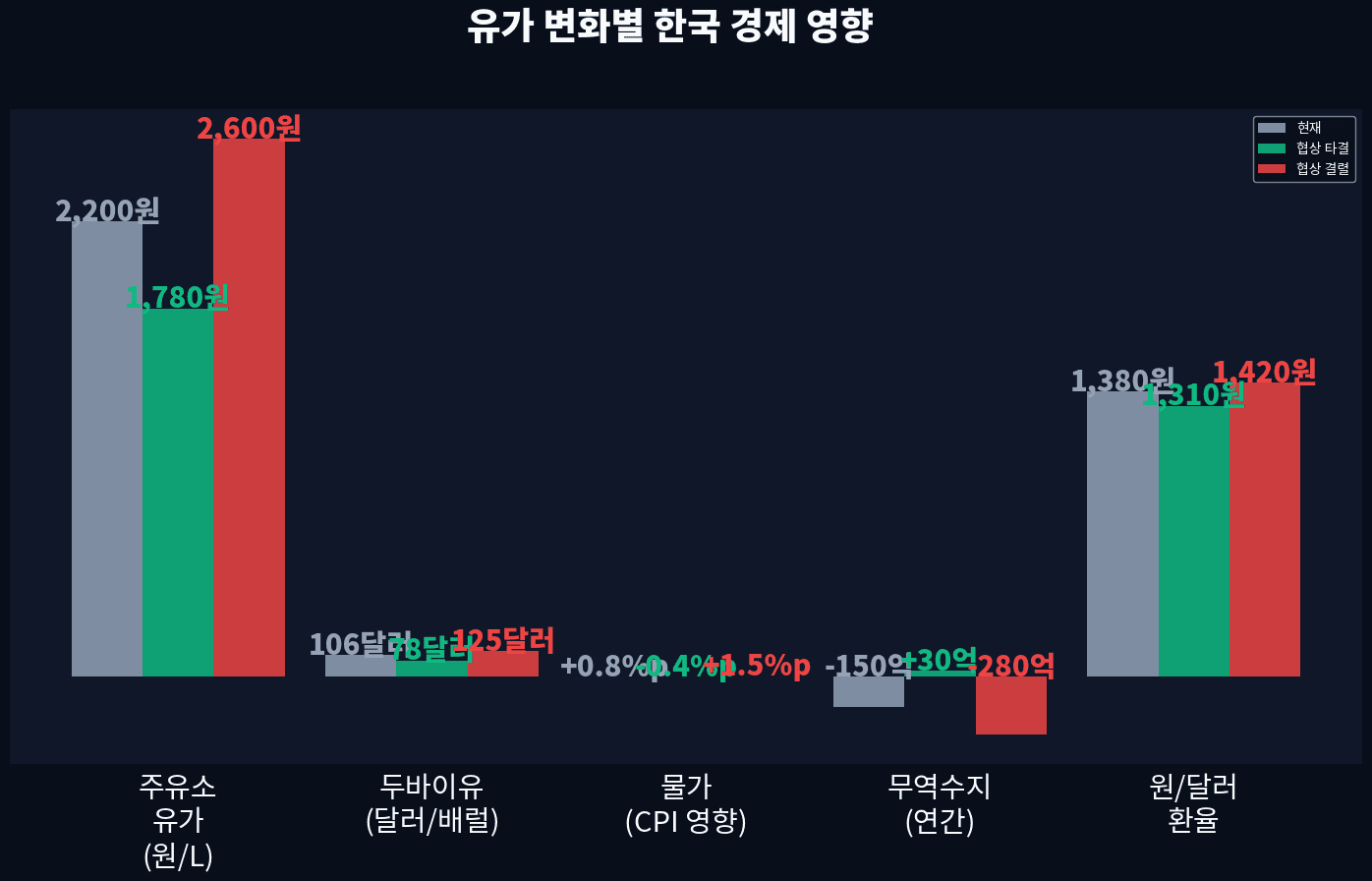
| Indicator | Pre-war | Now | Deal reached | Talks collapse |
|---|---|---|---|---|
| Brent crude | ~$72 | $105 | $70-80 | $120-130 |
| Dubai crude | ~$68 | $106 | $68-78 | $115-125 |
| Gasoline (pump) | ~1,620 KRW/L | ~2,200 KRW/L | ~1,750-1,900 KRW/L | ~2,500-2,600 KRW/L |
| Trade balance (yr) | Surplus | -$15B | +$3B improvement | -$28B |
| KRW/USD | ~1,300 | ~1,380 | 1,300-1,330 expected | 1,400-1,420 risk |
04 | Sector winners and losers
A deal would shock the energy sector short-term while bolstering airlines, transport, and consumer staples. The safe move on positioning is to wait for a confirmed agreement before reallocating.
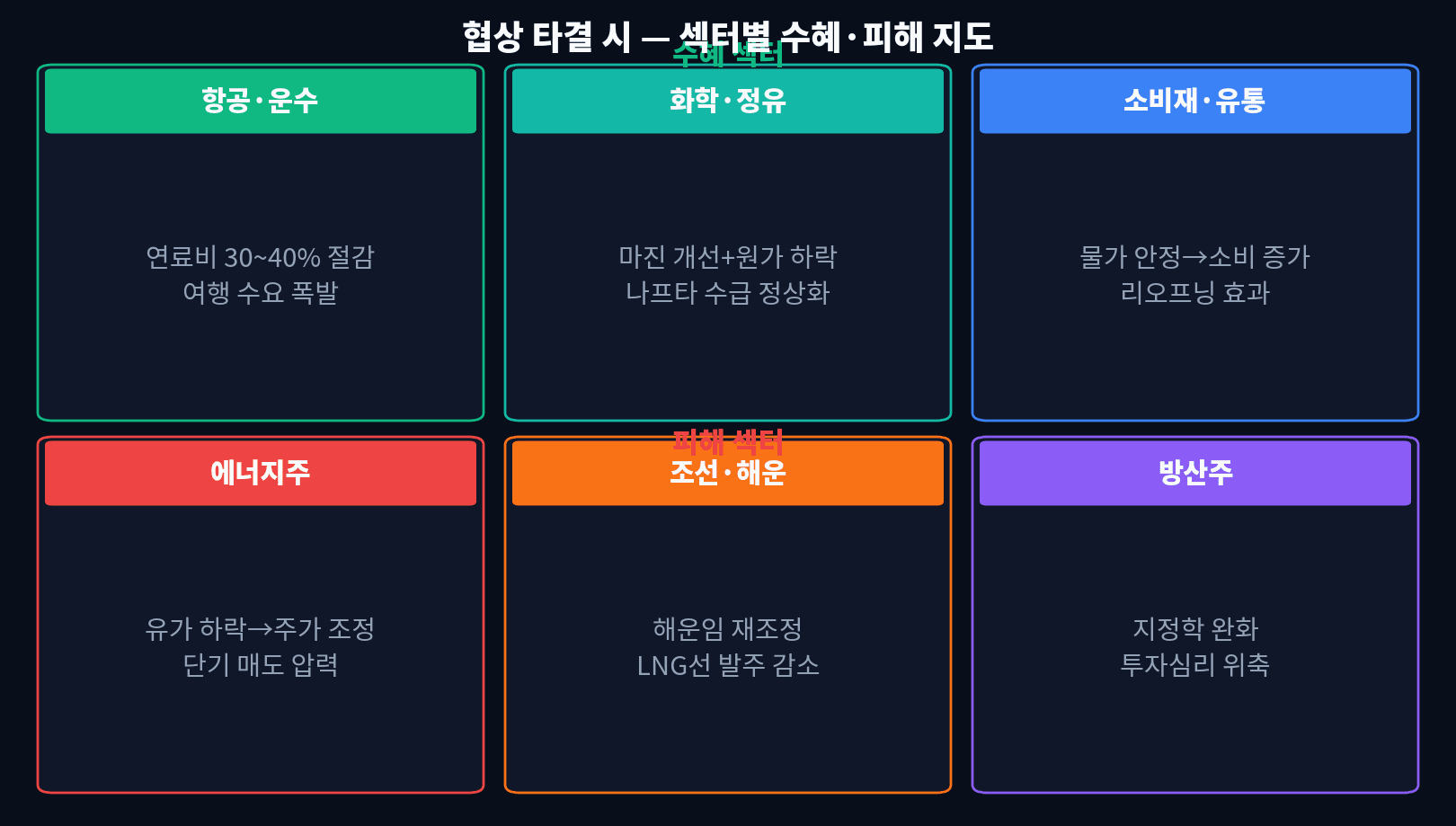
| Sector | If deal reached | If talks collapse | Korean tickers |
|---|---|---|---|
| Airlines | Fuel cost -30-40% → strong | High oil persists → weak | Korean Air (003490), Asiana |
| Oil & Chem | Inventory loss then margin gain | High-oil tailwind sustained | S-OIL (010950), Lotte Chem |
| Consumer | Prices stabilize → recovery | Inflation drags spending | E-Mart (139480), CJ CheilJedang |
| Energy utilities | Oil drop → price correction | High-oil tailwind sustained | Korea Gas Corp (036460) |
| Defense | Geopolitical relief → weak | Tension persists → strong | Hanwha Aerospace (012450) |
With the outcome still unclear, scale into airlines and trim energy ETF exposure. Once a deal is officially confirmed, use an event-driven approach to aggressively raise airline and transport weights.
05 | Supply recovery scenario — after Hormuz reopens
Even with a deal, traffic through the Strait of Hormuz won’t restore overnight. CNN reports crude flows will take at least four months to recover to 80% of pre-war levels. Through that window, oil will trace a stepwise decline.
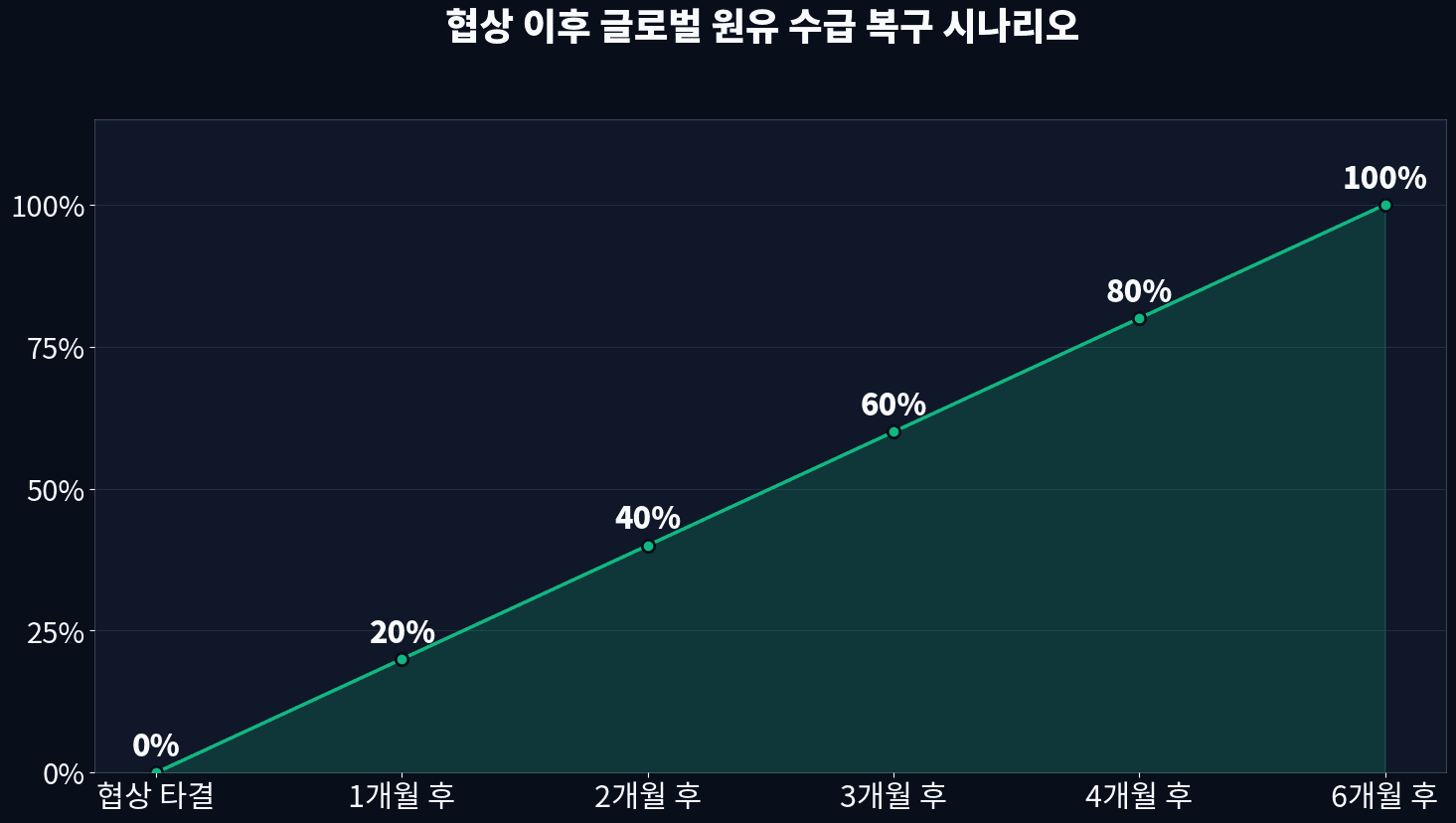
| Stage | Window | Throughput restored | Brent crude |
|---|---|---|---|
| 1: MOU signed | Immediate-1 wk | 15-20% | $95-100 |
| 2: Tactical reopening | 1-4 wks | 40-50% | $85-95 |
| 3: Partial normalization | 1-2 mo | 60-70% | $78-88 |
| 4: Full normalization | 3-4 mo | 80-90% | $70-80 |
| 5: Full recovery | 5-6 mo | 100% | $65-72 |
1. Simultaneous Trump / Iran foreign ministry announcement → real deal signal
2. IRGC official statement → strait reopening confirmed
3. Iran ports + U.S. blockade lifted → supply recovery starts
4. WTI futures crash → market confirms the deal
06 | Korean pump-price oil scenario — how far can it fall?
Korean gasoline currently averages around 2,200 won per liter. U.S. Memorial Day (May 25) prices are at four-year highs, and Korea mirrors that pattern. Below is the most likely oil scenario path for Korean pump prices if a deal closes.
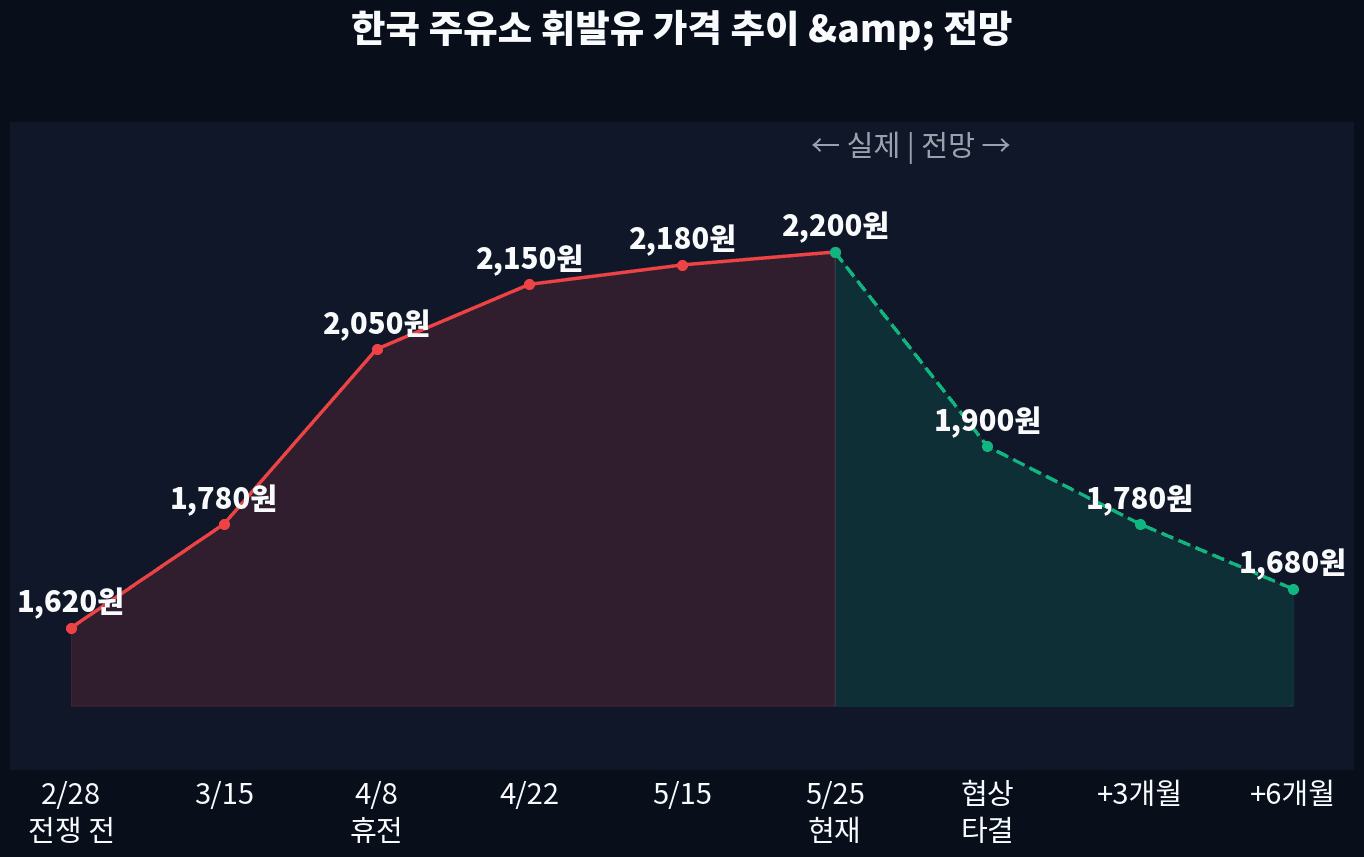
| Variable | Current | If deal reached | Time lag |
|---|---|---|---|
| Dubai crude | $106/bbl | Drop to $68-78 | Immediate-1 mo |
| Refining margin | High (oil) | Dip then normalize | 2-3 mo |
| KRW/USD | 1,380 | 1,300-1,330 expected | 1-3 mo |
| Retail gasoline | 2,200 KRW/L | 1,750-1,900 expected | 2-4 mo |
| Fuel-tax cuts | Cut in effect | Cut may shrink | Policy decision |
Even after international oil drops, Korean pump prices typically lag by 4-8 weeks. The refiner → station → consumer chain has to burn through existing inventory. Don’t expect immediate relief the moment a deal is announced.
07 | Next week’s key catalysts — Iran-deal flashpoints
Next week (May 26 – June 5) is the decisive window for Iran. Iran will deliver its formal response to the latest U.S. proposal, and Pakistani mediators are scheduled to visit Tehran.
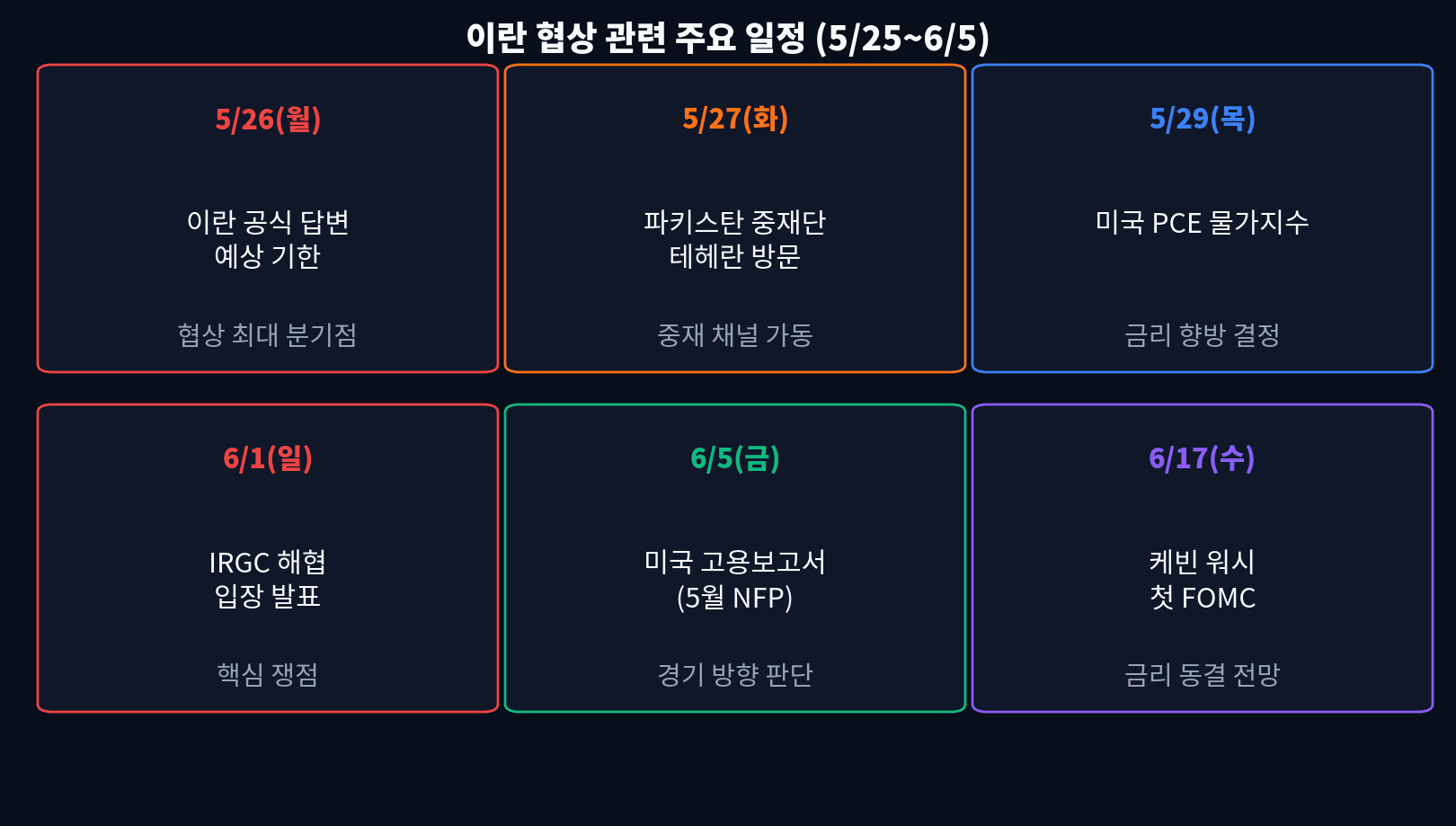
| Date | Event | Negotiation impact | Market reaction |
|---|---|---|---|
| 5/26 Mon | Iran formal response deadline | Biggest pivot | Deal → oil -$10-15 |
| 5/27 Tue | Pakistan mediators in Tehran | Talks resume | Positive → airlines rally |
| 5/29 Thu | U.S. PCE inflation | Rate-path driver | Hot print → rate jitters |
| 6/1 Sun | IRGC Hormuz statement | Critical variable | Hawkish → oil spike |
| 6/5 Fri | U.S. employment report | Cycle benchmark | Strong → risk-on |
is the largest pivot point of the deal
08 | Five investment strategies for the Iran oil scenario
To handle uncertainty, the five plays below work in both deal-reached and deal-collapsed directions. Stick to scaled entries until confirmation, then build size once a deal is officially confirmed.
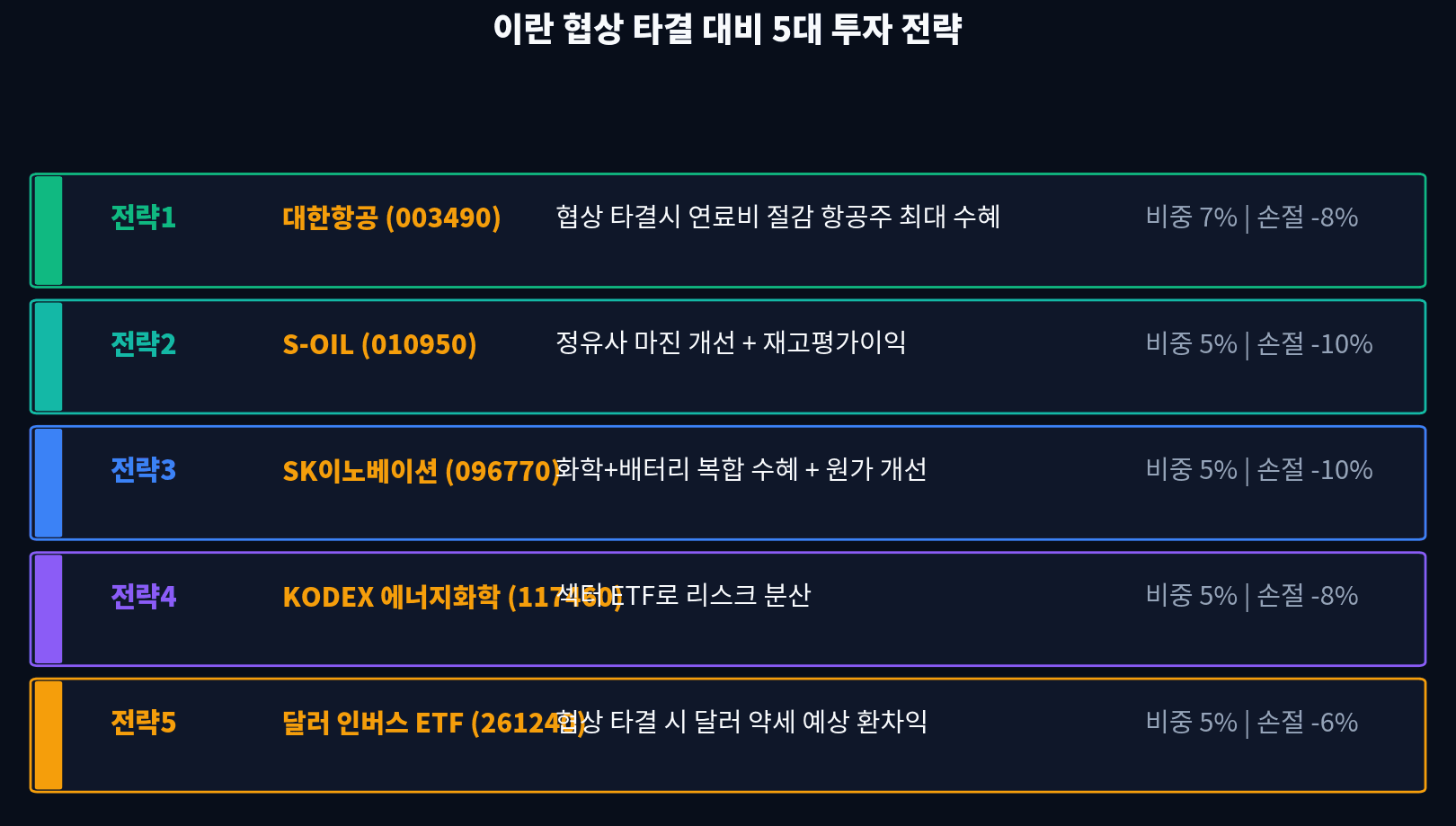
| Strategy | Ticker | Code | Stop-loss | Weight | Thesis |
|---|---|---|---|---|---|
| ① Airline upside | Korean Air | 003490 | -8% | 7% | Biggest fuel-cost beneficiary |
| ② Refining margin | S-OIL | 010950 | -10% | 5% | Margin rebound + dividend |
| ③ Chem + battery | SK Innovation | 096770 | -10% | 5% | Dual play + spin-off catalyst |
| ④ Sector ETF | KODEX Energy/Chem | 117460 | -8% | 5% | Diversified exposure |
| ⑤ USD hedge | USD Inverse ETF | 261240 | -6% | 5% | USD weakening hedge |
Until an official deal confirmation, cap total exposure at 50% and use scaled entries. Once confirmed, consider a second entry that lifts airline weight from 7% to 12-15%.
1. Watch May 26 Iran formal response — catch the deal signal early
2. Brent breaks below $100 → first entry into airlines
3. IRGC officially reopens Hormuz → scale into transport / airlines
4. Use USD inverse ETF to hedge KRW appreciation
5. If talks collapse, rotate immediately into refiners and defense
Sources
- CNBC — Trump says Iran deal ‘largely negotiated’ (May 23, 2026)
- CNN — US and Iran signal progress on peace deal (May 24, 2026)
- TheStreet — Stock Market Today May 22 2026 (May 22, 2026)
- Barclays Research — Brent crude inventory deficit analysis
- Kyunghyang Shinmun — Latest Iran negotiation update (May 25, 2026)
- Korea National Oil Corp. — Daily Dubai crude pricing (as of May 20, 2026)
This article is for informational purposes only and is not investment advice. All investments carry the risk of principal loss and outcomes are the sole responsibility of the investor. Content is based on public information as of May 25, 2026 and may not remain accurate as conditions evolve.